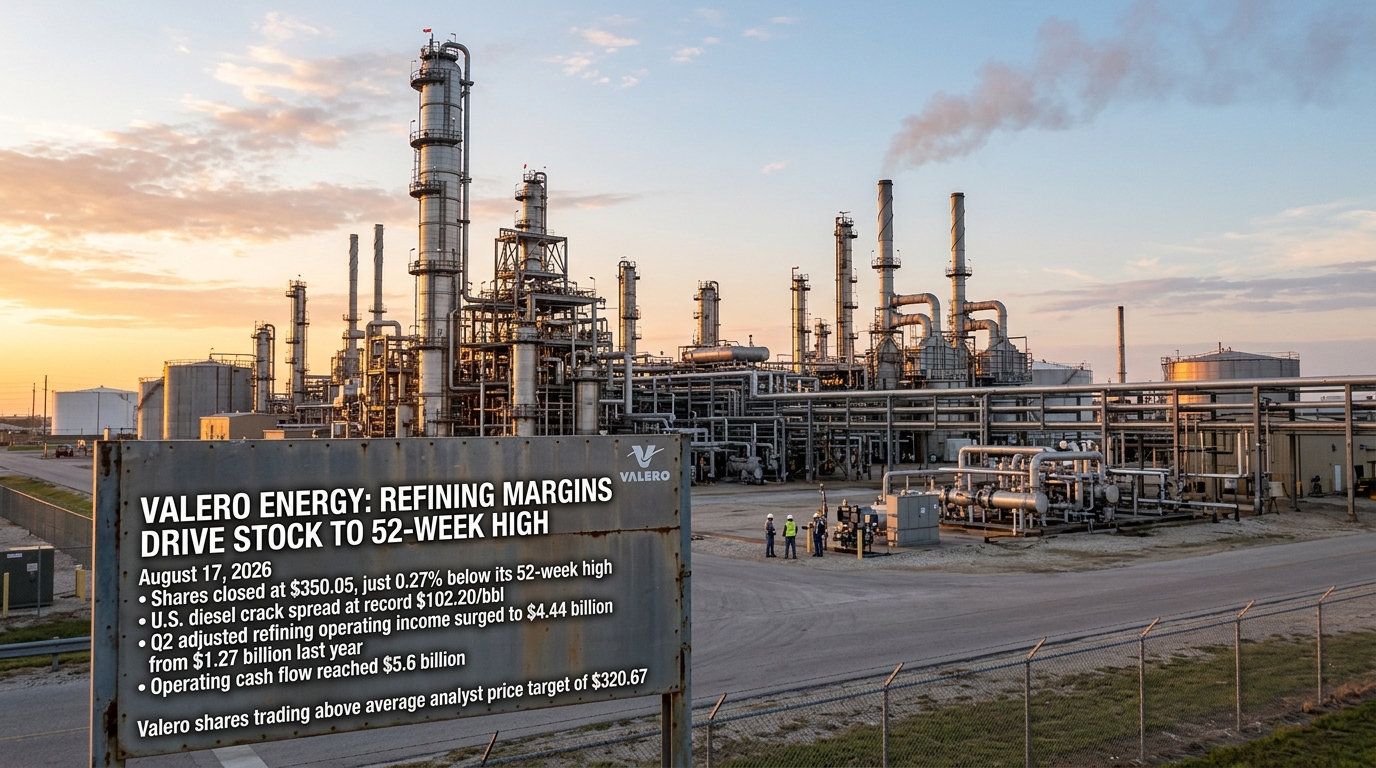
Shares of Valero Energy closed Tuesday at $350.05, just 0.27% below their 52-week high, as extraordinarily wide refining margins continue to power the stock to fresh records. The gain followed news that the U.S. diesel crack spread, the difference between the price of crude oil and refined diesel, reached an all-time high of $102.20 per barrel on August 17.
The margin strength has already shown up sharply in Valero's financial results. The refiner's second-quarter adjusted refining operating income rose to $4.44 billion, up from $1.27 billion in the same period a year earlier, while operating cash flow reached $5.6 billion for the quarter. With the average analyst price target sitting at $320.67, Valero shares are now trading above consensus expectations even as the underlying refining economics remain exceptionally strong.
Valero is one of several major U.S. refiners benefiting from the widening gap between crude and diesel prices, a dynamic driven in part by constrained refining capacity in Russia and the Middle East amid ongoing geopolitical disruptions. Marathon Petroleum has traded at its highest level since splitting from Marathon Oil in 2011, while Phillips 66 has reached a record high dating back to its 2013 spinoff, as both companies capture similar margin tailwinds.
Valero and Marathon Petroleum shares have each more than doubled in value so far this year, while Phillips 66 is up roughly 85%, reflecting how dramatically refiner economics have improved even as crude oil prices themselves have also climbed sharply amid Middle East tensions. The diesel crack's record level reflects both constrained global refining capacity and strong underlying demand for diesel, which is used heavily in trucking, shipping, agriculture and industrial applications.
Refining margins have become one of the more closely watched corners of the energy sector this year, as investors weigh how sustainable the current level of profitability is against the risk that either new refining capacity comes online or that softer economic growth eventually curbs diesel demand. For now, ongoing supply disruptions tied to the Strait of Hormuz standoff and reduced Russian export volumes have kept the market tight.
Analysts have generally remained constructive on the refining sector given the current margin backdrop, though some have cautioned that crack spreads at record levels historically prove difficult to sustain over extended periods, making valuation an increasingly important consideration for investors chasing the sector's recent gains.
With Valero's stock already trading above the average analyst target, some investors may be weighing whether to lock in gains after this year's remarkable run, even as the underlying fundamentals supporting refiner profitability show few signs of near-term deterioration.
The refining rally stands in contrast to weakness elsewhere in the energy value chain, underscoring how unevenly this year's oil-and-gas-related gains have been distributed across upstream producers, midstream operators and downstream refiners.