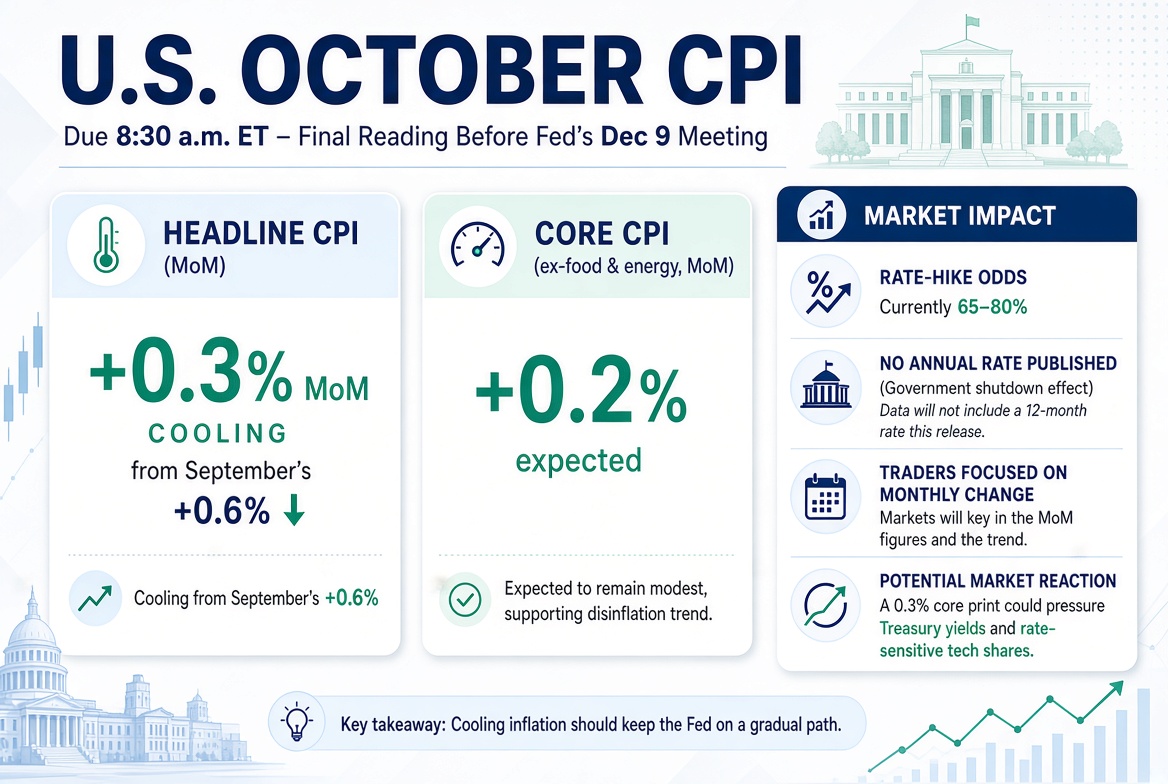
U.S. stocks head into Tuesday’s session with one number dominating the tape: the October Consumer Price Index, which the Bureau of Labor Statistics releases at 8:30 a.m. Eastern. Economists expect headline prices to rise 0.3% from September, a sharp cooling from the 0.6% jump a month earlier, while core CPI, which strips out food and energy, is forecast to climb 0.2% after a 0.3% gain in September.
The report carries unusual weight for several reasons. It is the last major inflation reading before the Federal Reserve meets on December 8 and 9. The federal funds target range sits at 3.75% to 4.00%, and futures pricing for a quarter-point hike at that meeting has run from roughly 65% to as high as 80%, depending on the source and the day. Friday’s October payrolls report added to the pressure, showing 165,000 new jobs against forecasts near 60,000 and an unemployment rate that slipped to 4.1%.
There is also a data quirk. Because last year’s 43-day government shutdown prevented the BLS from collecting October 2025 prices, no official 12-month change will be published for headline or core inflation. Analysts estimate annual headline inflation near 4% and core near 2.8%, compared with September’s published readings of 3.7% and 2.6%, but traders will focus almost entirely on the month-over-month figures. Individual forecasts range from 0.24% to 0.4% for headline and from 0.21% to 0.3% for core, leaving room for a surprise in either direction.
The setup follows a violent swing in sentiment. After the worst week since April 2025, driven by worries over data center spending and the aftermath of the midterm elections, the S&P 500 surged 2.35% on Monday to 7,549.94, its best session since April. The Nasdaq rose 2.74%, the Dow gained 2.15% to 52,389.75, and the VIX tumbled 22% to 19.92, its biggest one-day drop of 2026. Brent crude fell about 5.9% on hopes for U.S.-Iran diplomacy and U.S.-Russia-Ukraine talks. Early Tuesday, Dow futures were up about 0.3%, S&P 500 futures were roughly flat to slightly higher, and Nasdaq-100 futures were down about 0.2%.
The outcomes break into rough scenarios. An in-line print, with core at 0.2%, would likely extend the relief rally and favor the growth and chip stocks that led Monday’s bounce, because lower yields raise the present value of long-duration earnings. A core reading of 0.3% or higher, particularly if goods and services both rise, would reinforce hike expectations, lift short-term Treasury yields and the dollar, and could stall the rebound. A hot headline driven mostly by energy would likely matter less, since oil has been falling. The 10-year Treasury yield closed Monday at 4.89%, a level that leaves little cushion for a hawkish surprise.
Federal Reserve Governor Christopher Waller struck a hawkish tone ahead of the release, adding to the sense that policymakers see little reason to signal easier policy while inflation risks linger. Gold held above $4,100 an ounce as lower oil eased inflation worries.
For a paper-trading book, the practical takeaway is to respect the 8:30 a.m. volatility window, keep position sizes modest until the first hour settles, and treat today’s earnings gaps as secondary to the rate path. This article is informational and not investment advice.