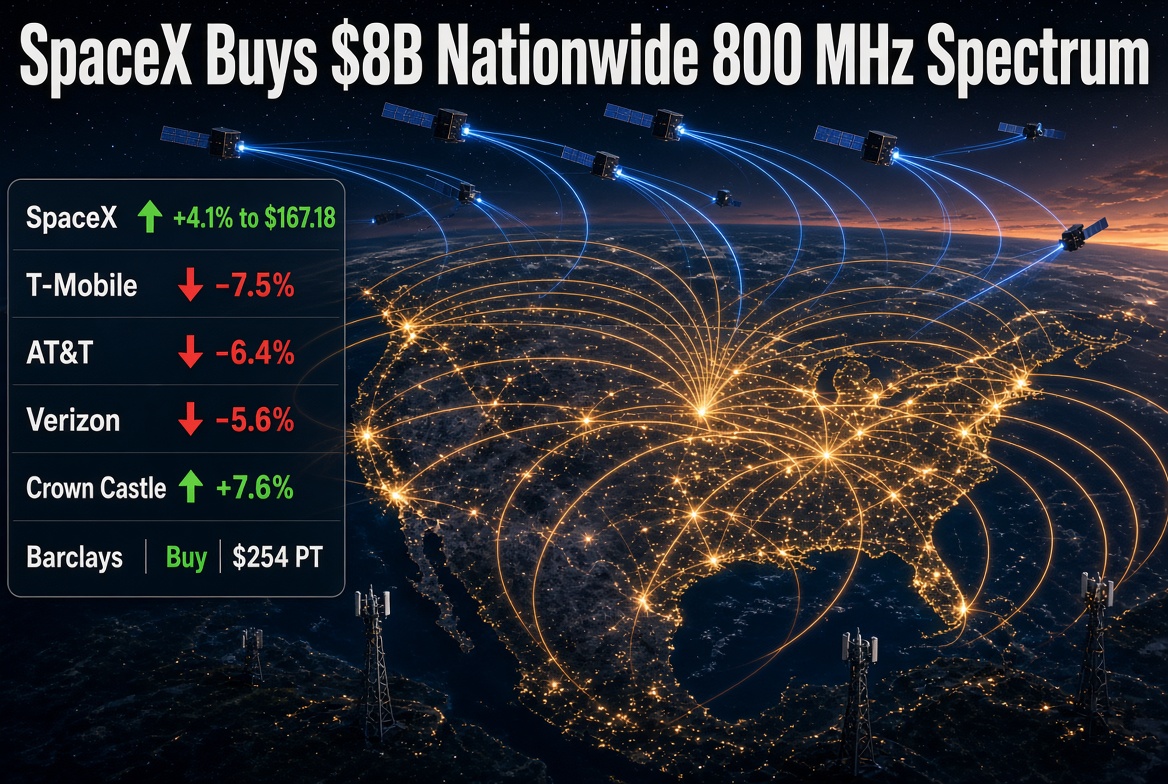
SpaceX shares rose 4.12% to $167.18 in premarket trading on Friday after the company announced an agreement to acquire Grain Management's nationwide 800 MHz low-band wireless spectrum assets in a deal valued at roughly $8 billion. The announcement landed alongside a bullish initiation from a Wall Street analyst and quickly redrew the premarket map for US telecommunications stocks.
Incumbent wireless carriers bore the brunt of the reaction. T-Mobile US fell 7.49% in early trading, AT&T dropped 6.41% and Verizon slipped 5.58%. The moves suggest investors are pricing in a scenario in which a deep-pocketed new entrant with access to coveted low-band airwaves could pressure pricing, capture subscribers or raise the cost of competing for network quality.
Low-band spectrum is prized because its signals travel farther and penetrate buildings better than higher-frequency bands, making it valuable for broad rural and in-building coverage. A nationwide block of such airwaves is rare, which helps explain the sharpness of the market's response, even though details on regulatory review and the timeline to close were not spelled out in premarket reports.
Not every name in the sector sold off. Crown Castle, the real estate investment trust that owns shared communications infrastructure, jumped 7.60%. Tower operators can benefit when new or expanding network builders need sites for their equipment, and traders appeared to treat the SpaceX agreement as a potential source of incremental demand for that infrastructure.
Separately, Barclays analyst Anthony Valentini initiated coverage of SpaceX with a Buy rating and a $254 price target. That target sits well above Friday's premarket price of $167.18. SpaceX shares debuted at $135 apiece on June 12 and climbed to a record $225.64 on June 16, meaning the stock remains below its post-listing peak even after today's gain.
For portfolio managers, the setup is a classic event-driven split. Telecom holders face a sharp, headline-driven drawdown that may or may not prove durable, depending on how much of the spectrum SpaceX can actually put to use, how quickly regulators act and how the incumbents respond with pricing moves or spectrum purchases of their own. SpaceX bulls, meanwhile, have a fresh strategic catalyst and a high-profile analyst endorsement.
Risks cut both ways. Premarket moves of this magnitude often fade or extend once regular trading begins and liquidity improves. The broader tape adds noise: US stock futures were rising as oil prices eased and technology shares rebounded, while investors awaited University of Michigan consumer sentiment data at 10 a.m. ET. Sentiment toward higher-valuation growth stocks has been fragile this week, so SpaceX's gains could prove sensitive to any renewed selloff tied to concerns over artificial intelligence spending.
Investors should watch for details on financing, closing conditions and regulatory approvals, for any public response from the carriers, and for whether analysts begin revising estimates for T-Mobile, AT&T and Verizon. Until those details emerge, the deal is best treated as a volatility event for the telecom group rather than a settled change in industry economics, with the tower sector emerging as an early relative winner on the day.