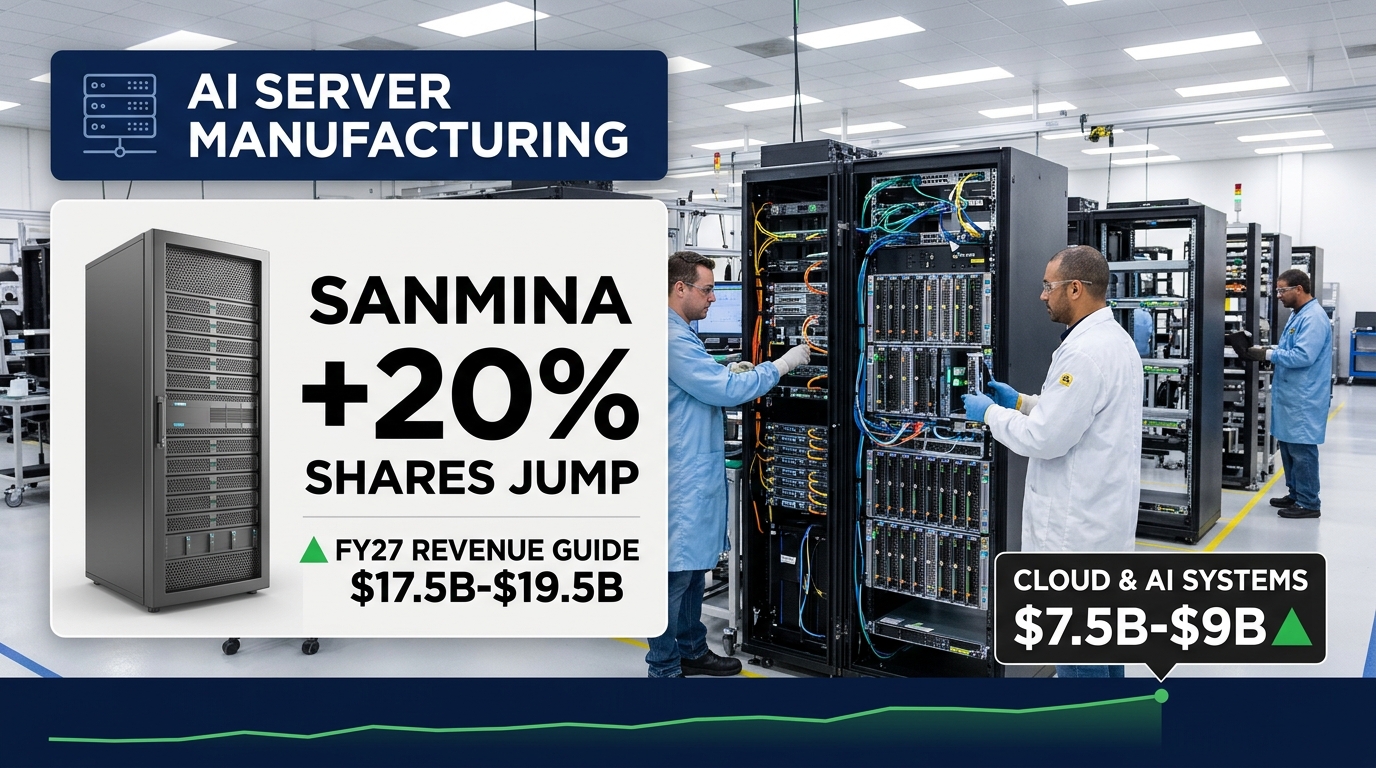
Sanmina Corporation shares jumped roughly 20% in premarket trading on Tuesday after the electronics manufacturing services provider issued fiscal 2027 guidance that topped Wall Street expectations, handing the AI hardware supply chain a fresh catalyst on a day when most investors are waiting for the October inflation report. Seeking Alpha ranked the move among the largest gains in its early-morning list of market movers.
The company projects fiscal 2027 revenue of $17.5 billion to $19.5 billion. Management said $7.5 billion to $9 billion of that total is expected to come from cloud and AI systems, citing strong customer demand. Sanmina also guided first-quarter revenue and earnings per share above consensus estimates. A separate market summary noted that both full-year revenue and EPS guidance exceeded expectations, sending the stock about 20% higher in after-hours trading on Monday.
The reason this matters beyond a single stock is where Sanmina sits in the supply chain. Contract manufacturers assemble servers, networking equipment and power systems for the companies that build data centers, so a higher outlook tends to signal that customers are still placing orders rather than pausing. That message carries extra weight now. Last week, equities sold off on worries that data center spending could slow, and the Philadelphia Semiconductor Index rebounded 6.85% on Monday to recover much of the damage. A company-level forecast with a specific dollar figure attached helps validate that rebound.
The broader tape is supportive but fragile. The S&P 500 gained 2.35% on Monday, the Nasdaq rose 2.74% and the VIX fell 22% to 19.92, yet futures were mixed on Tuesday as traders braced for a consumer price index forecast to show a 0.3% headline gain and a 0.2% core gain. A hotter-than-expected core reading would lift rate-hike odds for the Federal Reserve’s December meeting and could pressure the same momentum names that led the rebound.
Investors should also weigh what the guidance does and does not prove. A forecast is not a result, and contract manufacturing is typically a thinner-margin business than chip design, so revenue growth does not automatically translate into proportional earnings growth. The AI portion of the outlook also implies meaningful concentration: $7.5 billion to $9 billion against a $17.5 billion to $19.5 billion total works out to somewhere between roughly 38% and 51% of revenue, depending on where the final numbers land. That makes the stock more sensitive to any renewed doubt about AI capital spending.
The sheer size of the move adds another layer. A 20% gain in a single session pulls forward a lot of good news, and the stock now has to hold the new level while the market digests macro data. Analysts will likely spend the next several sessions updating models, and any upward revisions to price targets could provide a second leg of support if the broader market stays stable.
For a paper-trading book, a 20% gap higher raises the classic question of chasing versus waiting. Stocks that gap on guidance often retest their opening range once the first wave of buyers is exhausted, particularly when a major macro release lands within the first hour. Traders who want exposure may prefer to watch how the shares behave after the 8:30 a.m. Eastern inflation data, define a stop below the premarket consolidation, and size the position modestly. The article is for information only and is not investment advice.