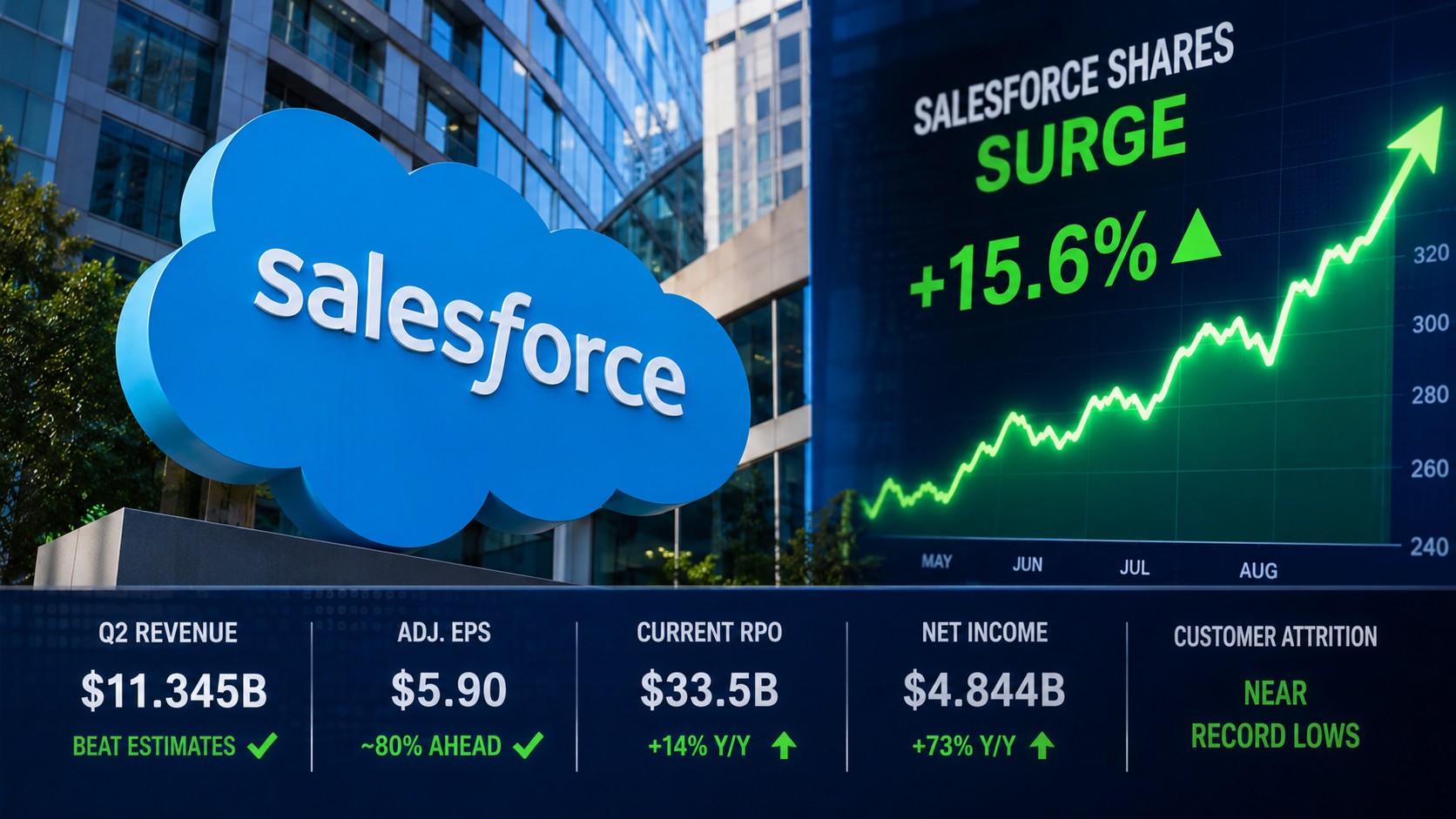
Shares of Salesforce jumped more than 15% after the enterprise software giant reported fiscal second-quarter 2027 revenue of $11.345 billion, up 10.83% year-over-year and modestly ahead of Street estimates for the period ended July 31. Adjusted earnings per share of $5.90 beat consensus estimates by roughly 80%, and net income of $4.844 billion climbed 73.31% from a year earlier.
While the headline revenue and earnings beat drew initial attention, the more significant news for investors came in the company's bookings metrics. Current remaining performance obligations, which represent Salesforce's pipeline of contracted but unrecognized revenue, grew 14% year-over-year in constant currency to $33.5 billion, a point ahead of the company's own guidance. Chief Financial Officer Robin Washington described it as the strongest quarter for net new annual order value in four years.
Customer attrition sat near its lowest level on record during the quarter, according to the company, a sign that Salesforce's core customer relationship management platform continues to retain enterprise clients even as competition in the broader software-as-a-service market has intensified. Slack, which Salesforce acquired in 2021, posted its fastest growth in net new annual order value since the acquisition closed, suggesting the collaboration platform is gaining renewed traction within Salesforce's broader product suite.
The strong bookings growth is viewed by analysts as a leading indicator of future revenue, often carrying more weight with investors than the trailing quarter's results, since it reflects the pace at which new and existing customers are committing to future spending with the company. Salesforce's ability to grow bookings meaningfully faster than revenue suggests accelerating momentum that could show up in reported results over coming quarters.
The results landed the same evening as earnings from Nvidia and CrowdStrike, giving investors a broad, same-session view of enterprise technology spending trends spanning artificial intelligence infrastructure, customer relationship management software and cybersecurity. Salesforce's stock reaction on Thursday ranked among the strongest single-day moves for the stock in recent years, reflecting how significant the bookings beat was relative to a stock that had underperformed parts of the broader software sector earlier in 2026.
Salesforce has spent much of the past two years emphasizing the integration of artificial intelligence features, including its Agentforce autonomous agent platform, across its core cloud products, positioning the company to capture incremental spending as enterprises look to deploy AI-powered automation within existing customer relationship management and workflow systems. Thursday's results offered early evidence that those AI-related investments may be beginning to translate into stronger bookings growth, a dynamic investors will continue to monitor closely in subsequent quarters as Salesforce works to demonstrate a durable acceleration in its underlying growth rate.
Management's commentary on the earnings call framed the quarter as a turning point after several periods of decelerating growth expectations, with the improved bookings trajectory giving the company more confidence in its full-year outlook heading into the back half of fiscal 2027.