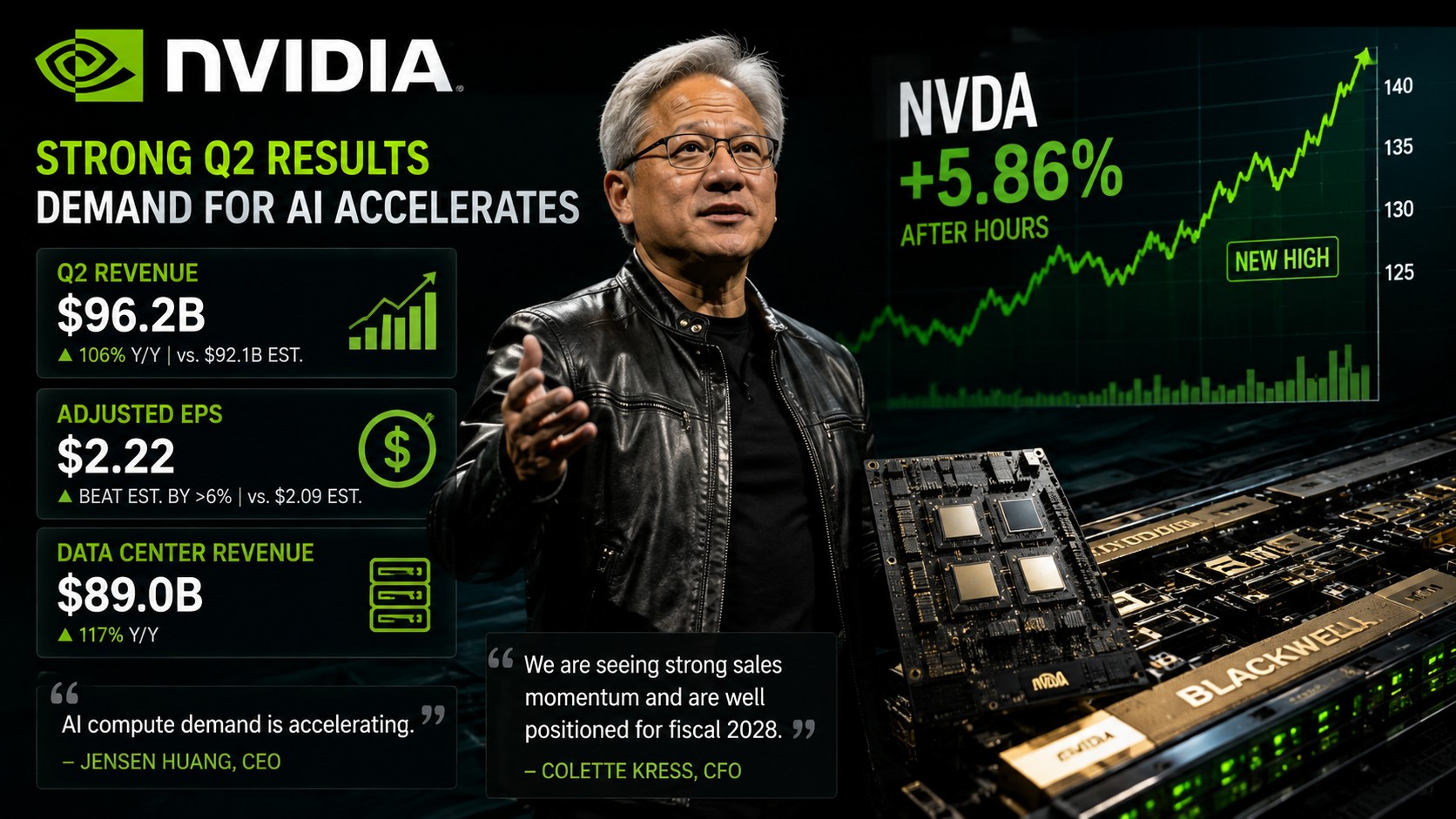
Nvidia reported fiscal second-quarter 2027 revenue of $96.2 billion, up 18% sequentially and 106% from a year earlier, comfortably topping the $92.1 billion Wall Street consensus and the company's own guidance of roughly $91 billion. Adjusted earnings per share came in at $2.22, beating the $2.09 analyst estimate by more than 6% and extending the chipmaker's streak of consecutive earnings beats to five quarters.
Data center revenue, the primary engine of Nvidia's growth, reached $89.0 billion, up 117% from the year-ago period, as demand for the company's Blackwell Ultra architecture continued to outstrip supply across hyperscale cloud providers and enterprise customers. GAAP and non-GAAP gross margins both came in at 75.0%, in line with the company's targets even as it ramps production of increasingly complex AI accelerator systems.
"AI has reached its inflection point. It's doing useful work. Its tokens are productive and profitable. Now, compute is revenue," said Jensen Huang, Nvidia's founder and chief executive, in the company's earnings release. "And demand is accelerating."
Shares of Nvidia rose nearly 6% in Thursday trading, helping lift the broader Nasdaq Composite and easing concerns that had built in recent weeks about whether the AI infrastructure buildout was beginning to lose momentum. Chief Financial Officer Colette Kress told investors the company expects strong sales growth to continue into fiscal 2028, a signal that helped push Nasdaq 100 futures higher by roughly 1% in the hours after the report.
Notably, Nvidia's guidance once again assumed no data center compute revenue from China, a market the company has been effectively locked out of amid ongoing export restrictions. Any eventual resumption of China sales would represent pure upside to current estimates, and investors will be watching closely for any signals on that front in the coming quarters. Kress also addressed concerns about whether customers might simply upgrade existing chips rather than purchasing new hardware, noting that previously deployed Hopper-generation systems are generating more revenue for customers now than when they were first installed, thanks to ongoing software improvements.
The results landed the same evening as earnings from Salesforce and CrowdStrike, both of which also posted strong beats, giving investors a broad, same-session read on enterprise technology spending across cloud infrastructure, software and cybersecurity. Nvidia's report is widely viewed as the most consequential single data point of the current earnings season given the company's outsized influence on major indices and its role as a bellwether for artificial intelligence capital spending more broadly.
Nvidia's next-generation Vera Rubin platform, which Kress has said is already in full production, is expected to begin ramping in the fiscal third quarter, a transition analysts will watch closely for its effect on both revenue growth and gross margins in coming quarters. With the stock still trading below its May record high despite Thursday's gain, investors appear to be viewing the report as confirmation that AI-related demand remains robust, even as questions persist about the sustainability of the broader infrastructure buildout heading into 2027.