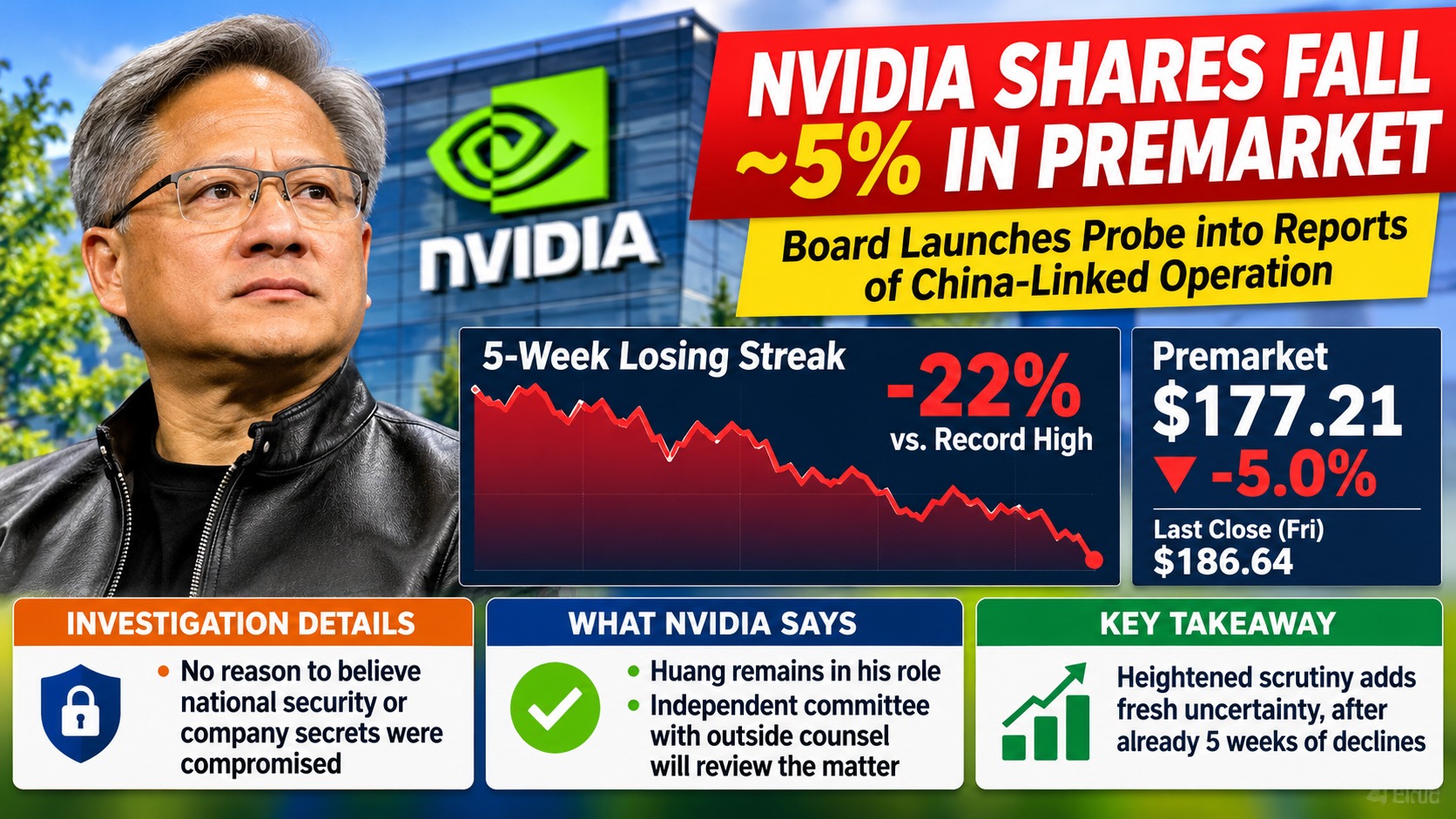
Nvidia shares dropped roughly 5% in premarket trading on Monday after the company’s board announced an independent investigation into reports that Chief Executive Officer Jensen Huang was the target of a foreign intelligence operation. The board’s statement came on Sunday, after the U.S. market had closed on Friday, so Monday’s premarket session was the first chance investors had to price the news into a stock that was already under heavy pressure.
The New York Times reported on Saturday that China’s Ministry of State Security had recruited a Chinese businesswoman, Alice Huang, to gather intelligence on the Nvidia chief. Follow-up reporting said a memo circulated among senior policymakers in the Trump administration last spring cited intelligence that she was working for Beijing’s top spy agency. She was associated with Megaspeed, a Singapore-based data center company that has been a significant Nvidia customer. The Times reported that Megaspeed bought more than $4.8 billion worth of Nvidia chips over the preceding two years.
Reports also said Huang developed a close personal relationship with Alice Huang. In a message to Nvidia employees, he acknowledged that he had been unfaithful to his wife and apologized to his family and colleagues. Nvidia had previously played down the interactions, describing them as nothing unusual or unexpected.
In its statement, the board said a committee of independent directors, assisted by external legal counsel, will oversee the inquiry. The board described U.S. national and economic security as paramount to Nvidia and its shareholders, said it has no reason to believe national security or the company’s confidential information was compromised, and reiterated its confidence in Huang and his leadership team. Huang supports the investigation, has committed to cooperating fully, and is expected to keep running the company while it proceeds.
The story has quickly taken on a political dimension. Three Republican committee chairs in the U.S. House of Representatives asked Huang to brief Congress on his interactions with Alice Huang and on Nvidia’s safeguards for protecting sensitive information. President Donald Trump said on Sunday that he had not discussed the allegations with Huang, whom he described as an honorable person and credited for his contribution to the company.
The timing is awkward for shareholders. Nvidia closed Friday, November 6, at roughly $186.64 after falling for five consecutive weeks, leaving the stock about 22% below its record close of October 6. That decline has erased about $1.27 trillion in market value from the peak and has coincided with a broader rout in artificial intelligence stocks, driven by doubts about data center spending and by concern that a Democratic-controlled Congress could slow power permitting and buildouts.
Dan Ives of Yorkville Ives & Co told Reuters the investigation could create risks for the stock because of Huang’s importance to Nvidia’s global strategy. Other analysts have argued that the underlying business is unchanged, and at least one highly ranked analyst urged investors to buy the dip, though the market reaction remains fluid and sentiment toward the stock has clearly weakened.
For portfolio managers, the key questions are whether the probe widens to touch customer relationships such as Megaspeed, whether it influences export-control or China policy discussions in Washington, and whether the congressional briefing request escalates. As the world’s most valuable company, Nvidia’s moves can ripple through index funds and chip peers. With October CPI due Tuesday and a December Fed rate hike priced at roughly three-in-four odds, any additional headline risk lands on a market already running with the VIX above 25. A disciplined approach would favor small position sizes and waiting for clarity from the board’s review before adding exposure.