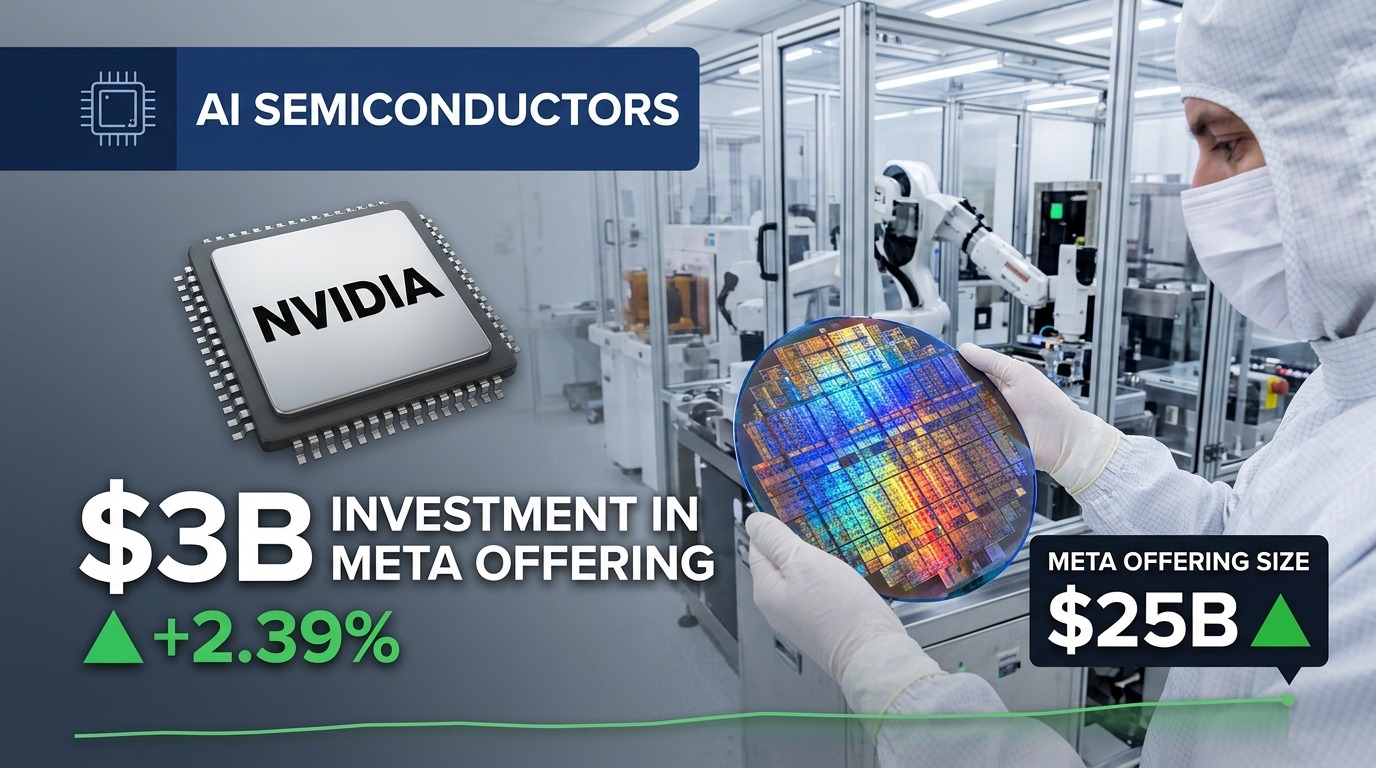
Nvidia said late Monday that it will invest $3 billion in Meta Platforms’ recent stock offering, a deal that pairs the dominant AI chip supplier with one of its largest customers. As part of the arrangement, Meta plans to increase deployments of Nvidia’s Vera Rubin systems and Vera CPUs, along with Spectrum-X networking and BlueField-4, to support its next generation of AI agents. The companies are also exploring further collaboration.
Meta upsized its common stock offering to $25 billion from $22.5 billion, pricing the shares at $625 each, and a separate depositary offering priced at $50 per share. Paired together, the total raise could reach $37.5 billion. Meta has also outlined plans for a separate $60 billion non-voting stock offering in 2027. The proceeds are aimed mainly at its AI infrastructure buildout.
Investors may ask why Nvidia would fund a customer that could probably raise the money itself. The answer appears strategic. Meta builds custom chips with Broadcom, whose CEO Hock Tan serves as a strategic advisor to Meta’s board, and Meta disclosed that both Broadcom and AMD showed interest in joining the offering. An equity stake gives Nvidia a closer seat at a customer that is diversifying its silicon, and Nvidia CEO Jensen Huang said the two companies are expanding their partnership to optimize computing for capable, efficient and secure AI agents.
Demand on the Meta side appears real. Meta’s Muse AI models have caught on quickly, and the Muse agent app became one of the most downloaded apps within a week of launch, according to market reports. The companies will also work together on training and inference performance for the Muse models, signaling a deeper technical relationship than a simple purchase order.
Nvidia stock closed at $216.00 on Monday, up 2.39%, and was little changed near $215.95 before Tuesday’s open. Meta shares fell 1.88% in the previous session and were flat in premarket trading. Broadcom rose 2.33% and AMD gained 2.80% on Monday, and Broadcom added about 1.2% in premarket trading Tuesday.
The transaction highlights two themes for traders. First, AI capital spending is increasingly financed through equity markets, with Meta raising tens of billions of dollars rather than relying only on internal cash flow. Second, the supplier landscape is crowded: because Broadcom and AMD also showed interest in the offering, Meta appears intent on keeping multiple chip vendors competing for its spending, which limits how exclusive any single relationship can become.
Risks include dilution for existing Meta shareholders, scrutiny of financing structures in which suppliers fund customers who then buy their products, and the possibility that an unexpected Fed message on Wednesday dampens appetite for high-multiple technology shares. Traders will also watch how Broadcom and AMD respond, since any participation by them would reinforce the view that the AI hardware race is widening rather than consolidating.