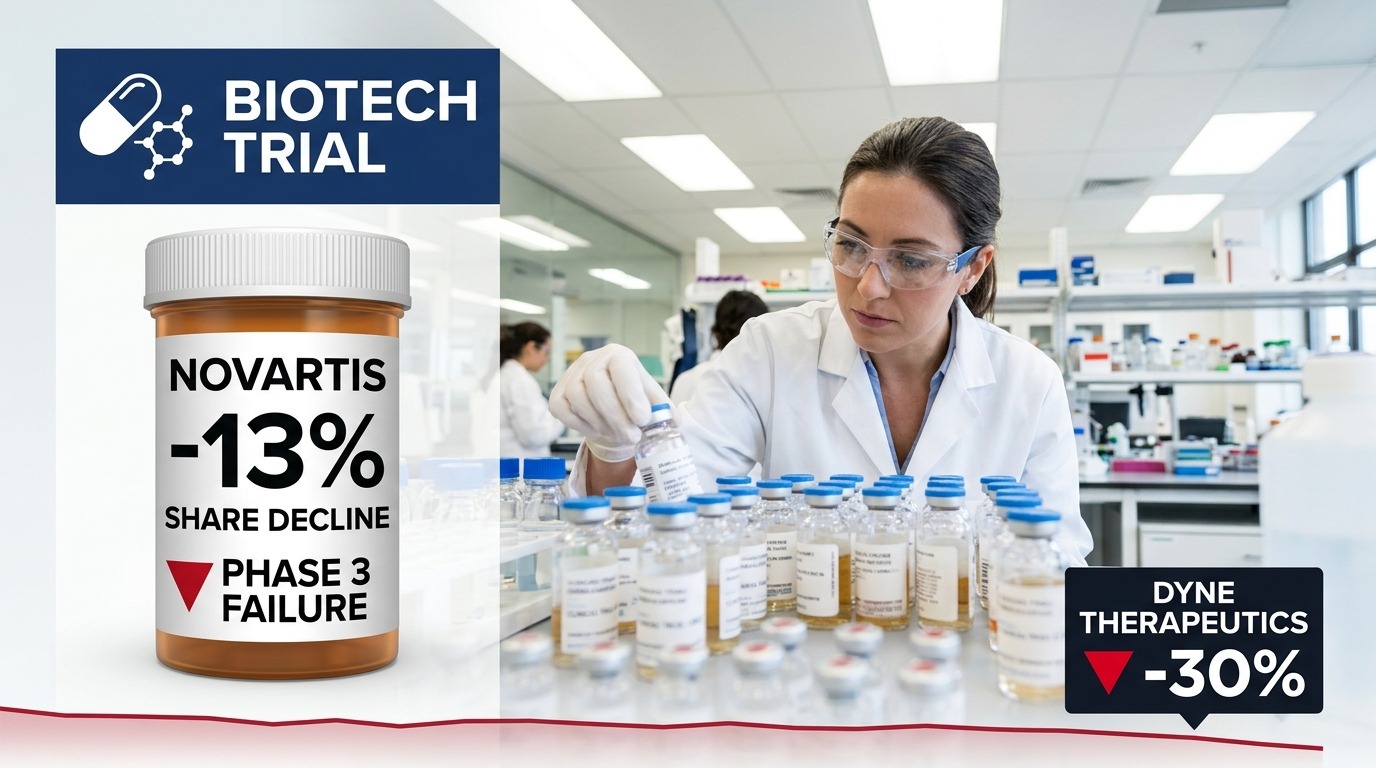
Novartis shares tumbled as much as 13% in Tuesday trading after the Swiss pharmaceutical giant disclosed that its experimental drug del-desiran failed to demonstrate a statistically significant improvement in patients with myotonic dystrophy type 1 in a Phase 3 trial, marking the company's third clinical setback in the span of a week.
The muscle-wasting disorder has limited treatment options, and del-desiran had been viewed by some analysts as a potential blockbuster addition to Novartis's neuroscience pipeline. The company's chief medical officer characterized the outcome as an inherent risk of scientific innovation rather than a signal of broader pipeline weakness, and Novartis reiterated its target of 5% to 6% annual sales growth through 2030.
The disappointment rippled well beyond Novartis itself. Shares of Dyne Therapeutics, which is developing its own therapies for neuromuscular disease, collapsed roughly 30% as investors drew read-through concerns about the broader mechanism class. Sarepta Therapeutics, another neuromuscular-focused biotech that has faced its own string of regulatory and safety setbacks over the past year, fell about 11%. NewAmsterdam Pharma slid 9% and other clinical-stage names in the space saw sharp declines as well.
The selling pressure also spread to companies outside the direct disease area. Amgen shares declined nearly 5% even though the company's pipeline is not directly comparable to del-desiran; Amgen is developing its own cardiovascular therapy, olpasiran, and traders appeared to price in generalized concern about binary trial risk across late-stage cardiovascular and neuromuscular programs rather than any drug-specific read-through.
The pharmaceutical sector's volatility stood in contrast to relative strength in technology and industrial names Tuesday, illustrating how idiosyncratic clinical trial outcomes can move entire sub-sectors independent of the broader market's direction. Biotech investors have grown increasingly sensitive to binary catalysts this year after a string of high-profile trial disappointments across the industry, and Tuesday's reaction underscores how quickly capital can rotate out of story stocks tied to unproven drug classes.
Novartis, for its part, emphasized that its broader pipeline remains intact and that del-desiran represented one of several late-stage neuroscience bets rather than the centerpiece of its growth thesis. Analysts said the market's outsized reaction across the sector likely reflects positioning as much as fundamentals, with several neuromuscular-focused names having run up sharply in recent months on optimism ahead of this and other pending trial readouts. Investors are now awaiting additional data updates from peer companies later this quarter that could either confirm or ease the sector-wide anxiety triggered by Tuesday's news.