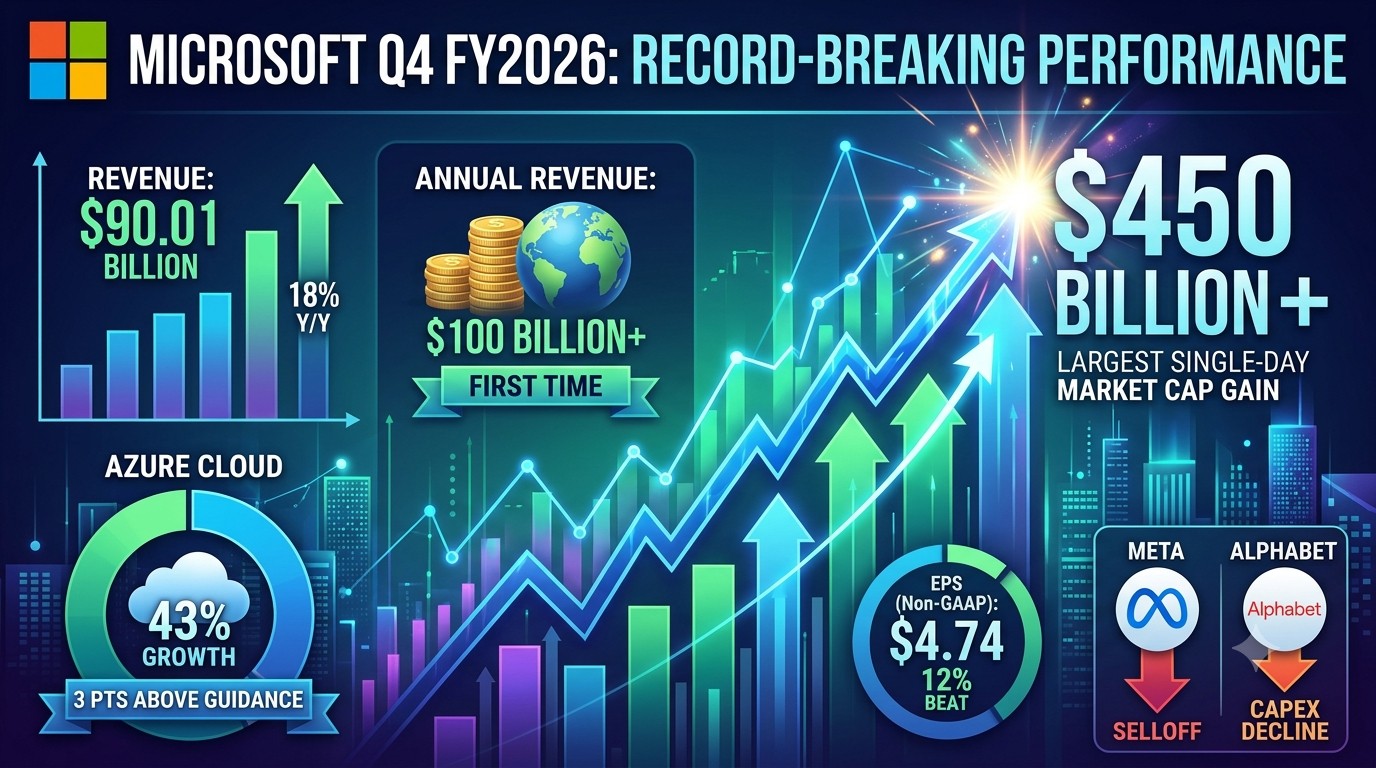
Microsoft Corporation delivered a landmark fiscal fourth-quarter result Wednesday evening, reporting revenue of $90.01 billion — an 18% year-over-year increase that beat the $87.67 billion consensus estimate compiled by analysts polled by StreetAccount. Non-GAAP earnings per share of $4.74 cleared the $4.24 forecast by approximately 12%, while GAAP diluted EPS of $4.81 surged 32% from the prior-year quarter, underscored in part by a $0.27 benefit from discrete items including gains from the company's OpenAI investment.
The headline number for the AI trade was Azure. Cloud revenue for Microsoft's Intelligent Cloud segment grew 43% year-over-year — compared with Wall Street's 40% estimate — and passed the $100 billion annual revenue mark for the first time in the company's history, with full fiscal 2026 Azure growth of 41%. CFO Amy Hood guided Q1 FY2027 Azure growth of approximately 45% in constant currency, meaningfully above the 41.4% consensus, and confirmed that commercial remaining performance obligations surged 84% year-over-year to $678 billion — the single most compelling demand-visibility number in the report. Sequential RPO growth was driven primarily by enterprise customers outside of large AI model developers, addressing a key investor concern about customer concentration tied to OpenAI.
Copilot, Microsoft's enterprise AI assistant, crossed 30 million paid seats — a milestone that implies approximately a $10 billion annual revenue run rate even at discounted enterprise pricing. Management described adoption as genuine deployed usage rather than trial, though Copilot revenue is not yet broken out as a standalone line item, leaving the precise contribution to Intelligent Cloud's 32% revenue growth unverifiable from external data alone.
The market's reaction was unambiguous. Microsoft shares surged as much as 16% in Thursday's session — the company's largest single-day percentage gain in modern history — adding roughly $450 billion in market capitalization, making it the biggest single-stock value creation in a single day on record. The move extended an S&P 500 advance of 1.7% and a Nasdaq 100 gain of 3.4%, snapping a six-session losing streak as semiconductor stocks also recovered sharply alongside the Microsoft catalyst.
The contrast with peers that reported the same evening was stark and instructive. Meta Platforms fell as much as 9.6% after hours after its EPS missed by approximately 14% and free cash flow collapsed to $784 million as $31.1 billion in capital expenditures consumed nearly all operating cash flow. Alphabet had already declined more than 5% the prior week after raising 2026 capex to $195–$205 billion without providing investor-satisfying ROI linkage. What separated Microsoft was not merely the earnings beat, but the specific $678 billion RPO figure that tied future infrastructure spending to contracted customer demand — a demand-first narrative that Alphabet and Meta could not match.
Capital expenditures and finance leases for the quarter reached $41 billion, up 69% year-over-year — a significant number that management framed in context of the $678 billion backlog. FY2027 capex guidance of $255–$260 billion, disclosed prior to the report, represents a 35% step-up from FY2026's $190 billion and will be parsed closely by investors for signs of margin pressure into next year. Hood confirmed cloud gross margin came in better than expected at 65%, though it declined year-over-year due to sales mix shift toward Azure and increased AI infrastructure costs.
For investors assessing the AI capital expenditure debate that has defined technology sector sentiment in 2026, Microsoft's Q4 report provides the clearest data point yet that AI cloud spending, when anchored to contracted enterprise demand, can be rewarded rather than penalized by markets. The report arrives the same day as Amazon's own blockbuster Q2 results, reinforcing the AI infrastructure supercycle narrative heading into the second half of 2026.