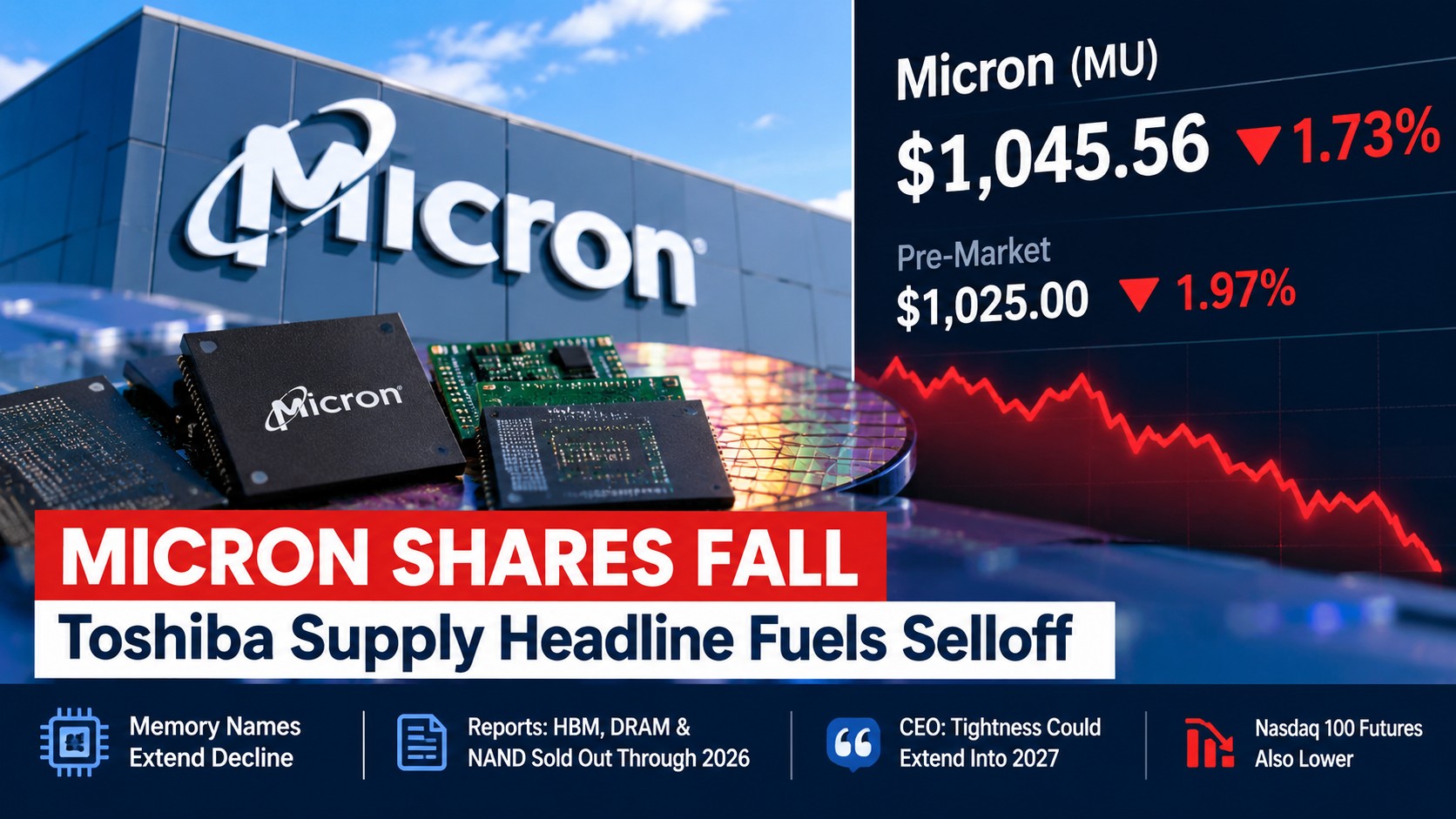
Micron Technology shares closed at $1,045.56, down 1.73%, on Tuesday and were indicated 1.97% lower at $1,025.00 in pre-market trading on Wednesday, according to market commentary from Cardinal Bridge Capital. The decline extends a run of weakness in memory-chip names tied to a headline about Toshiba supply.
SKHY, a memory-linked ticker highlighted in the same commentary, fell 6.39% to $182.56 and had its worst single session in weeks on Tuesday.
The commentary argued that part of the market already views the selloff as overdone. The argument rests on supply tightness: high-bandwidth memory, DRAM and NAND capacity were reportedly sold out through 2026 as of last fall, and Micron's chief executive has discussed tightness lasting into 2027.
Memory is historically one of the most cyclical corners of the semiconductor industry, because supply additions and demand swings can shift pricing quickly. That history is one reason traders react sharply to supply headlines, even when the underlying capacity picture remains tight. AI data center build-outs have increased demand for high-bandwidth memory, which is why sold-out capacity commentary carries so much weight among investors who own the group.
Context matters for the broader tape. S&P 500 futures fell 0.5% and Nasdaq 100 futures dropped 0.9% on Wednesday, with chipmakers and big tech under pressure, as Brent crude rose above $101 a barrel and yields climbed, Bloomberg reported. Both the S&P 500 and the Nasdaq Composite had closed at record highs on Tuesday.
For memory producers, the investment debate centers on whether the supply headline changes the pricing outlook or simply triggers profit-taking in a crowded trade. A stock priced above $1,000 has substantial expectations embedded, and moves of 1% to 2% in a day can represent large dollar swings for holders.
The pre-market indication of $1,025.00 would leave the stock about 2% below Tuesday's close, a modest move in percentage terms but one that adds to the recent weakness in the group. Pre-market volume is typically thin, so opening prices can diverge from early indications.
Risk factors cut both ways. Rising bond yields and a $39 billion 10-year Treasury auction today can pressure high-multiple technology shares by raising discount rates. Meanwhile the Federal Reserve's September meeting minutes, due later, could shift expectations for rates. Any hawkish tone would likely compound pressure on semiconductor valuations.
Investors tracking the sector may focus on three signals: whether the Toshiba-related supply news is confirmed or clarified, whether Micron holds support near its pre-market level, and whether commentary from memory suppliers continues to describe sold-out capacity. Confirmation of tight supply would favor dip buyers, while evidence of easing supply could extend declines.
Traders should also consider position size, as volatile sessions in a high-priced stock can quickly exceed risk limits. The setup points to selectivity rather than broad semiconductor buying until the macro calendar clears.
This article is for informational purposes only and does not constitute investment advice.