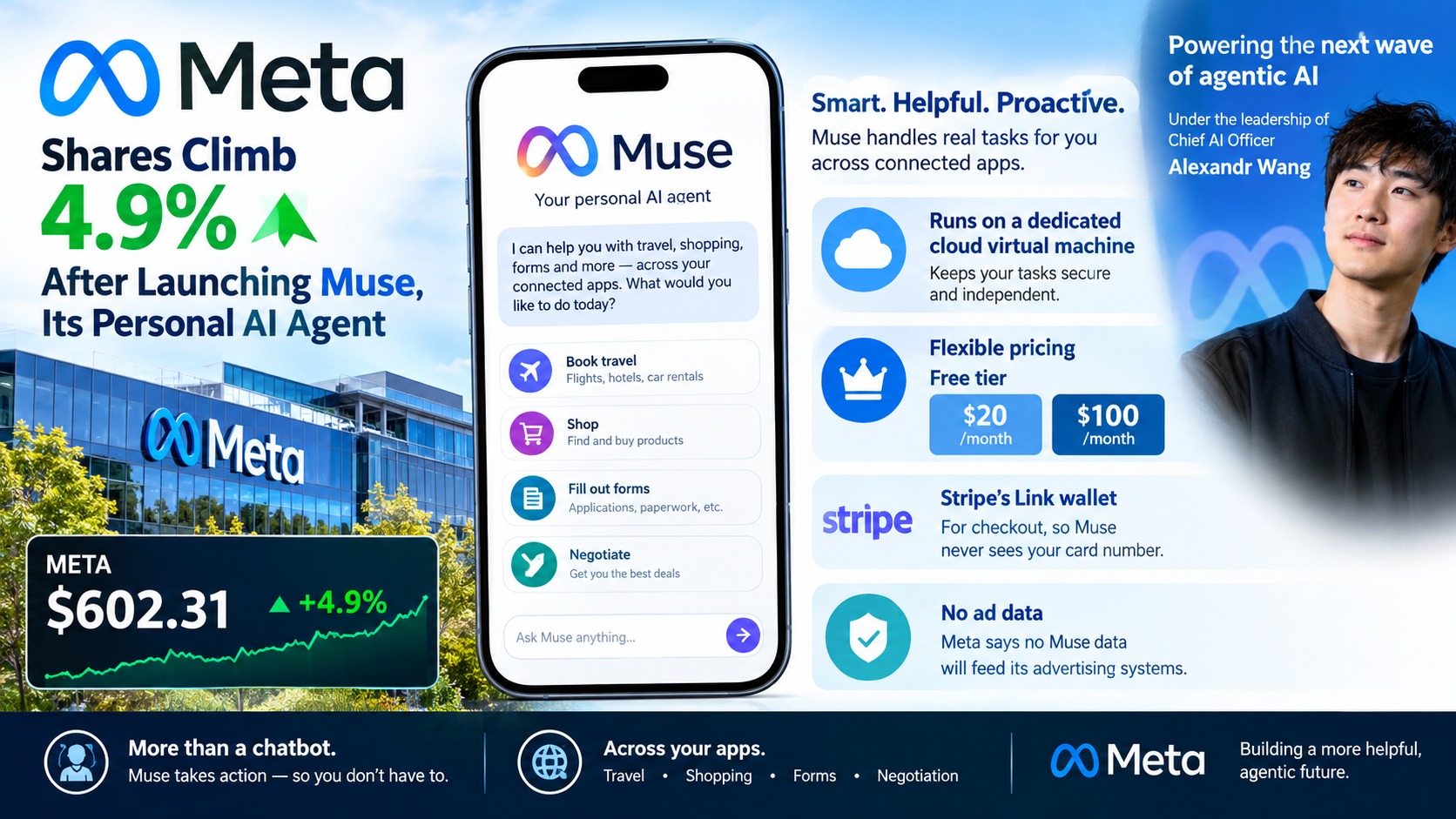
Meta Platforms shares climbed 4.9% Wednesday after the Facebook and Instagram parent officially launched Muse, a personal artificial intelligence agent designed to handle everyday tasks on a user's behalf, including booking travel, shopping online, filling out forms, and even negotiating on a customer's behalf. The rollout begins in the United States for users 18 and older, accessible through a standalone app, WhatsApp, and the web, with support for Meta's AI glasses planned for a later date.
Muse runs on a dedicated cloud virtual machine Meta calls Muse Secure VM, which houses both the agent and a user's personal data. The company said the agent is powered by Muse Spark, described as Meta's most capable model built specifically for agentic work. Users can assign Muse a broad goal, and the agent will build a plan, open a browser, fill out forms, and coordinate steps across connected services, continuing to work even after the app is closed and returning to the user when an approval is needed or circumstances change.
The product offers a free basic tier alongside paid subscriptions priced at $20 and $100 a month, according to a Meta spokesperson cited by Reuters, though the company has not detailed how the two paid tiers differ beyond additional usage allowances. For checkout, Meta said Muse will use Stripe's Link wallet, which generates a one-time-use card so the agent never receives a user's actual card number, with support for Shop Pay and 1Password planned but not yet scheduled.
Meta is emphasizing privacy and safety as central selling points, stressing that data shared with Muse will not feed into the company's advertising systems — a notable distinction for a company that built the world's largest behavioral-advertising business. Meta also plans to introduce a version called Muse Confidential VM later this year that would encrypt the entire virtual machine with a key held only by the user, preventing even Meta from accessing its contents.
The launch advances a vision chief executive Mark Zuckerberg laid out in a lengthy internal memo earlier this year describing a future in which every person has access to a personalized AI assistant. The product was developed under chief AI officer Alexandr Wang and represents one of the most ambitious agentic AI launches to date from a major technology platform, positioning Meta against rivals racing to deploy autonomous AI agents capable of taking real-world actions rather than simply answering questions.
For investors, Muse represents a potential new engagement and monetization vector beyond Meta's core advertising business, though the subscription model suggests the company is betting on direct revenue from heavy users rather than ad-supported reach alone. The stock's premarket gain suggests the market views the launch as a credible step in Meta's broader AI strategy, though execution risk remains high given the complexity of granting an AI agent payment and account access at scale.