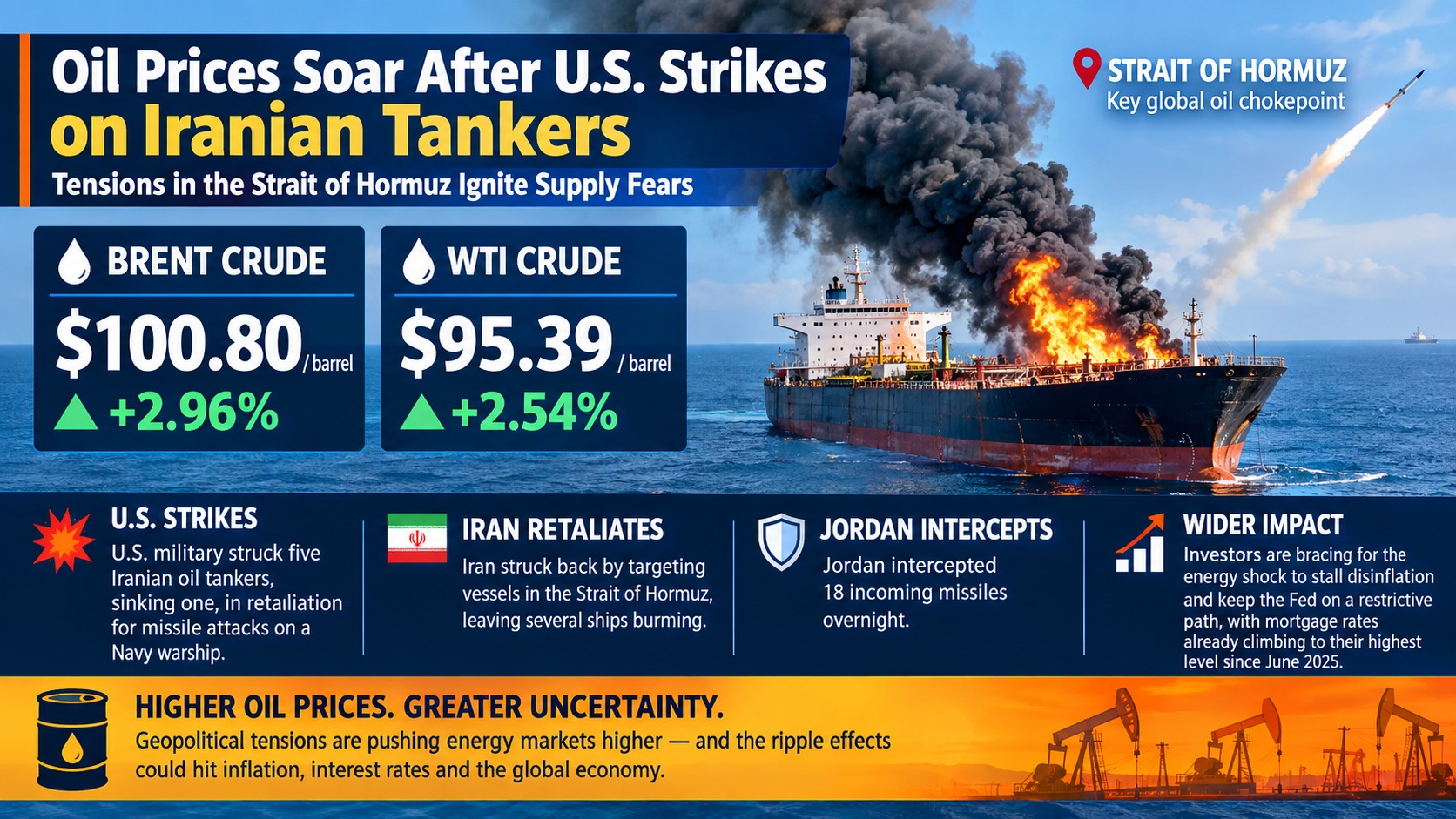
Oil prices surged Wednesday after the United States military struck five Iranian oil tankers overnight, sinking one, in retaliation for Iran firing ballistic missiles at a U.S. Navy warship earlier this week. Brent crude jumped 2.96% to $100.80 a barrel, its highest level since late July, while West Texas Intermediate climbed 2.54% to $95.39. The escalation marks a sharp turn in the months-long standoff between Washington and Tehran, and traders are now pricing in a sustained risk premium across energy markets.
Iran retaliated by targeting vessels attempting to transit the Strait of Hormuz without its permission, and the U.K. Maritime Trade Operations center reported that several merchant ships in the Northern Arabian Gulf and the Gulf of Oman were struck by disabling fire as part of the ongoing military activity. Jordan said its air defenses intercepted eighteen incoming Iranian missiles overnight, with no casualties reported. Houthi attacks on Saudi energy facilities have widened the threat further, raising fears that disruption could spread beyond Iranian supply routes to the broader infrastructure that has kept Gulf crude flowing throughout the conflict.
"Houthi attacks on Saudi energy facilities have widened the threat further, raising concerns that disruption could spread beyond Iranian supply to the infrastructure and alternative routes that have helped keep Gulf crude flowing," said Daniela Hathorn, senior market analyst at Capital.com. "That has brought the inflationary consequences of the conflict firmly back into focus."
U.S. equity futures fell Wednesday morning as investors weighed the prospect that sustained higher oil prices could stall the disinflation trend that has supported equity valuations for much of the year. Stocks closed lower on Tuesday for a second straight session as higher crude prices revived worries that an energy shock could force the Federal Reserve to keep policy restrictive for longer. Rate expectations have already shifted in response, and upcoming inflation data will be closely watched for signs of how much $100 oil is feeding through to price pressures.
The conflict's economic fallout is already visible beyond the energy complex. The average 30-year fixed mortgage rate climbed to 6.85% in the week ended September 4, its highest level since June 2025, as Treasury yields rose on inflation concerns tied to the widening war. Oil traders, meanwhile, are growing more cautious about long-term positioning. Morgan Stanley's co-head of global oil trading, Brendan Ross, said at the Asia Pacific Petroleum Conference in Singapore that traders are concentrating derivatives exposure over shorter time horizons and becoming more selective about which risks they take on as the outlook beyond the next few months grows increasingly cloudy.
For portfolio positioning, the immediate implication is a rotation toward energy producers and defensive sectors and away from rate-sensitive growth names and consumer discretionary stocks exposed to higher gasoline prices. Airlines, retailers, and homebuilders are among the more vulnerable groups if crude remains elevated, while integrated oil majors and oilfield services firms stand to benefit from higher realized prices. Investors should also watch Treasury yields closely, since a sustained move higher in borrowing costs would compound pressure on equity valuations already grappling with geopolitical risk.