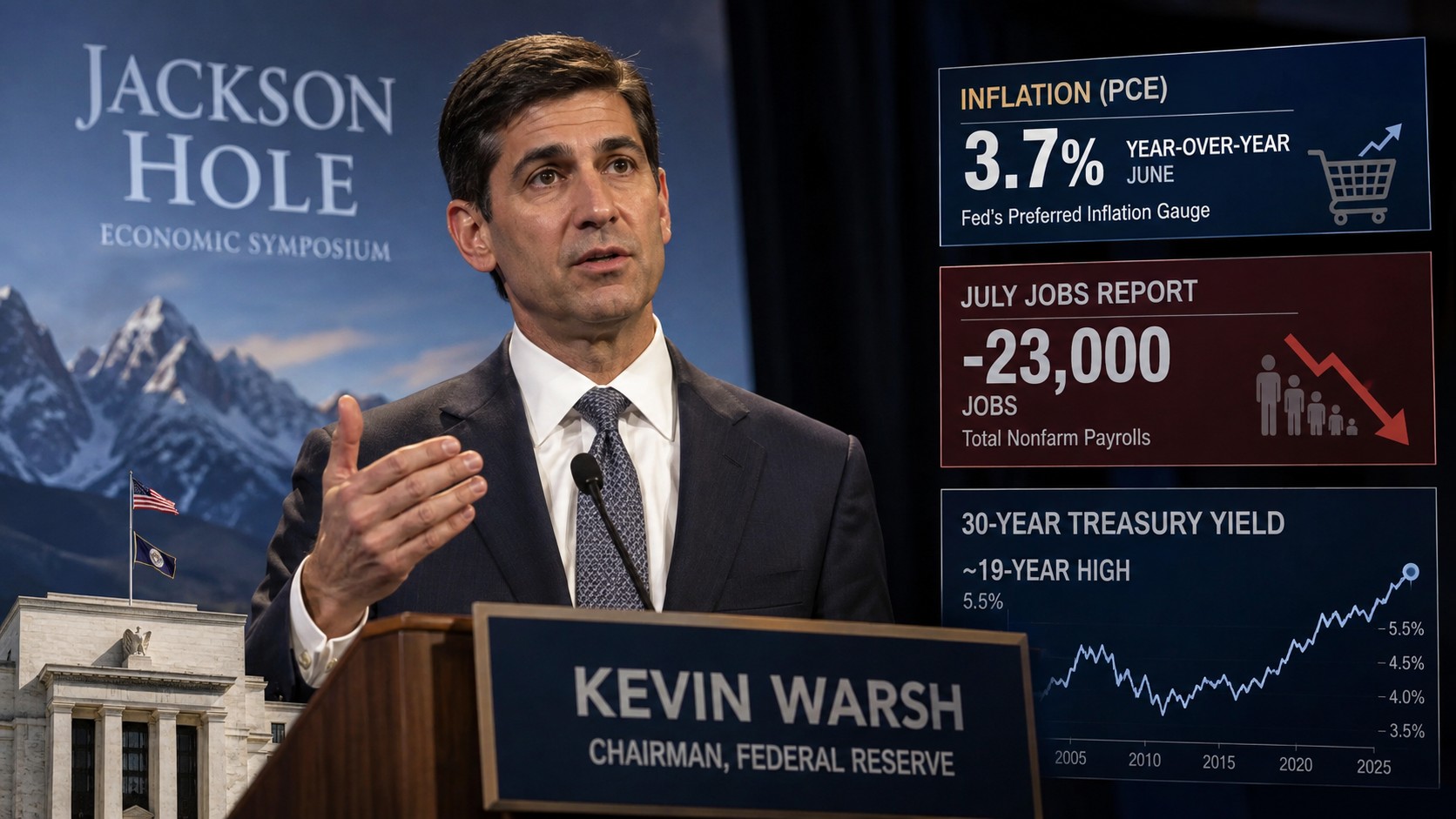
Federal Reserve Chairman Kevin Warsh is scheduled to deliver his first Jackson Hole keynote address at 10 a.m. ET Friday, a speech that has taken on outsized importance as investors search for clarity on the central bank's next move under its new leadership. Warsh, who became the Fed's 17th chair in May after succeeding Jerome Powell, has held the benchmark rate steady in a range of 3.50% to 3.75% at both policy meetings since taking office.
The speech comes at a delicate moment for markets. The Fed's preferred inflation gauge, the personal consumption expenditures price index, showed prices rising 3.7% year-over-year in the most recent reading, while the economy shed 23,000 jobs last month. At the same time, the 30-year Treasury yield touched a 19-year high last week before pulling back modestly after Treasury Secretary Scott Bessent announced plans to double the maximum size of the government's long-term debt buybacks.
Economists are divided on what Warsh will say. During his July press conference, Warsh repeatedly pointed to rising bond yields as a welcome development, suggesting the Fed was comfortable letting markets do some of the tightening work rather than raising the policy rate directly, a stance that initially pushed long-term yields even higher and left some investors confused about the central bank's strategy. Robert Kaplan, former head of the Dallas Fed, said he hopes Warsh uses Friday's remarks to explain the reasoning behind that July stance directly.
Some economists believe Warsh, who arrived at the Fed chairmanship with a reputation as an inflation hawk from his earlier tenure as a Fed governor during the financial crisis, will use the Jackson Hole platform to break from the tradition of using the keynote address to signal near-term policy shifts. "I don't expect any signals to come out of Kevin Warsh's Jackson Hole speech," said Jan Groen, chief U.S. economist at Societe Generale. "And if I'm right, I think the market is not going to like it."
Others argue Warsh needs to be more explicit about his willingness to raise rates if inflation does not moderate, particularly given that some of his fellow Federal Open Market Committee members have already called for the first rate increase since July 2023. Adam Posen, an economist who has closely tracked the Fed, said Warsh should be blunt about his readiness to act on inflation without abandoning his broader thesis that rising productivity and other structural factors should help keep price pressures contained over time.
The symposium, hosted annually by the Federal Reserve Bank of Kansas City, runs from Wednesday through Saturday this year and has drawn roughly 120 officials and economists from more than 70 countries under the formal theme of financial innovation and its implications for payments and policy. The Federal Open Market Committee is not expected to announce any policy changes at the gathering; the next scheduled rate decision comes at the Fed's Sept. 15-16 meeting.
Markets were little changed heading into the speech, with S&P 500 futures roughly flat and the dollar holding near a one-week high as investors positioned for Warsh's remarks. A clear signal in either direction, hawkish or dovish, could trigger a sharp move across equities, Treasurys and the dollar, while continued ambiguity from Warsh risks leaving markets to search for direction elsewhere heading into the long Labor Day weekend.