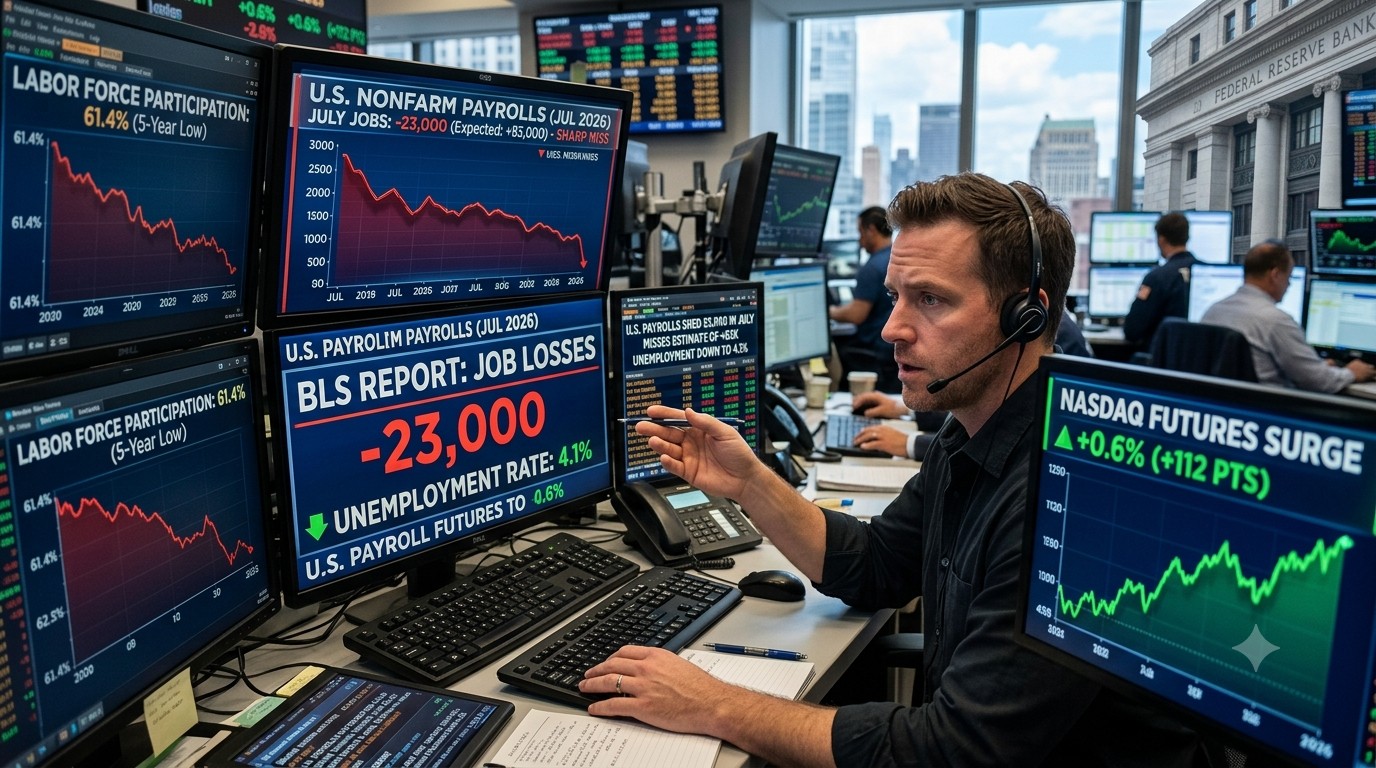
The U.S. labor market delivered its most alarming monthly reading in years on Friday, with the Bureau of Labor Statistics reporting that nonfarm payrolls contracted by a seasonally adjusted 23,000 in July 2026 — a result that shocked economists who had forecast a gain of 83,000 and sent Nasdaq 100 futures surging 0.6% as traders rapidly repriced Federal Reserve rate-cut expectations.
The headline miss was compounded by a sweeping downward revision to prior months: May's payroll count was cut by 66,000 to a gain of 129,000, and June was revised 37,000 lower to just 57,000. Together the two-month revision removed 103,000 jobs from previous estimates, dragging the 12-month average monthly gain to only 34,000 — a figure that signals the labor market has been meaningfully weaker than the top-line prints suggested throughout most of the year. The BLS also noted that October 2025 data were not collected due to a federal government shutdown, introducing additional complexity into the seasonal adjustment methodology.
July's job losses were concentrated in two sectors. Local government education shed 50,000 positions, a seasonal anomaly that may partly reflect the timing of summer hiring cycles relative to the BLS's calendar survey week. Retail trade lost 19,000 jobs, led by declines in warehouse clubs, supercenters, and general merchandise retailers. Every other major industry, including manufacturing, construction, financial activities, and information, showed little net change. Average hourly earnings grew 3.2% year-over-year, a deceleration from recent months, while the average workweek held at 34.3 hours.
The household survey told a slightly less dire story: the unemployment rate edged down to 4.1% from 4.2%, though the decline was accompanied by a contraction in labor force participation to 61.4% — its lowest level in more than five years — suggesting the improvement in the headline rate was driven by workers leaving the labor force rather than by increased hiring. The number of people on temporary layoff rose 153,000 to 921,000, a forward-looking indicator that bears close watching in coming months. Long-term unemployment edged down to 1.8 million but still accounted for 25.5% of all unemployed people.
Financial markets reacted with a reflexive dovish repricing. The logic is textbook: a materially weak labor market report reduces the Fed's rationale for holding rates elevated, particularly in an environment where core PCE has been trending toward target and oil-driven inflation pressures from the Iran conflict have eased meaningfully. Fed funds futures immediately shifted to price in a higher probability of a September rate cut, with market-implied odds of at least 25 basis points of easing at the September 17 FOMC meeting rising sharply post-release.
Equity futures responded in kind. Nasdaq 100 futures rose 0.6%, S&P 500 futures gained 0.3%, and Dow futures edged up 0.1% — a pattern consistent with rate-sensitive growth stocks outperforming as the Fed is perceived to be moving closer to easing. Bond yields fell, with the 10-year Treasury retreating as investors added duration in anticipation of a softer Fed path. The dollar weakened modestly against major currencies.
The broader economic backdrop complicates the Fed's calculus. The S&P 500 closed at 7,709.96 on Thursday — down 0.18% — and sits roughly 20.6% above year-ago levels. Despite Thursday's pullback, the index has returned nearly 3% over the past month. Corporate earnings have broadly impressed, with technology and AI-linked names delivering outsized beats. The tension between a weakening labor market and resilient corporate profitability will be central to how the Fed frames its September decision. Today's jobs number dramatically increases the probability that September's FOMC meeting becomes a live one — the most consequential macro question in the market entering the coming week.