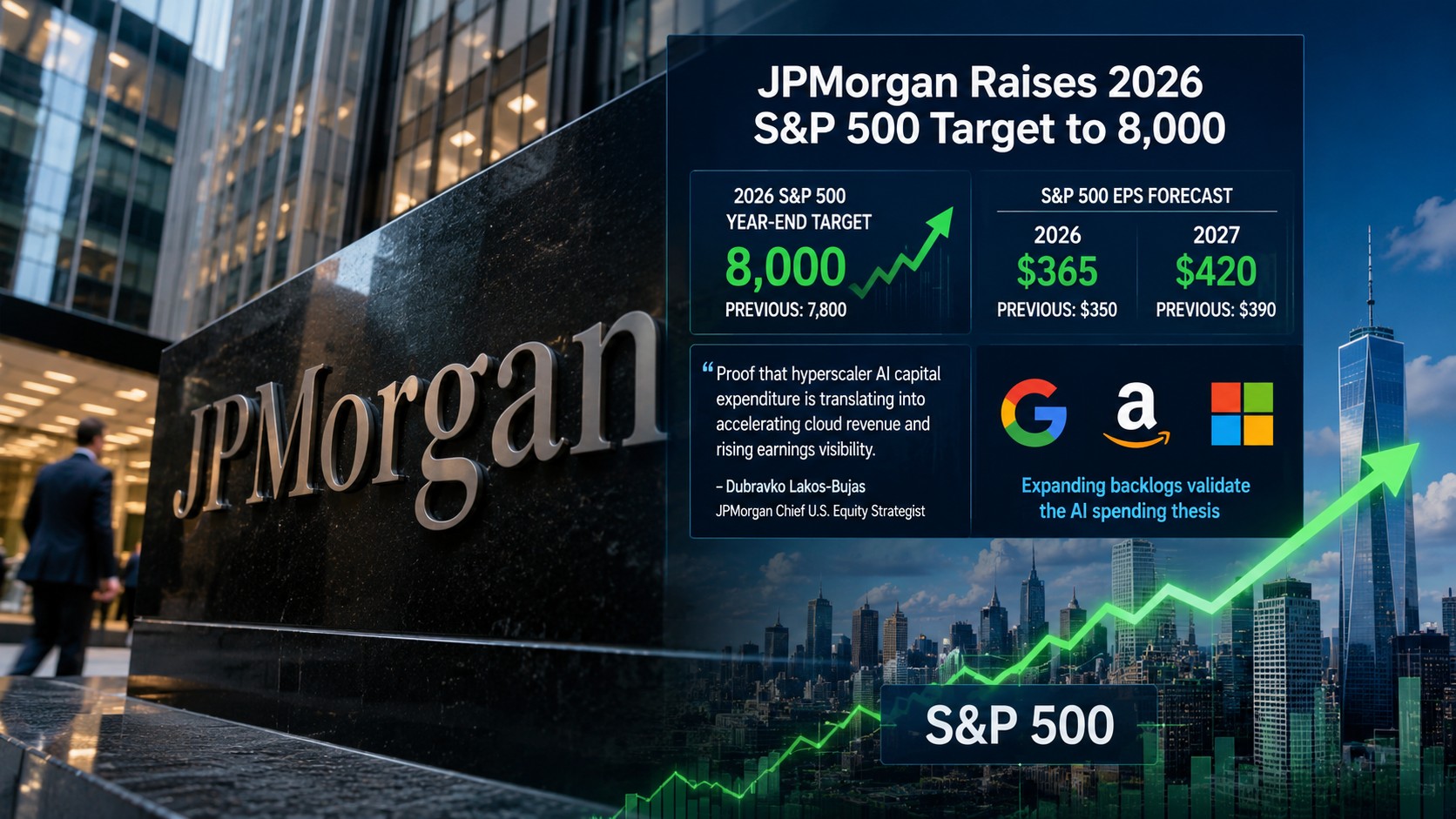
JPMorgan Chase strategists raised their year-end S&P 500 target to 8,000 from 7,800 on Monday, marking the second upward revision in two months and adding to an increasingly crowded chorus of bullish Wall Street calls, with at least seven brokerages now projecting the benchmark will reach that level by December 31, 2026. The new target implies approximately 3.1% upside from Friday's record close of 7,757.64 — itself an all-time high — as the index has climbed 13.3% year-to-date.
The upgrade, authored by team leader Dubravko Lakos-Bujas, rests on a central conviction that the long-debated return on AI investment has now become visible in reported corporate financials. "As elevated backlogs convert into recognised revenue, cloud growth should remain well supported, helping validate rising AI capex, strengthen order coverage, and further ease ROIC concerns," the JPMorgan note stated. The bank specifically cited Google, Amazon, and Microsoft as the clearest examples: all three reported Q2 2026 results that surprised to the upside, with shares rising post-earnings as investors grew more comfortable with returns on AI spending, aided by strong cloud growth and improving cash-flow outlooks.
Alongside the index target, JPMorgan revised its S&P 500 earnings-per-share estimates upward in both years under coverage. The 2026 EPS forecast rises to $365 from $350, and the 2027 estimate climbs to $420 from $390 — implying roughly 15% earnings growth next year even from an elevated base. The broader earnings backdrop supports the revision: LSEG data showed that 85.1% of the 436 S&P 500 companies that had reported June-quarter results by Friday beat analyst estimates, well above the long-term average beat rate of 68% since 1994. Corporate earnings have now surged approximately 32% in one of the strongest earnings seasons on record.
The structural case for the upgrade rests on AI capital expenditure trajectory. JPMorgan projects that AI spending will account for well over half of total S&P 500 capex of $1.5 trillion in 2026 — a proportion the bank expects to grow further in 2027. Strategists at Citigroup, Deutsche Bank, and Goldman Sachs are similarly positioned among the most bullish voices on U.S. equities, with the Bloomberg consensus of 20 strategists now placing the S&P 500 at approximately 7,845 by year-end — a figure the JPMorgan upgrade now sits comfortably above.
The upgrade lands in a week heavy with macro and earnings catalysts that could sharpen the market's directional signal. The July CPI report prints Wednesday, August 12, at 8:30 a.m. ET — with consensus expecting headline inflation to moderate further as energy prices ease alongside the partial progress in Iran-Oman Hormuz negotiations. July PPI follows Thursday and retail sales on Friday. Earnings catalysts are equally dense: CoreWeave reports Q2 results after the close Tuesday, followed by Applied Materials and Cerebras Systems on Wednesday, and Cisco Systems later in the week. The week's macro data and earnings combined represent the clearest near-term test of the AI monetization thesis JPMorgan has staked its revised target on.
For investors, the upgrade confirms a risk-on setup dominated by long-duration AI growth trades. Breadth has been improving — the S&P 500 finished Friday at an all-time high of 7,758, the Nasdaq gained 1.3%, and the Dow added 152 points — following last Friday's weaker-than-expected July jobs report that showed nonfarm payrolls unexpectedly falling by 23,000, reducing concern about Fed rate hike risk and allowing yields to ease. The dollar dipped to a two-month low, providing an additional tailwind for multinational earnings. The primary risk to the bullish thesis remains a Hormuz breakdown or a CPI surprise that revives rate-hike expectations before the September FOMC meeting.