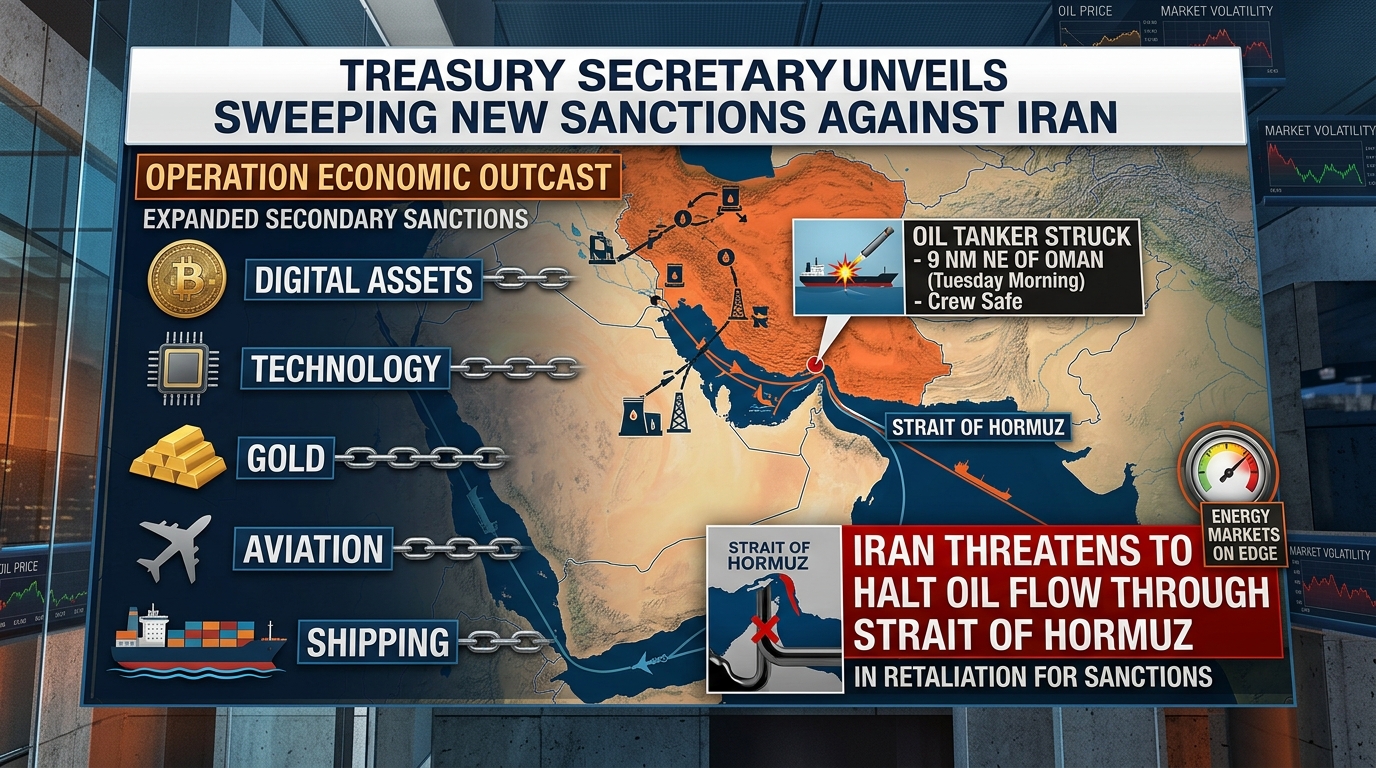
U.S. Treasury Secretary Scott Bessent unveiled a sweeping new round of sanctions against Iran on Monday, an initiative the administration has dubbed Operation Economic Outcast, as tensions over the country's oil exports and nuclear ambitions continued to escalate. Bessent called the measures an "economic onslaught" aimed at severing "every economic lifeline that sustains this tyrannical regime."
The new sanctions expand the categories subject to secondary sanctions to include digital assets, technology, gold, aviation and shipping, areas the Treasury Department said Iran has used to generate revenue, evade existing sanctions and blunt economic pressure. The department also sanctioned nearly 60 entities, individuals and vessels tied to illicit procurement of nuclear and missile technology, cyber operations and oil smuggling, and suspended several previously issued licenses that had allowed certain payments to Iran.
Bessent said he had not set a compliance deadline but warned that "we do not have infinite patience," and that the campaign's objective was to isolate Iran economically to the point that force might not be necessary. He added that no country, including China, is exempt from the reach of the new measures, a signal that Washington may be prepared to escalate friction with Beijing over its continued purchases of Iranian oil.
The sanctions news came alongside a fresh security incident in the region. An unidentified projectile struck and disabled an oil tanker approximately nine nautical miles northeast of Oman's Ash Shishah early Tuesday, damaging the vessel's engine room, according to the United Kingdom Maritime Trade Operations agency. The crew was reported safe, and the environmental impact was not immediately known. UKMTO advised vessels transiting the area to exercise caution and report suspicious activity.
Iran's Supreme National Security Council chief, Mohsen Rezaei, has threatened to halt oil flow through the Strait of Hormuz entirely in response to the tightening sanctions, warning that "not even a single drop of oil will leave the region" if neighboring countries cooperate with the U.S. pressure campaign. Iran has continued to allow some Iraqi oil tankers to pass through the strait even as the threat remains in place, and energy exports from the Gulf have already suffered significant disruption since the closure measures began.
The developments add a fresh layer of geopolitical risk to energy markets already grappling with the broader Middle East conflict, now approaching its sixth month. Gulf nations that have invested heavily in pipeline infrastructure designed to bypass the Strait of Hormuz have not yet commented publicly on the latest U.S. sanctions push. Analysts said the combination of expanded secondary sanctions and continued attacks on shipping in the region is likely to keep a geopolitical risk premium embedded in oil prices in the near term, even as the underlying supply-demand picture remains uncertain.
Investors are also watching for signs of how China, Iran's largest oil customer, responds to the threat of secondary sanctions, since its cooperation or resistance could determine how effective the latest pressure campaign proves to be in practice.