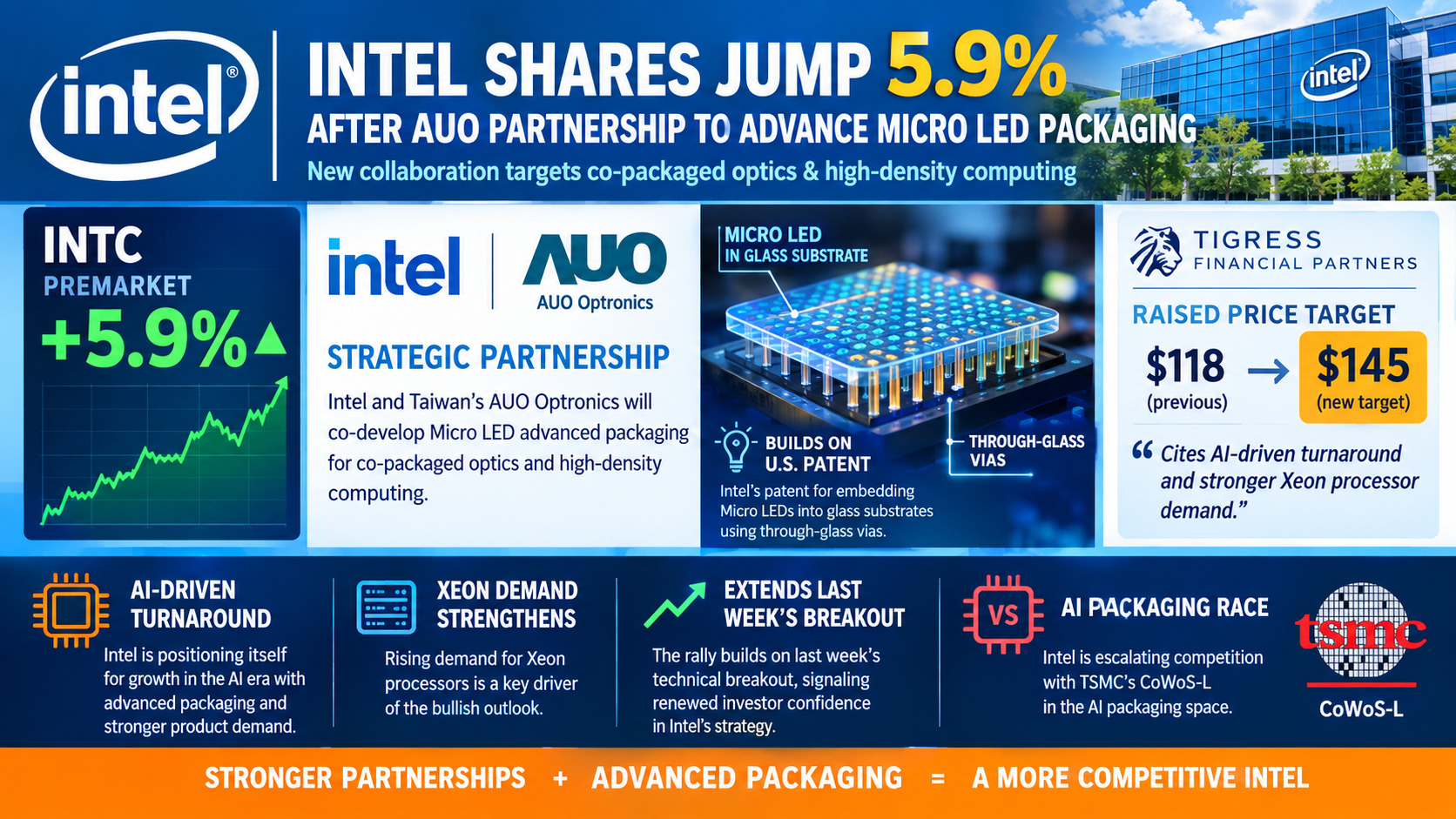
Intel Corporation shares surged 5.9% in premarket trading Monday, extending a breakout rally that began last week, after multiple reports confirmed the chipmaker is deepening ties with Taiwanese display giant AUO Optronics to co-develop Micro LED advanced packaging technology.
The partnership targets co-packaged optics (CPO) and high-density computing integration, two of the fastest-growing segments in AI infrastructure buildout. According to Taiwan's Economic Daily News, industry insiders say Intel has already secured a U.S. patent titled "IC Package with Micro LEDs," which describes embedding semiconductor chips at least partially within glass substrates while simultaneously embedding through-glass vias (TGVs) that electrically couple to Micro LEDs for power delivery.
AUO, historically a display-panel manufacturer, has spent the past year pivoting toward advanced packaging, working alongside ecosystem partners Ennostar, Tyntek, Daxin Materials, and Corning on Micro LED CPO modules and glass-core substrate technology. AUO's chairman Peng Shuanglang told investors the company has "completed its strategic layout" in advanced packaging and glass substrates, and analysts say the overlap between AUO's existing capabilities and Intel's patented approach suggests a formal collaboration could be close to materializing.
Wall Street responded swiftly. Tigress Financial Partners raised its price target on Intel to $145 from $118, citing what the firm called an AI-driven turnaround alongside stronger-than-expected demand for Intel's Xeon processor line. The upgrade adds to a wave of renewed analyst optimism around Intel's foundry and packaging ambitions, which have struggled for years to keep pace with rival TSMC.
The stock's move also comes against a broader market backdrop that has turned more favorable for risk assets. Reduced uncertainty around the Federal Reserve's rate path, combined with a constructive tone toward AI-linked equities, has encouraged investors to add exposure to semiconductor names heading into the new trading week. Chipmakers broadly outperformed in premarket trading as the Nasdaq-100 futures rose more than 1%.
Industry analysts note that Intel's push into Micro LED-based packaging positions the company to compete more directly with TSMC's CoWoS-L technology, which research firm TrendForce expects to remain the dominant AI packaging standard through 2028. Nvidia and AMD currently rely on CoWoS-L, with hyperscalers including Meta, AWS, and Microsoft also adopting the technology. If Intel's Micro LED approach with AUO gains traction, it could offer the company a genuine differentiator in optical interconnects for next-generation AI data centers, a segment expected to see explosive capital spending over the coming years.
For AUO, the potential tie-up represents a strategic opportunity to migrate away from a commoditized display panel business — one that carries painful memories of a $500 million U.S. antitrust fine over LCD price-fixing more than a decade ago — and into higher-margin, higher-growth advanced packaging. AUO has already committed roughly NT$8.64 billion in capital expenditure toward through-glass via, redistribution layer, and glass-core pilot production lines, while partner Tyntek has earmarked NT$1.2 billion for 800G and 1.6T optical applications.
Neither company has issued an official joint statement confirming the scope or timeline of the partnership, and details remain based on patent filings and industry sourcing rather than a formal announcement. Still, the market reaction underscores how sensitive investors have become to any signal of expanded AI packaging capacity, with Intel emerging as one of the more actively traded large-cap names of the session.