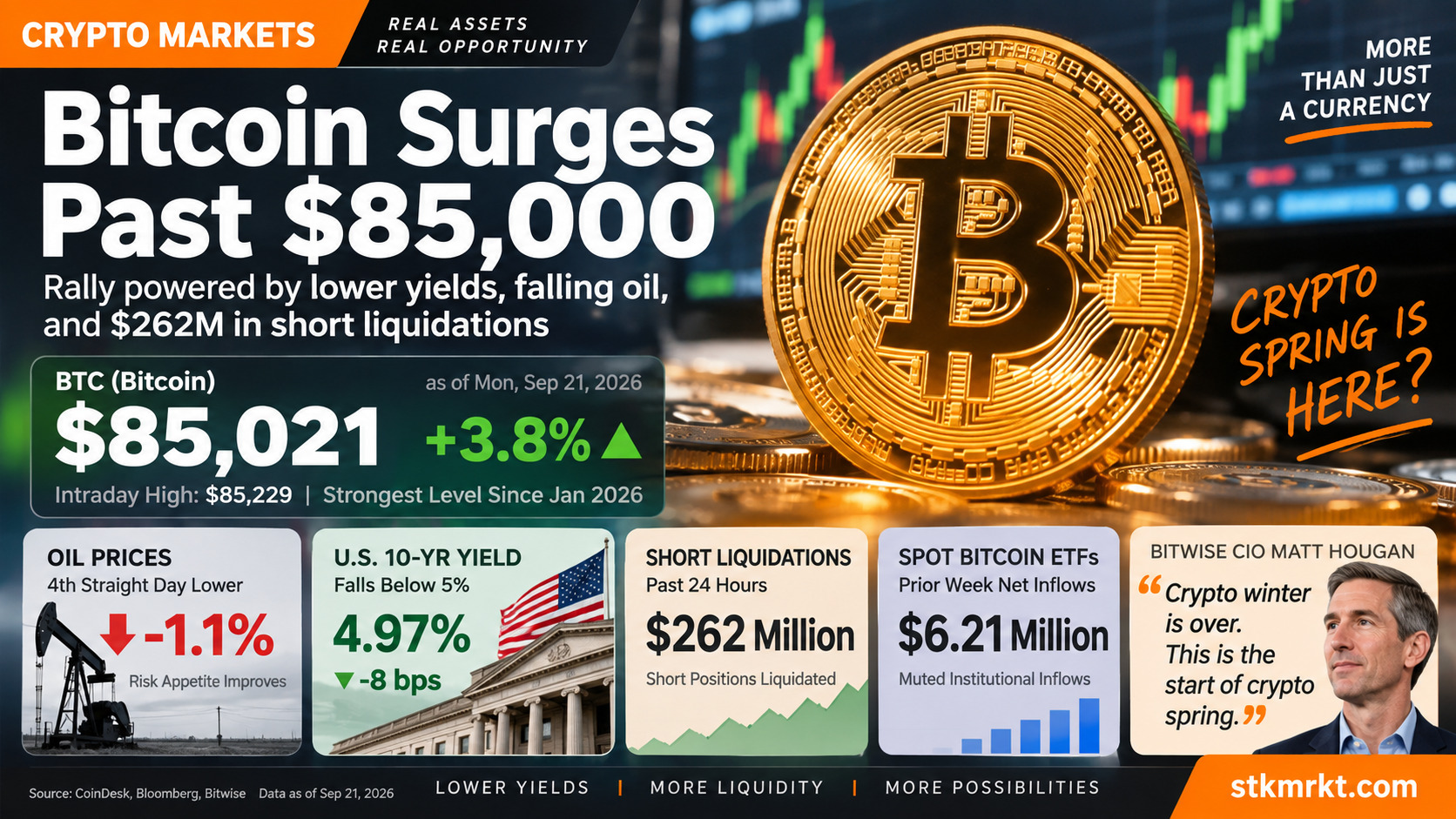
Bitcoin pushed above $85,000 on Monday, rising as much as 3.8% intraday to $85,229 — the highest level the cryptocurrency has traded at since late January — as a wave of favorable macro developments converged to fuel one of the sharpest rallies of the year.
The advance builds on a powerful weekly close. Bitcoin ended last week above its 50-week moving average for the first time in 45 weeks, a technical milestone traders had been watching closely as a signal of a potential trend reversal. According to CoinMetrics data, the token was trading around $84,256 shortly after 6:35 a.m. ET before extending gains through the session.
Three catalysts are driving the move, according to market strategists. First, Brent crude fell for a fourth consecutive session, dropping roughly 2% to about $102 a barrel — its longest losing streak in three months — as reports suggested more oil supply was leaving the Gulf than previously believed despite the ongoing regional conflict. Falling oil prices have eased inflation concerns, pulling the 10-year Treasury yield back below the psychologically important 5% threshold and making non-yielding assets like Bitcoin relatively more attractive to hold.
Second, the strong weekly close above the 50-week average appears to have triggered a wave of forced short covering. Roughly $262 million in short positions were liquidated as bitcoin broke higher, according to data cited by 24/7 Wall St., with total 24-hour liquidations across the crypto market topping $769 million and more than 115,000 traders affected, according to CoinPedia.
Third, easing geopolitical tension added to the risk-on tone. Reports indicated President Trump decided against authorizing U.S. strikes on Houthi positions in Yemen over the weekend, reversing an earlier order after Saudi Arabia's Crown Prince urged intervention. Yemen's Houthi movement responded by saying it would not target U.S. vessels in the Red Sea, further calming fears of a wider Middle East conflict that could disrupt energy supplies.
"I do think it's over — it's crypto spring, the crocuses are blooming," Bitwise CIO Matt Hougan said on CNBC's "Squawk Box Europe," predicting what he called the strongest and longest-running bull market in the asset's history. Bitcoin remains down for the year but has climbed more than 7% over the last five trading days and nearly 35% over the past three months, according to CoinDesk data.
Not every signal is unambiguously bullish. Institutional demand has notably lagged the price action: spot Bitcoin ETFs recorded net inflows of just $6.21 million for the week ended September 19, a sharp slowdown after outflows of $746 million on September 15 and 16. Technical indicators also flag the move as stretched, with the daily relative strength index near 71.5 and the hourly RSI above 84, both in overbought territory, while the price trades outside its upper Bollinger Band on multiple timeframes.
Traders are now watching whether Bitcoin can hold above the $82,000 support zone on any pullback, with BTIG analysts targeting a push toward $90,000 as long as the $75,000 level continues to hold. The next major test comes September 26, when the U.S. releases its August PCE inflation report — a data point that could either extend the rally or trigger a sharper reversal if it surprises to the upside.