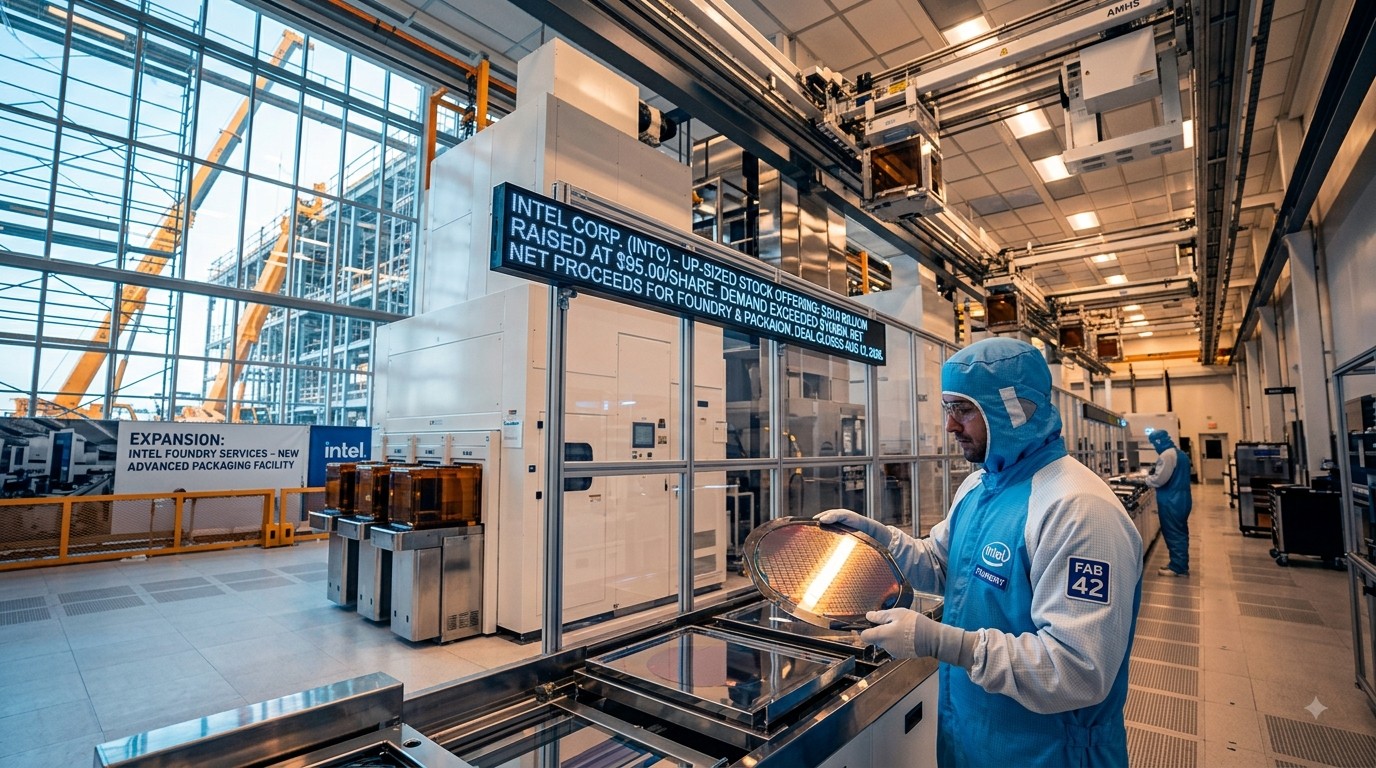
Intel Corporation priced an upsized $20 billion common stock offering at $95 per share on Tuesday, raising its target by a third after investor demand for the deal reportedly topped $100 billion. The chipmaker had initially announced a $15 billion offering on Monday morning, but strong institutional interest pushed underwriters to increase the size of the sale before it was finalized.
The offering, which is expected to close on August 12, 2026, will generate approximately $19.7 billion in net proceeds after underwriting discounts and expenses. Intel said it plans to use the money for general corporate purposes, including capital expenditures and working capital, as the company races to expand its foundry business and advanced packaging capacity to meet surging demand for AI compute.
Underwriters were granted a 30-day option to purchase an additional 31.6 million shares, a provision that could push total proceeds even higher if exercised. The pricing represented roughly a 6.5% discount to Intel's prior closing level, a common structure for large secondary offerings designed to ensure the deal clears the market smoothly.
The upsized sale comes at a striking moment for Intel. Shares of the company have surged nearly 175% so far in 2026 and have roughly quintupled over the past year, as investors have grown more confident in the chipmaker's manufacturing turnaround. That rally has been fueled by a combination of factors, including a 10% U.S. government equity stake aimed at bolstering domestic semiconductor production, a $5 billion investment from Nvidia, and a $2 billion stake from SoftBank.
Despite an initial 4% pullback in Intel shares on Monday tied to dilution concerns, the reaction among institutional investors told a different story. Orders for the offering reportedly reached $100 billion, an oversubscription ratio that dwarfs typical secondary equity deals and suggests large investors view Intel's artificial intelligence-driven growth as outweighing the roughly 3% dilution to existing shareholders from the new share issuance.
Intel has been positioning itself as a domestic alternative to Taiwan Semiconductor Manufacturing Company in advanced contract chip manufacturing, an area where U.S. policymakers have pushed for greater independence from overseas suppliers. The company raised its 2026 capital expenditure forecast from $18 billion to $20 billion in July, and it has committed to high-volume production using its next-generation 14A manufacturing process starting in 2028, contingent on securing a major external customer.
Intel's foundry unit has already won Tesla as a 14A customer, and speculation has grown around a potential relationship with Apple after comments from President Donald Trump suggested the iPhone maker could manufacture processors with Intel, though neither company has confirmed such an arrangement. Last month, Intel also announced a roughly $5.8 billion investment to expand chip manufacturing capacity in Ireland, representing more than a quarter of its planned capital spending for 2026.
Analysts covering the semiconductor sector broadly framed the offering as a sign of the times. Technology companies are on pace to spend roughly $765 billion on AI infrastructure in 2026, according to estimates from Goldman Sachs, with that figure projected to climb to $1.2 trillion in 2027. That level of capital intensity has pushed even well-funded companies like Intel to tap public markets for additional cash, even as investors remain sensitive to the dilutive effects of large stock sales.
For now, Wall Street's verdict appears to favor Intel's growth story over near-term dilution concerns. The stock's performance in the days following the offering's close on August 12 will offer an early read on whether that institutional enthusiasm translates into sustained investor confidence.