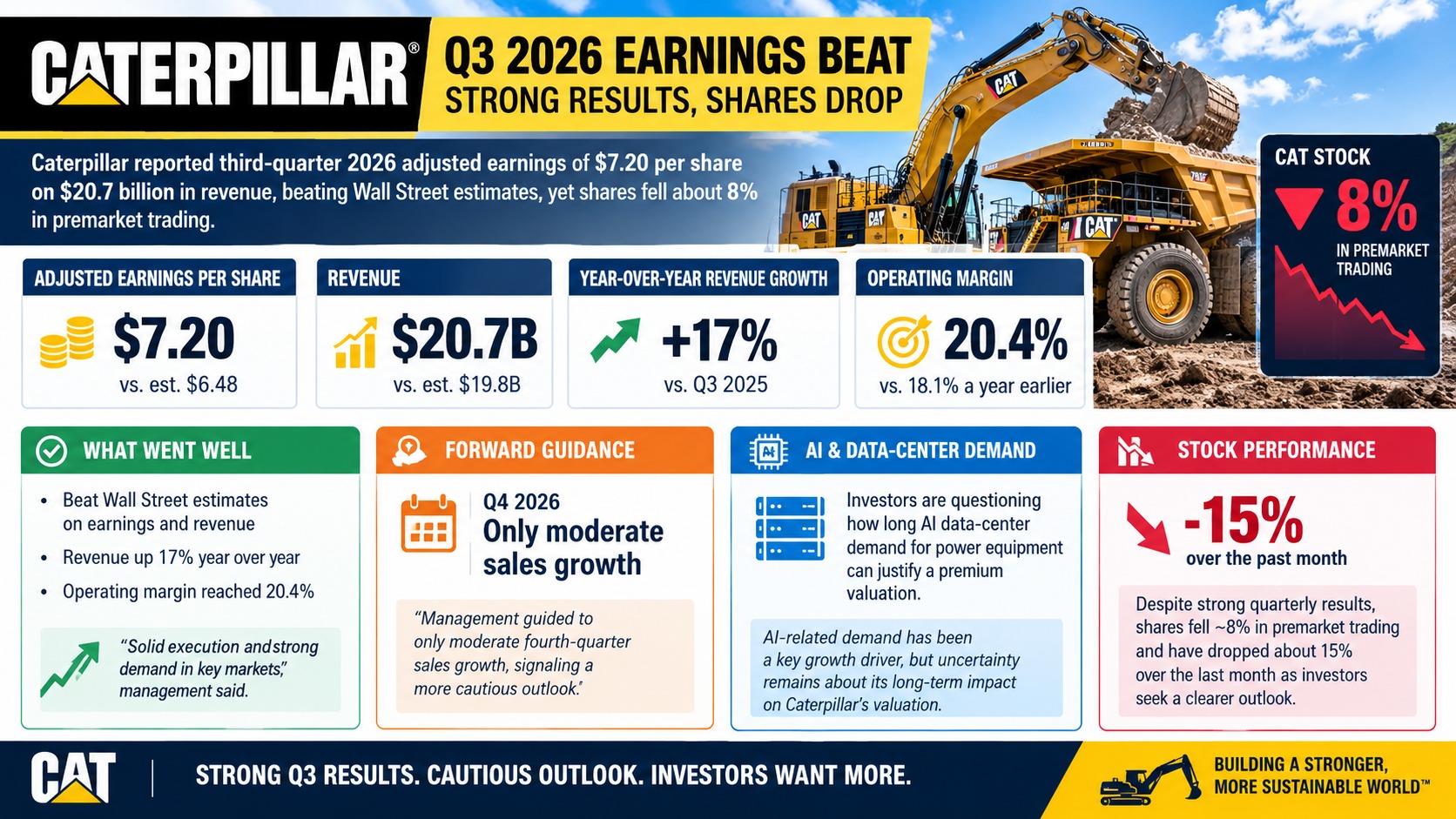
Caterpillar reported third-quarter 2026 results on Thursday that cleared Wall Street's estimates, yet the stock fell sharply before the open. Adjusted earnings were $7.20 per share, up from $4.95 a year earlier and above the $7.03 consensus, while revenue rose about 17% to $20.7 billion, in line with the $20.69 billion estimate. Premarket declines ranged from about 6% to more than 8% depending on the report, and one data provider showed shares falling as much as 9.5% to roughly $645 right after the release.
Chairman and CEO Joe Creed pointed to strong order rates and a record backlog as evidence of resilient end markets. Higher sales volume added $2.2 billion to the quarter's revenue increase and favorable price realization contributed $663 million. Reuters reported that profit was helped by demand for backup power equipment, turbines and construction equipment, part of a group of industrial companies benefiting from the AI-driven expansion of U.S. data centers. The operating margin was 20.4%, up 3.1 percentage points from a year earlier, according to StockStory data.
Investors had wanted more. Caterpillar's outlook for the fourth quarter called for moderate sales growth compared with the fourth quarter of 2025, which the market read as a deceleration for a stock that had traded as high as $1,073.46 within the past year. Investing.com reported that investors appeared disappointed by the margin outlook and by uncertainty over how durable the AI infrastructure boom will prove, prompting a reassessment of how much premium to assign to the company's data-center and power-generation exposure.
The reaction extends a slide that began well before the report. Shares fell about 15% over the month before earnings, and by one measure were roughly 20.8% lower between July 24 and October 22 while the S&P 500 gained 3.7%. The stock closed at $686.79 on October 23 and traded near $716 in after-hours trading Wednesday. Pre-report commentary pointed to a joint FTC and USDA inquiry into agricultural equipment markets, rising bond yields and inflation worries as pressure points. Bernstein analyst Chad Dillard had said he expected an easy beat but anticipated a downshift in bookings momentum that he believed was not reflected in the valuation.
The fundamentals the market was watching remain sizable. Backlog stood at $72 billion at the end of June, up 92% from a year earlier, with 59% scheduled to ship within 12 months, and power generation sales rose 72% in the second quarter on data center demand. Tariffs are a continuing cost: management had guided to about $600 million of tariff costs in the third quarter and roughly $2.2 billion for the full year, and expected to reduce dealer inventory by more than $1 billion in the fourth quarter.
For portfolio positioning, the gap lower resets expectations for AI-linked industrials but does not change the backlog math. Traders may watch whether the stock holds near its post-earnings range, whether bond yields near 5% keep pressuring cyclical valuations, and how Thursday's GDP and inflation data shape the interest-rate path. Caterpillar is a Dow component, and Dow futures edged lower on the move, offering a read on how far the pullback in AI-exposed industrial names could extend.
This article is for informational purposes only and is not investment advice.