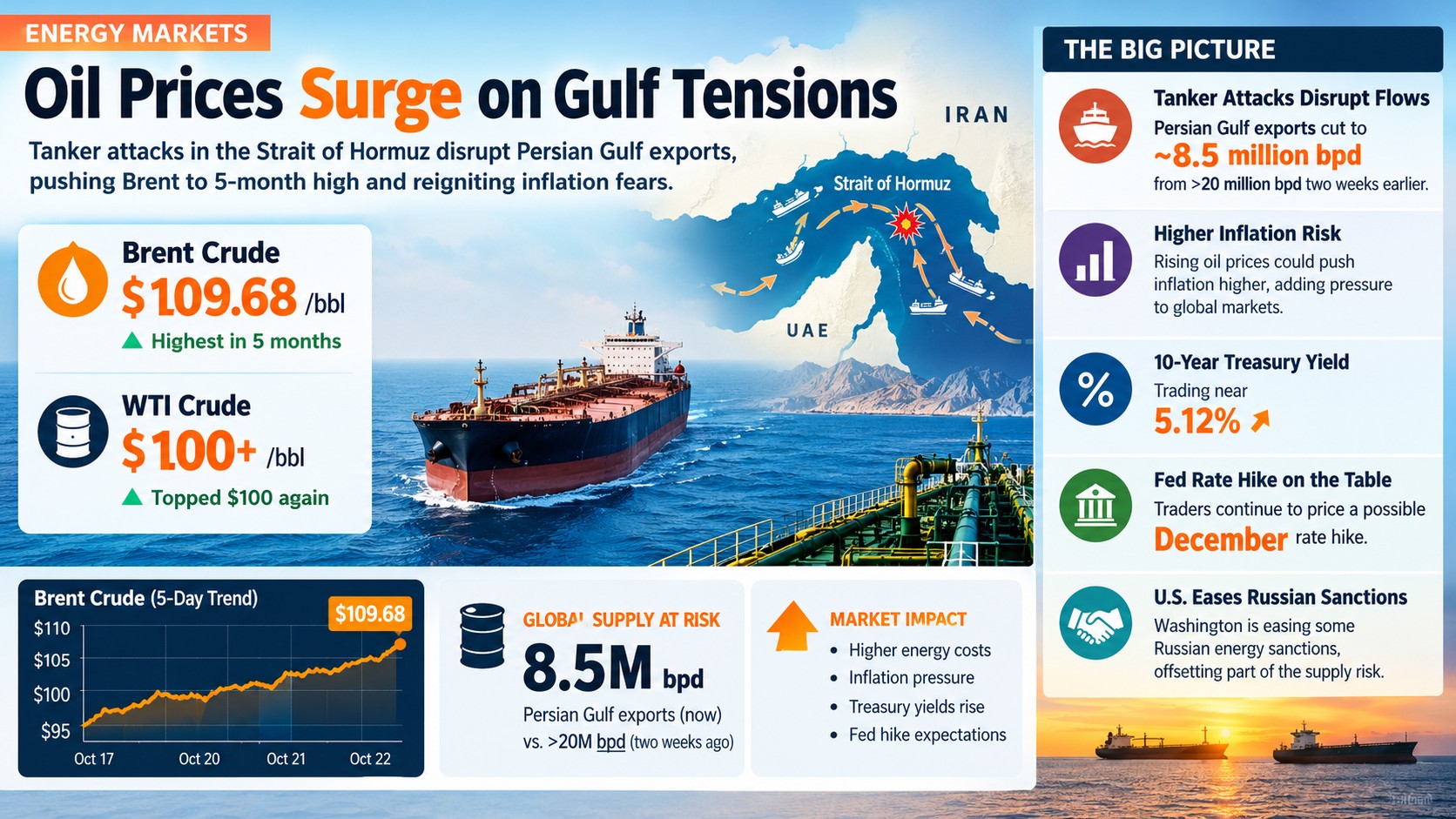
Brent crude futures traded between roughly $109 and $111 a barrel in early Tuesday dealings, the highest level since May, as renewed attacks on tankers in the Strait of Hormuz and Houthi strikes on Saudi Arabia revived fears of a prolonged supply shock. West Texas Intermediate climbed back toward or above $100 a barrel. Brent has gained roughly 80% since the start of the year, and the latest leg higher has landed on a market already wrestling with doubts about artificial-intelligence spending and elevated bond yields.
Shipping data explains the move. Kpler, the commodity analytics firm, told Reuters that at least 18 tanker attacks have occurred over the past two weeks, and that the daily flow of crude leaving the Persian Gulf has dropped to about 8.5 million barrels from more than 20 million barrels two weeks ago. Separately, UKMTO figures show weekly transits through the Strait of Hormuz down about 70% to 254 vessels. The reversal is notable because Kpler had reported earlier this month that exports had recovered to pre-war levels.
Policy responses are pulling in the opposite direction. President Donald Trump signed an executive order on Friday waiving some sanctions and tariffs tied to Russian energy exports, including an arrangement involving Russian diesel shipments to the United States, and Washington has planned releases of fuel from reserves. OPEC output also rose in September, led by Saudi Arabia and Iraq. Analysts quoted by Reuters and other outlets argue these steps do little to fix the physical bottleneck in the Gulf, which is why crude shrugged off a session swing of more than $3 on Monday and settled at $109.55.
The macro transmission is the central issue for equity investors. The 10-year Treasury yield sits near 5.12%, and Nordfx notes in its market wrap that the Federal Reserve is expected to hold rates at its October 27 to 28 meeting while a December hike is heavily priced in. Higher energy costs feed headline inflation and complicate any path toward easier policy. Gold, around $4,133 an ounce, slipped in early trading, while the dollar-yen rate near 158 is a reminder of currency strains elsewhere.
Equity indexes have so far held up better than the commodity tape suggests. The S&P 500 closed Monday at 7,690.73, up 0.41%, the Dow Jones Industrial Average slipped 0.07% to 51,966.03, and the Nasdaq Composite gained 1.11% to 26,430.89, according to Investrade. Futures were mixed early Tuesday, with Dow futures higher and Nasdaq futures down about 0.5%. European shares fell on Monday, with the DAX down 1.2% and the FTSE 100 down 1.1%, per Nordfx, and Asian markets were broadly lower Tuesday.
Geopolitics remains the swing factor. Reports of a Houthi attack that killed 58 people at a Yemeni security forces training camp, along with strikes on Saudi energy infrastructure, have heightened concerns about regional stability. Russia's foreign minister visited Tehran on Monday, and Iran's foreign minister said regional disputes should be settled through diplomacy while blaming the United States for insecurity around Hormuz. No joint statement on shipping safety had been issued, leaving traders without a clear catalyst for de-escalation.
For a paper-trading book, the practical read is that energy-linked exposure is the cleanest hedge against Hormuz headlines, while rate-sensitive and long-duration growth names carry the most downside if crude pushes toward new highs. Airlines, chemicals and consumer discretionary companies face the sharpest cost pressure. Housing starts data due at 8:30 a.m. Eastern, with a 1.35 million estimate, and weekly API inventory figures after the close are the next scheduled catalysts, but headline risk rather than data will probably set the tone for the session.