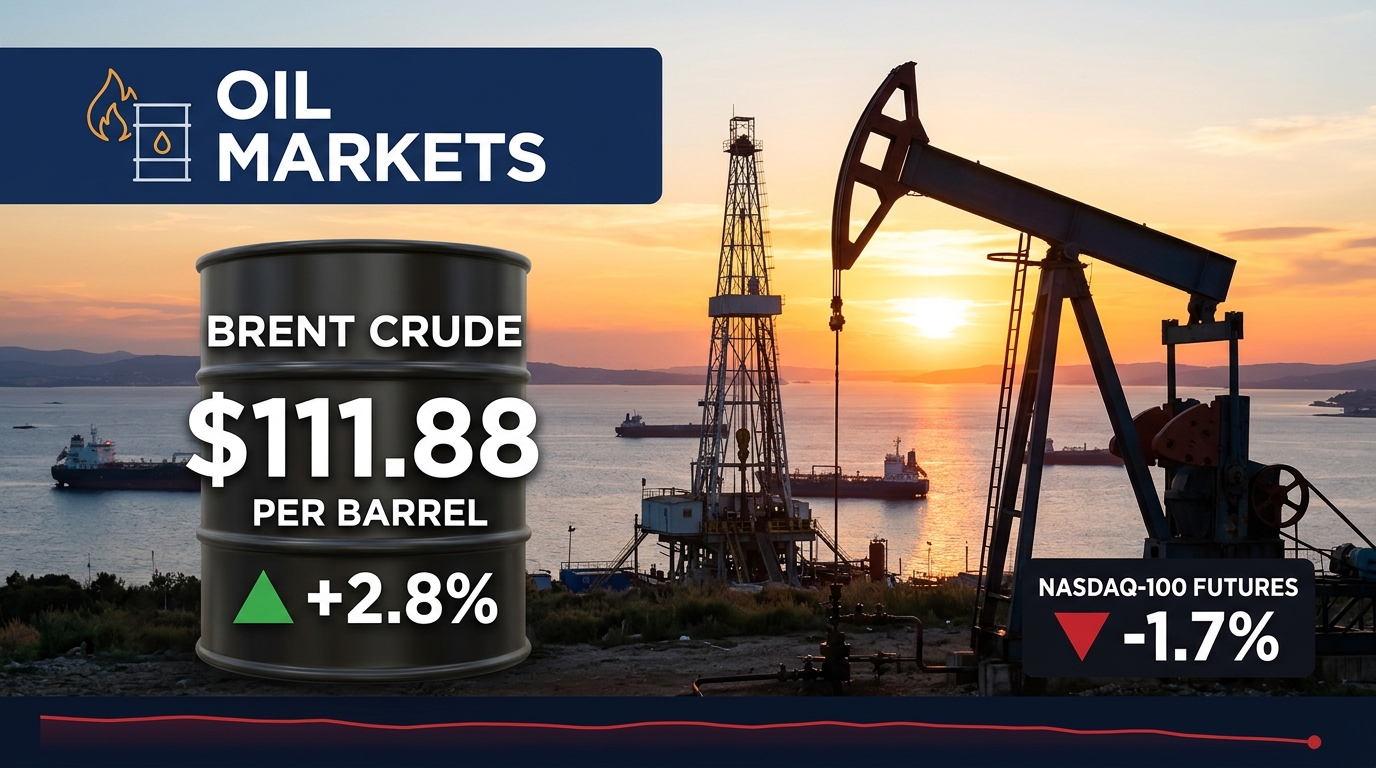
U.S. equity futures pointed sharply lower on Thursday as a fresh jump in crude oil revived inflation and borrowing-cost worries, with energy markets reacting to escalating conflict in the Middle East. Brent crude futures rose 2.8% to $111.88 a barrel after touching their highest level since May, while U.S. West Texas Intermediate climbed 2.4% to $99.48. The move followed additional Houthi attacks in Saudi Arabia, which stoked concerns about a broader escalation and further disruption to supplies from the world’s key exporting region.
Equity futures reflected the shift in tone. Dow futures were down about 0.6% to 0.7% near 52,700, S&P 500 futures were off roughly 1% near 7,720, and Nasdaq-100 futures fell as much as 1.7%, led by semiconductor and broader technology shares that had rallied the previous session. The S&P 500 closed Wednesday up 0.58% at 7,757.17, the Dow rose 0.69% to 52,856.09 and the Nasdaq Composite added 1.05% to 26,702.86, so futures were pointing to a meaningful reversal. The VIX, Wall Street’s fear gauge, rose about 9% to roughly 18.
Rates compounded the pressure. The benchmark 10-year Treasury yield sat between about 5.07% and 5.15% depending on the quote, a level that raises discount rates for long-duration growth stocks and tightens financial conditions for borrowers. Gold fell more than 1% to roughly $4,090 an ounce, and Bitcoin slipped nearly 2% to about $81,800, a sign that investors were selling a broad range of assets rather than rotating into traditional havens.
Geopolitics added to the uncertainty. The New York Times reported that U.S. and Israeli militaries have developed specific plans for renewed strikes on Iran after the American midterm elections, according to U.S. officials and others briefed on the deliberations. Planning is described as focused on a short but intensive operation, and the militaries have stepped up exercises, including flights over Iraq to practice strike maneuvers. Traders read the report as a sign that supply risk in the Gulf may persist well beyond this week.
Asia and Europe traded lower in sympathy. Japan’s Nikkei fell about 2.65% to 62,907, South Korea’s Kospi dropped roughly 3.7%, Hong Kong’s Hang Seng lost more than 3%, and Germany’s DAX and Britain’s FTSE 100 slipped in early trade. India’s Sensex and Nifty also fell for a second straight session, with the Nifty down about 1.1% in morning trading.
For portfolio positioning, the oil shock creates a clear dispersion between sectors. Energy producers, refiners and defense contractors tend to benefit from higher crude and heightened geopolitical risk, while airlines, transport companies, chemical makers and consumer discretionary names face higher input costs. One airline reporting on Thursday cited fuel costs of $3.92 a gallon in the third quarter and assumed roughly $4.55 for the fourth, a vivid illustration of the squeeze.
Data on the calendar included weekly jobless claims, expected near 200,000, continuing claims near 1.72 million, and the Leading Index for September, forecast at a decline of 0.1%. Another heavy day of corporate earnings was also under way. Analysts say the combination of $100-plus oil, a 5% Treasury yield and elevated equity valuations leaves indexes sensitive to any further headline out of the Gulf, in either direction. A de-escalation signal could quickly unwind the energy premium, while a further attack on export infrastructure would likely push Brent higher still.