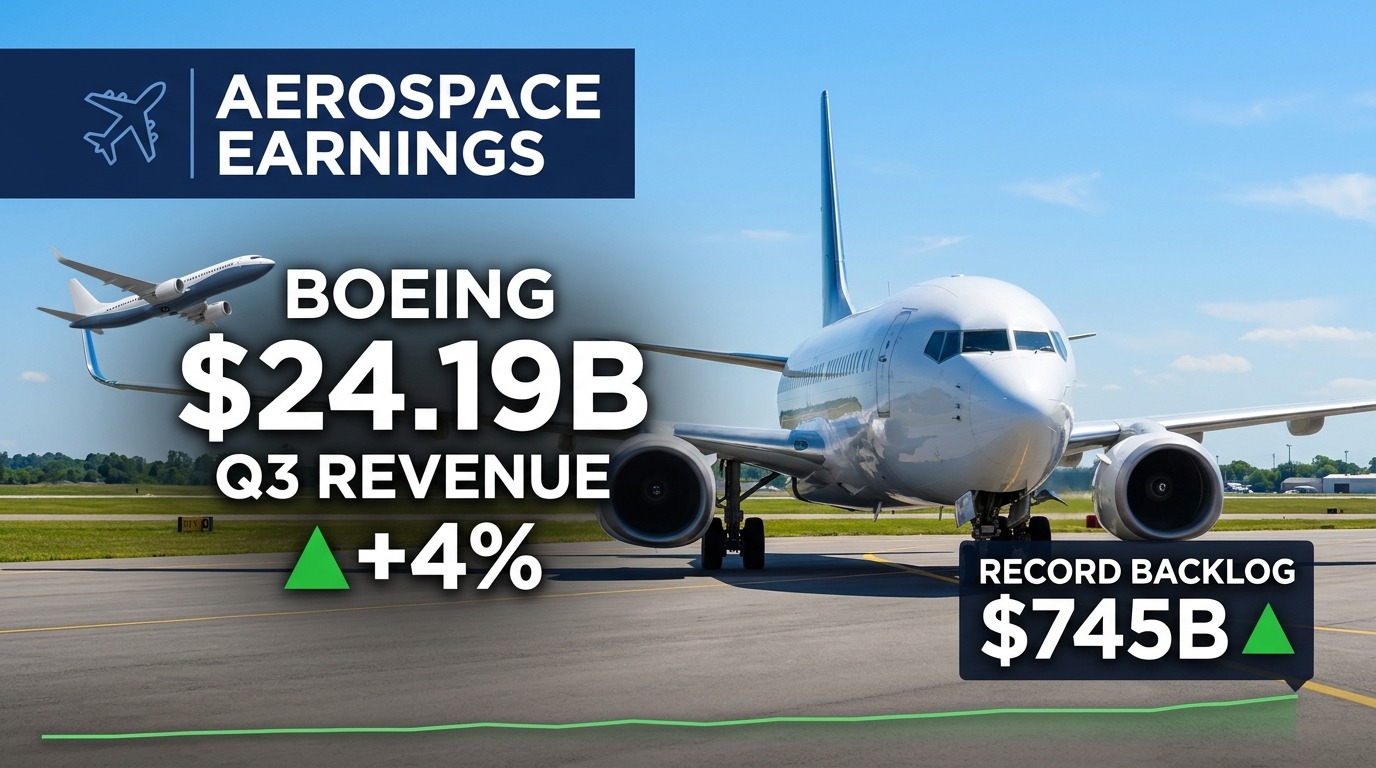
Boeing reported third-quarter 2026 results on Tuesday that showed continued progress in its recovery, with revenue growing, profitability returning at the operating line and backlog reaching a record. Revenue was $24.19 billion, up 4% from $23.27 billion a year earlier. GAAP earnings from operations were $354 million, compared with a loss of $4.78 billion in the third quarter of 2025, a period weighed down by large program charges.
Operating cash flow was $1.5 billion and free cash flow, a non-GAAP measure, was $0.5 billion. Total company backlog grew to a record $745 billion, including more than 6,300 commercial airplanes, giving the manufacturer multiyear visibility on production and delivery volumes.
For the first nine months of 2026, revenue was $70.97 billion, up 8% from $65.52 billion, and GAAP earnings from operations were $958 million versus a loss of $4.50 billion in the same period of 2025. The comparison underscores how much of the improvement has come from the absence of the heavy charges that dominated the prior year.
The company highlighted regulatory and defense milestones. The 737-7 achieved amended type certification from the Federal Aviation Administration, and the 737-10 achieved the same certification in October, clearing two key variants of the 737 MAX family. Boeing was also selected by the U.S. Navy to design, build and deliver the F/A-XX next-generation fighter aircraft, a long-horizon defense program that could support its Defense, Space and Security business for years.
Boeing had previously disclosed on October 13 that it delivered 161 commercial airplanes in the quarter, including 124 737s, 22 787s, 10 767s and 5 777s, along with 33 defense and space units. Year to date, commercial deliveries total 475 airplanes, a useful reference point for judging how quickly backlog is converting into revenue.
CEO Kelly Ortberg and Chief Financial Officer Jay Malave were scheduled to discuss results and the company outlook on a call at 10:30 a.m. ET. Investors will look for updates on 737 production rates and cash-flow expectations for the fourth quarter, topics a brief summary table cannot fully answer.
For traders, the stock’s reaction will depend on how the details compare with expectations that were not available in the initial company release, such as core earnings per share. The strategic story is clearer: a backlog of $745 billion and a return to operating profit support the turnaround thesis, but free cash flow of only $0.5 billion on $24.19 billion of revenue shows how much repair work remains. Macro factors also matter, because oil near $115 per barrel raises fuel costs for airline customers and the Federal Reserve’s Wednesday decision could influence capital-intensive industrials. Position sizing should reflect that mix of improving fundamentals and a still-thin cash cushion.