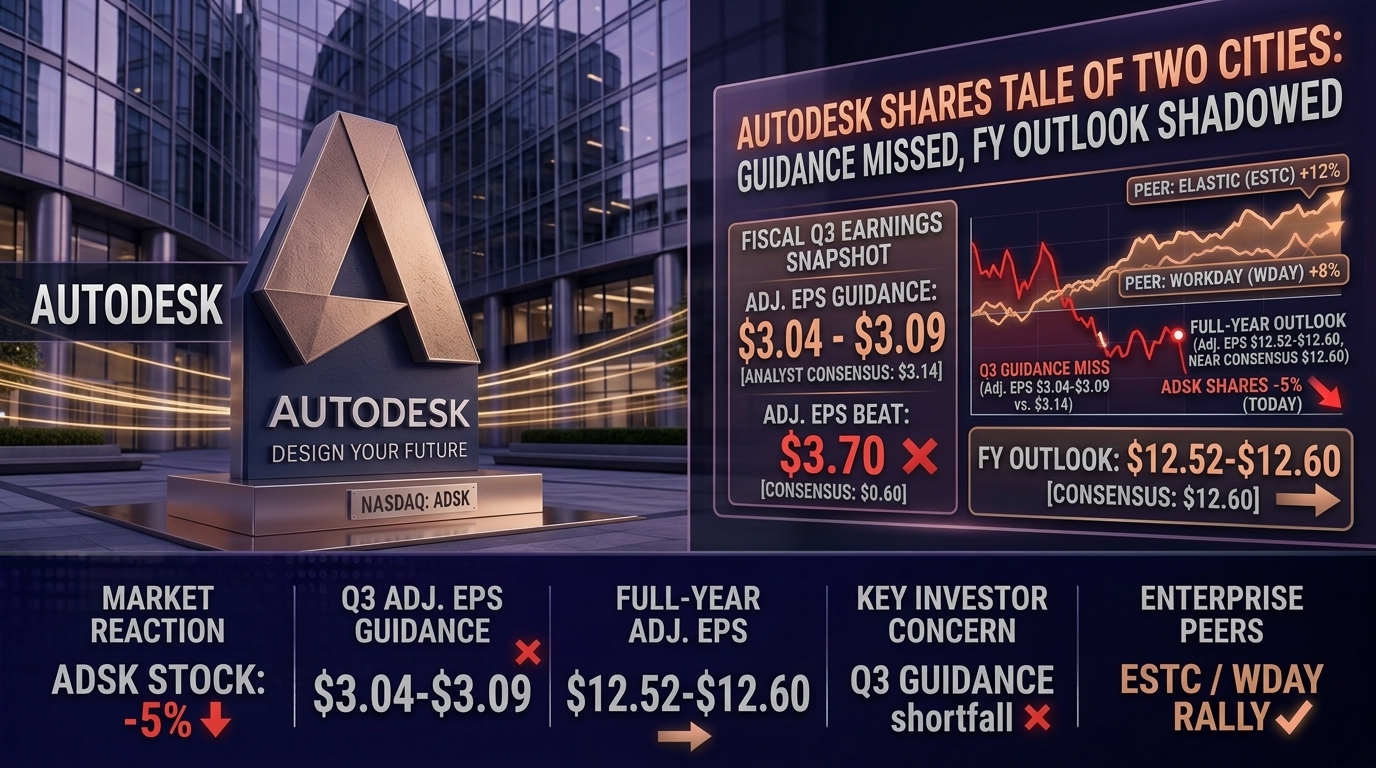
Shares of Autodesk fell 5% after the design and engineering software maker issued third-quarter earnings guidance that disappointed Wall Street, even as the company's full-year outlook came in largely in line with expectations.
The company projected adjusted earnings per share of $3.04 to $3.09 for the third quarter, below the $3.14 analysts polled by LSEG had been expecting. The guidance shortfall overshadowed Autodesk's full-year adjusted earnings guidance, which the company set at $12.52 to $12.60 per share, essentially matching the $12.60 consensus estimate heading into the report.
The disconnect between a roughly in-line full-year outlook and a disappointing near-term quarterly guide left investors uncertain about the timing and drivers of the shortfall, a dynamic that has weighed on shares of several software companies this earnings season even when full-year targets remain intact. Autodesk, whose flagship products include AutoCAD and other design tools widely used across architecture, engineering, construction and manufacturing industries, has been navigating a multi-year transition of its licensing model alongside broader macroeconomic headwinds affecting capital spending in some of its end markets.
Thursday's decline came amid a broader, sharply divergent session for enterprise software earnings. While Autodesk shares fell, Elastic surged more than 20% and Workday also traded higher after both companies posted results and guidance that topped Wall Street expectations. The contrast underscores how selectively investors are treating software earnings this quarter, rewarding companies that pair current-quarter beats with accelerating forward bookings metrics while punishing even modest guidance shortfalls elsewhere in the sector.
Analysts will be watching Autodesk's upcoming commentary for more detail on which end markets or geographies are driving the softer near-term guidance, particularly given the company's exposure to construction and manufacturing sectors that can be sensitive to broader economic conditions and interest-rate trends. Autodesk has also been working to expand its cloud-based and subscription offerings, a transition that has generally supported more predictable, recurring revenue streams even as it can create near-term guidance volatility as the mix of business shifts.
The stock's decline adds Autodesk to a growing list of software companies whose shares have moved sharply this week in reaction to earnings, alongside chipmaker Marvell Technology, cybersecurity firm Rubrik, and enterprise software peers Elastic and Workday, all of which reported results within a roughly 24-hour window. The divergent reactions across this cluster of reports illustrate how the market is drawing increasingly fine distinctions between companies based on the durability of their forward guidance rather than simply rewarding revenue and earnings beats in isolation.
Investors will look to Autodesk's next quarterly update for confirmation of whether Thursday's guidance shortfall reflects a temporary timing issue or the start of a more sustained deceleration in demand across the company's core design and engineering software markets.
Despite Thursday's pullback, Autodesk shares remain higher for the year to date, and some analysts characterized the decline as a reasonable reaction to a modest guidance miss rather than a signal of a broader deterioration in the company's underlying business fundamentals.