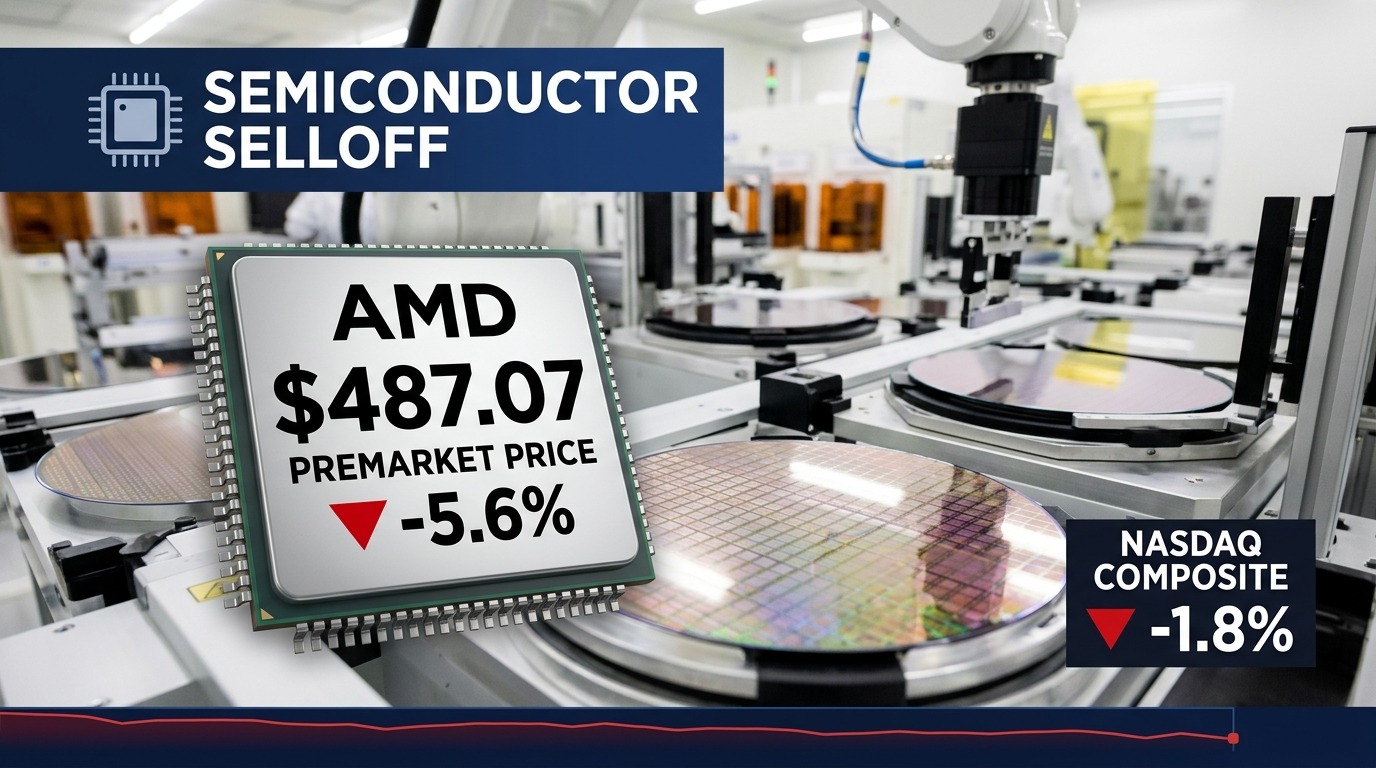
AMD shares fell 5.6% to $487.07 in premarket trading Monday, one of the sharpest individual declines among semiconductor stocks as the sector absorbed the fallout from a weekend essay by Anthropic CEO Dario Amodei calling for a slower pace of frontier AI development. OpenAI's Sam Altman and Elon Musk both publicly backed the proposal, and the rare alignment among rival AI executives unsettled investors positioned in chip stocks tied to the AI infrastructure buildout.
Unlike many of AMD's recent moves, Monday's decline was not tied to a company-specific announcement, earnings update, or analyst rating change. Instead, the selling reflected a broader reassessment of whether the AI capital spending cycle that has driven chip demand can continue at its current pace if major labs begin deliberately moderating how quickly they push out more capable models. AMD has been one of the primary beneficiaries of that spending cycle, with its MI-series AI accelerators and EPYC server processors central to its growth narrative over the past two years.
The decline extended a pattern of volatility that has gripped AI-linked chip names throughout August and into mid-September, as investors have repeatedly cycled between enthusiasm over AI demand and concern that valuations have run ahead of near-term fundamentals. AMD's stock has still posted substantial gains over the past year, but Monday's move highlighted how quickly sentiment can shift when a high-profile voice like Amodei's injects new uncertainty into the outlook for AI infrastructure spending.
AMD was not alone. The broader PHLX Semiconductor Index also declined, with peers across the chip sector under pressure Monday morning. Selling pressure was accompanied by weakness across the wider technology sector, with the Nasdaq Composite down roughly 1.8%, the S&P 500 off about 0.8%, and the Dow Jones Industrial Average slipping 0.3%, indicating the pullback was broad rather than isolated to any single company or subsector.
Elevated Treasury yields added to the pressure on AMD and other growth-oriented stocks. Higher yields tend to weigh disproportionately on companies whose valuations rest on expectations of strong future earnings growth, a category that includes most AI-linked semiconductor names. With a Federal Reserve interest rate decision expected later this week, investors have been reluctant to add to positions in high-multiple growth stocks ahead of that announcement, compounding the selling triggered by the AI pacing debate.
Analysts said AMD's fundamentals have not materially changed as a result of the weekend's developments, and the stock's move should be viewed in the context of a sector-wide repricing of AI infrastructure expectations rather than a shift in AMD's own competitive position. Still, the sharp premarket decline illustrates how sensitive chip stocks remain to any signal, however preliminary, about the future trajectory of AI capital spending.
Trading volume in AMD options also picked up sharply in early Monday activity, according to market data, as traders positioned for continued volatility in the shares heading into the Fed's rate announcement later this week.