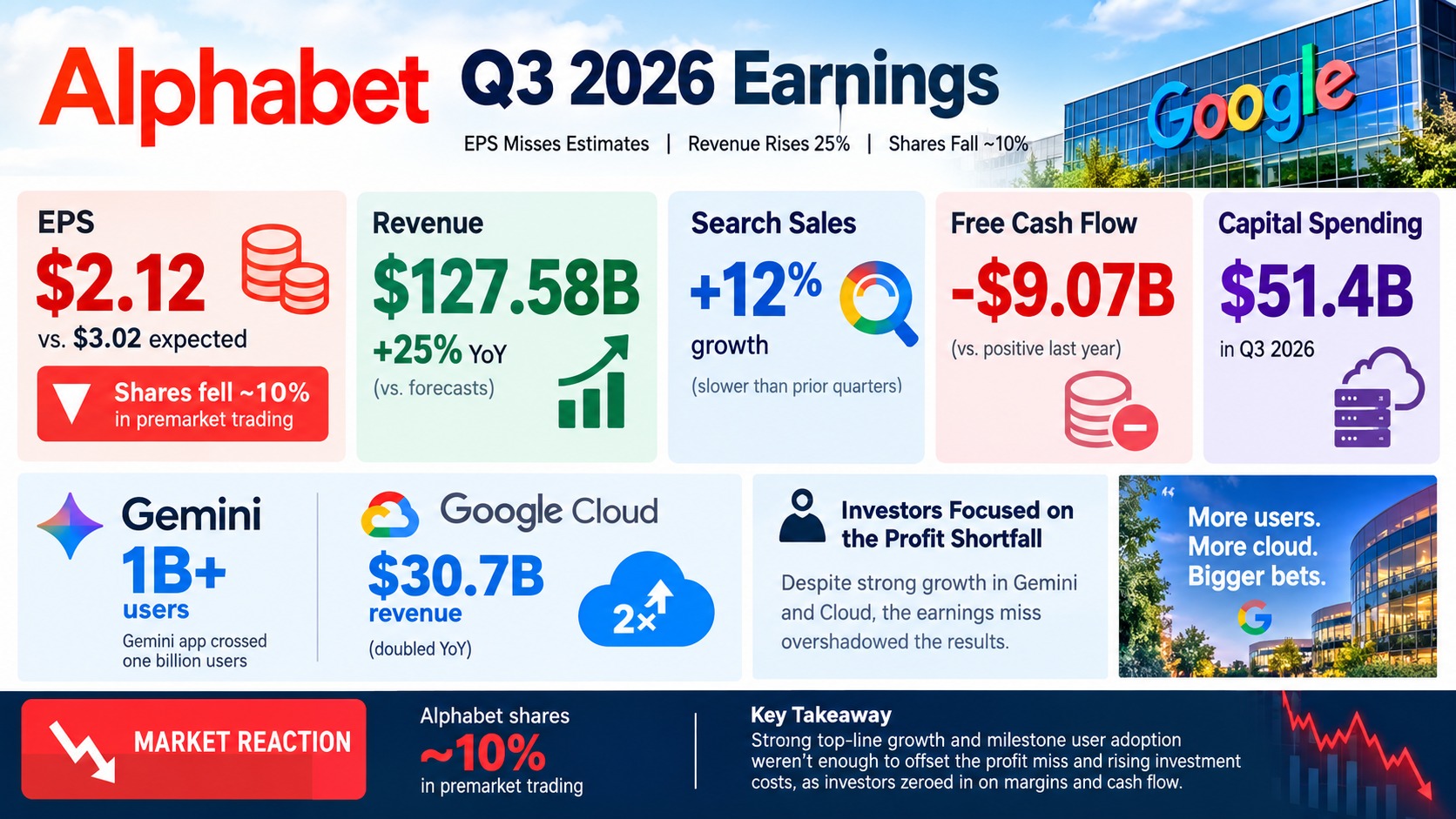
Alphabet shares fell about 10% in premarket trading on Thursday after the Google parent missed Wall Street's profit expectations for the third quarter of 2026, reversing a modest gain during Wednesday's regular session. The company reported earnings of $2.12 per share against a consensus estimate of $3.02. Part of the gap reflected an $8.7 billion loss on equity investments, but analysts also flagged that operating profit came in short, which they said matters more for how investors value the stock.
Revenue rose 25% from a year earlier to $127.58 billion, narrowly below the roughly $128 billion analysts had forecast. Net income attributable to common shareholders fell to $26.17 billion from $34.98 billion a year earlier, a 25% decline. Advertising revenue grew 11% to about $82 billion, short of estimates, and search revenue rose 12% to $63.35 billion, slowing from 17% growth in the previous quarter and missing the $64.96 billion analysts expected.
The cash picture drew the sharpest reaction. Alphabet spent $51.4 billion on capital expenditures in the quarter, mostly on data centers and AI chips, more than double the $24 billion of a year earlier. That outstripped the cash its businesses generated for a second straight quarter, leaving free cash flow at negative $9.07 billion. To fund the build-out, the company raised $28.7 billion through bond sales and $12.4 billion by issuing new shares during the period. Its full-year 2026 capital expenditure guidance remains at $195 billion to $205 billion, and management has previously said spending will increase further in 2027.
There were bright spots. Google Cloud revenue doubled to $30.7 billion, and CEO Sundar Pichai said the Gemini app has reached one billion users, the fastest-growing product in the company's history. Google's AI models now process nearly 32 billion tokens per minute, more than four times the level a year ago. Alphabet also launched Gemini 4 at the end of September. CFO Anat Ashkenazi called it a strong quarter with a 13th consecutive quarter of double-digit revenue growth. Even so, the market focused on the fact that AI spending, which previously weighed on cash flow, is now showing up in reported profits as depreciation rises.
The reaction contrasts sharply with Microsoft, which also reported Wednesday. Microsoft's Azure revenue grew 48% to $33.2 billion and its shares rose in premarket trading, as investors rewarded a quarter in which cloud strength came with capital spending below estimates. That divergence suggests the market is no longer paying for AI investment alone and is instead demanding visible returns in earnings and cash flow. Nasdaq-100 futures fell by about 1% in early trading as Alphabet's decline pulled on the index, while Amazon is scheduled to report after the close and will give investors another read on cloud demand and spending.
For portfolio positioning, the setup argues for caution on the most capital-intensive hyperscalers until free cash flow stabilizes. Alphabet remains above its 52-week low of $268.43, and the shares are well below their 52-week high of about $404, so the stock already reflects considerable skepticism. Traders may watch whether the decline stabilizes near the post-earnings range and how analysts revise estimates for depreciation and 2027 capital spending. Those revisions, along with Thursday's inflation and growth data and the Federal Reserve's hawkish tilt, will shape whether buyers return.
This article is for informational purposes only and is not investment advice.