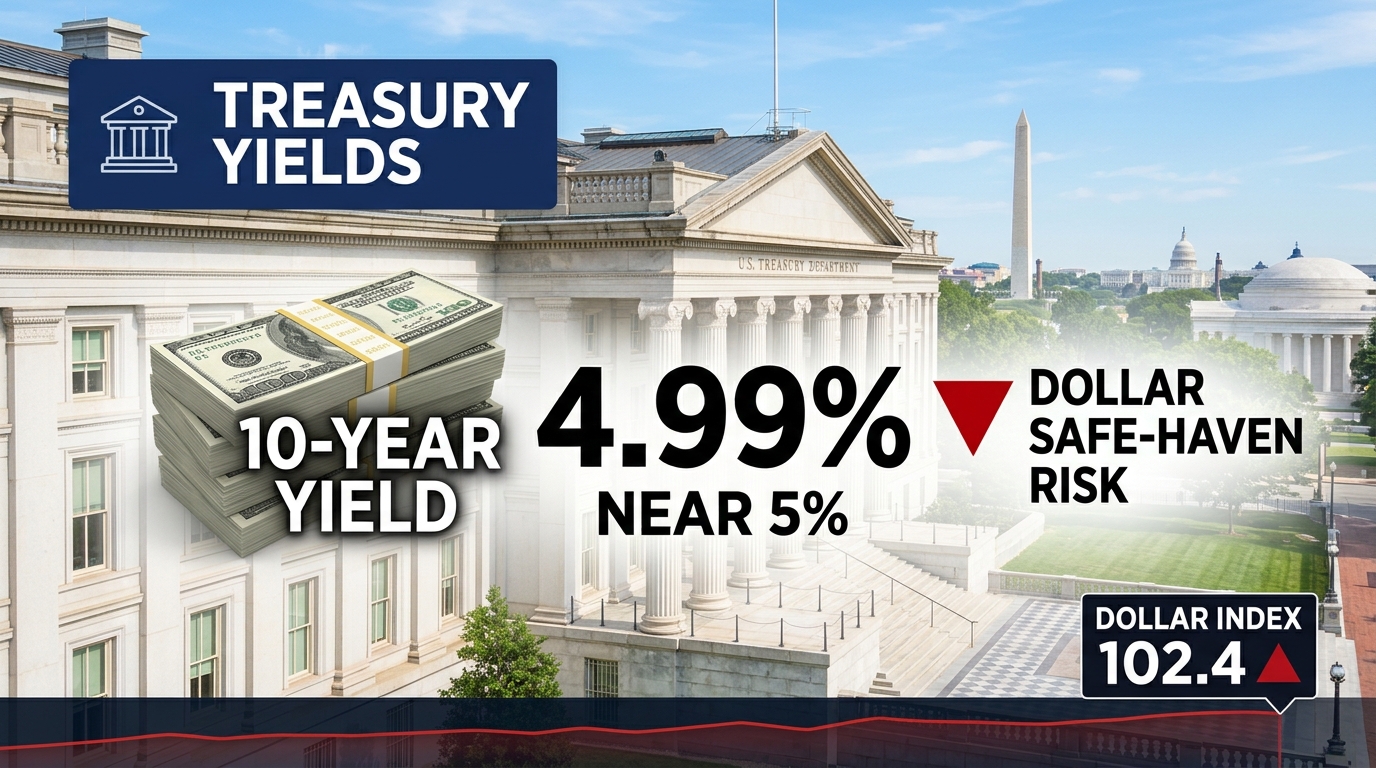
The 10-year Treasury yield is hovering just under 5% on Wednesday, near 4.99%, as investors position for the Federal Reserve's rate decision and a heavy slate of technology earnings. Some quotes put the benchmark slightly above 5%, a level that keeps pressure on equity valuations at a moment when the AI trade is the main driver of leadership in the U.S. stock market.
A separate analysis circulating this morning highlights a less-discussed risk: foreign capital that has flowed into the AI boom could weaken the dollar's traditional safe-haven role if the trade unwinds. Overseas investors have poured money into U.S. mega-cap equities, corporate bonds issued by hyperscalers and power-grid infrastructure, making the dollar an increasingly crowded bet on American exceptionalism backed by faster growth, higher yields and persistent demand for U.S. assets.
The concern is behavioral. If the AI narrative stumbles and a sustained equity selloff begins, price-sensitive foreign holders could sell U.S. assets, potentially overwhelming the usual flight into dollars. A head of G10 currency strategy at a major Japanese bank said it is not as clear that the dollar would benefit in the same way it did in past risk-off episodes, a notable shift for a currency long treated as the market's refuge.
Current market levels show little stress. The dollar index is near 102.4, the VIX closed Tuesday at 17.52, and the S&P 500 finished at 7,722.60 after back-to-back gains. Gold trades around $4,070 an ounce and Bitcoin near $81,000, while Brent crude has pushed above $115 on Middle East supply concerns. Together, those readings point to an environment where inflation risk and AI sentiment, rather than recession fear, are setting the tone.
Economists say elevated prices may linger. One overnight report cited economists who expect higher prices to stick around into 2027 as conflicts around the world continue, an outlook consistent with a Fed that has already raised rates once this cycle and has officials projecting more tightening. A yield near 5% also competes directly with equity returns, raising the hurdle for stocks that depend on distant cash flows.
For portfolios, the implications are uneven. Rate-sensitive sectors such as homebuilders and utilities are vulnerable if yields rise further, while banks and energy producers can benefit from higher rates and prices. Multinational companies are exposed to a weaker dollar through translation effects, although a softer currency can also help exporters. Investors who hold large positions in U.S. mega-cap technology are effectively exposed to both the equity and the currency channel of the AI trade.
The immediate catalysts are the 2:00 p.m. ET Fed decision, the 2:30 p.m. press conference and after-close earnings from two Big Tech leaders. A hawkish message could push the 10-year decisively above 5% and test the market's tolerance, while a patient tone could ease the pressure. Either way, the interplay between yields, the dollar and AI sentiment is likely to be a central theme for the rest of the week.