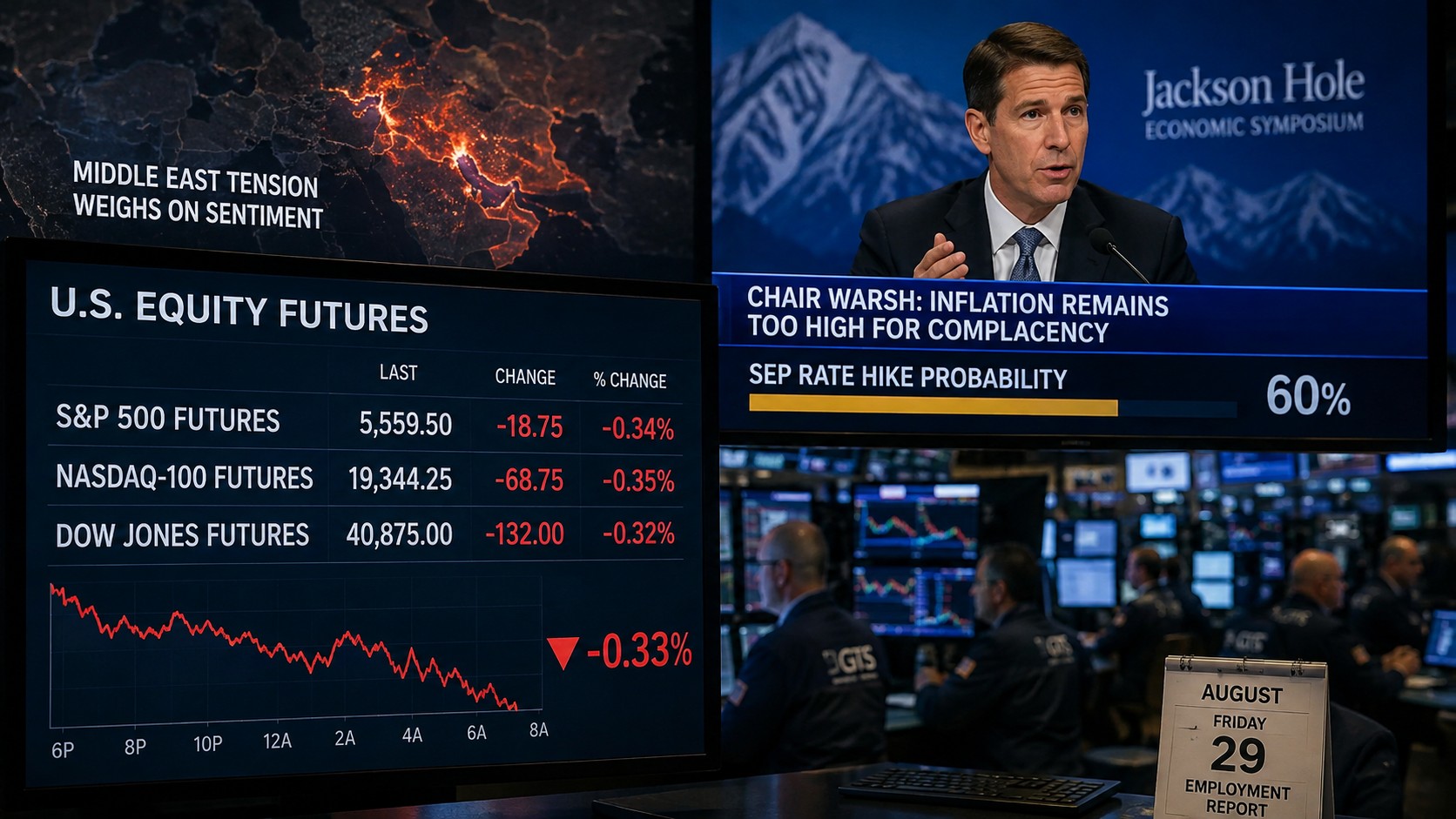
U.S. stock-index futures pointed lower on Monday as investors digested Federal Reserve Chair Kevin Warsh’s Jackson Hole remarks and the renewed escalation between the United States and Iran. Contracts on the Dow Jones Industrial Average, S&P 500 and Nasdaq-100 each showed declines of roughly 0.1% to 0.2% in early indications.
Warsh told the annual symposium that summer inflation readings, while better than some expectations, did not convince him that underlying trends had meaningfully improved. He described the 2% price-stability objective as a firm target and stated that policymakers still have “work to do.” Market-implied odds of a 25-basis-point rate increase at the September meeting rose to approximately 60%, up from lower levels earlier in the month.
Treasury yields remained elevated after Friday’s move, although some short-term yields pared a portion of the prior advance. The 10-year yield hovered near recent highs, supporting a cautious stance toward longer-duration growth stocks. Energy shares were positioned to benefit from the simultaneous jump in oil prices, while broader risk assets faced headwinds from the dual geopolitical and monetary-policy concerns.
Despite the soft start to the week, the major U.S. indexes were still positioned to finish August with solid gains, led earlier by technology and artificial-intelligence related names. The economic calendar is relatively light until Friday’s nonfarm-payrolls report, which is expected to show modest job growth. Traders will also monitor any further developments in the Middle East and comments from remaining Fed speakers before the blackout period ahead of the September decision.
Overall sentiment reflected a market balancing strong corporate fundamentals against higher policy uncertainty and episodic geopolitical shocks. Positioning into the jobs data and the next FOMC meeting is likely to remain cautious.