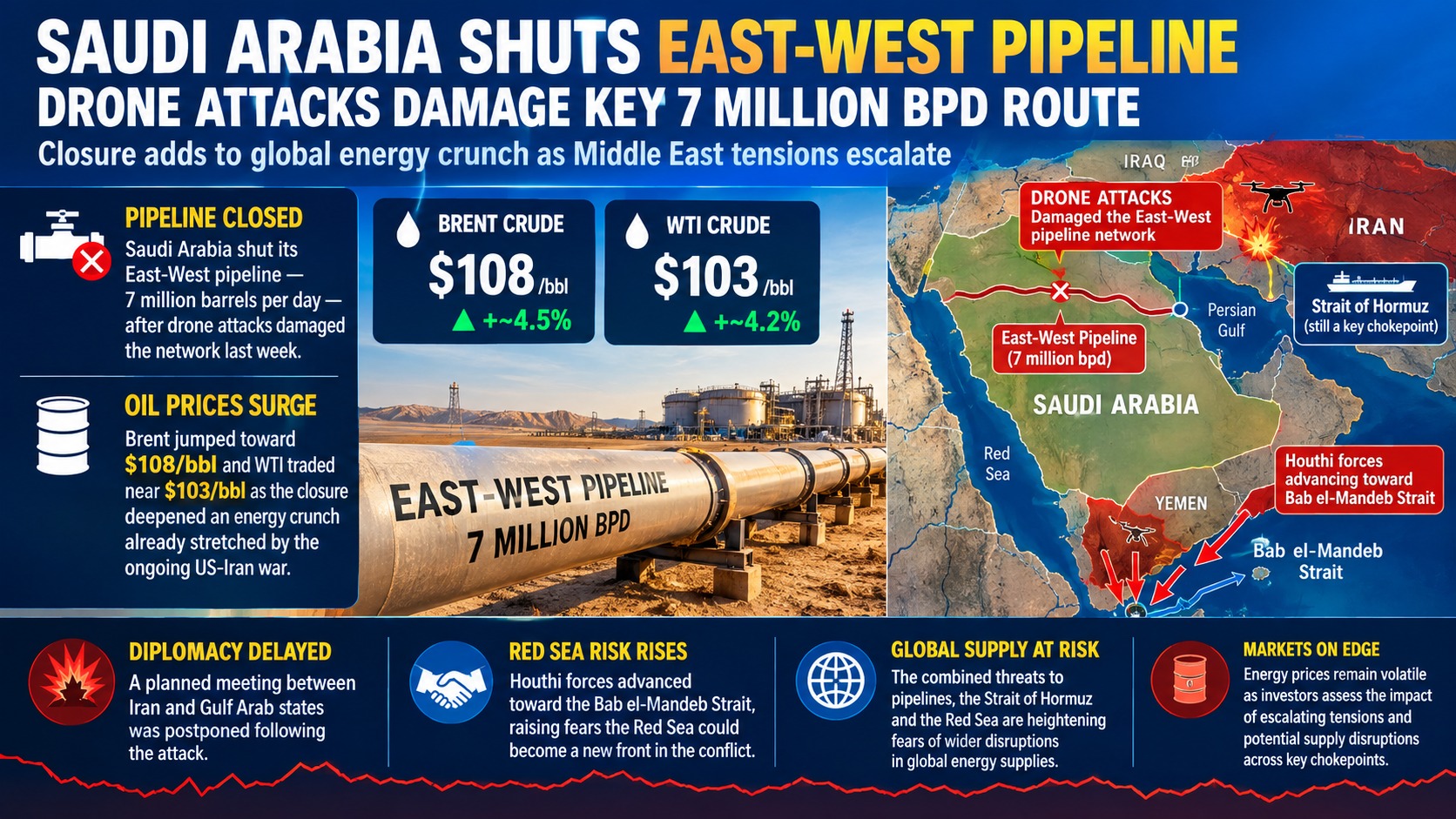
Saudi Arabia has shut down its East-West pipeline, the roughly 750-mile conduit that allows the kingdom to move crude oil away from the Strait of Hormuz to the Red Sea port of Yanbu, after drone attacks damaged sections of the network last Thursday. The closure of a route with a design capacity of 7 million barrels a day removes one of the few remaining safety valves for global oil supply amid the ongoing conflict between the United States and Iran.
Saudi Arabia's Ministry of Energy said the pipeline was shut as a precautionary measure while emergency crews assess the extent of the damage and secure the facility. The ministry has not disclosed how long the route will remain offline. Satellite imagery reviewed by news organizations showed extensive damage at pumping stations along the line, though the full scope of the disruption to flows remains unclear.
The pipeline has served as a crucial lifeline for Saudi exports since fighting between the US and Iran effectively closed the Strait of Hormuz to much of the tanker traffic that once carried roughly 15 million barrels a day of crude. Aramco chief executive Amin Nasser said on the company's August earnings call that the pipeline had done more to stabilize oil markets than the coordinated release of strategic petroleum reserves led by the United States. With that route now shut, traders are bracing for tighter supply just as winter demand begins to build.
Brent crude, the international benchmark, jumped toward $108 a barrel in early trading Monday, extending a rally of nearly 9% from the prior week, while West Texas Intermediate traded near $103. European natural gas prices also climbed as much as 3.8% on the same supply concerns. The moves mark some of the sharpest energy price swings since the early stages of the US-Iran conflict.
The disruption carries diplomatic consequences as well. A meeting between Iranian officials and Gulf Arab states, originally scheduled for Monday in Oman to discuss de-escalating tensions around the Strait of Hormuz, was abruptly postponed following the pipeline attack. Separately, Britain's maritime trade authority reported that another tanker came under attack in the Gulf over the weekend, resulting in a significant fire onboard.
Adding to the uncertainty, Yemen's Iran-backed Houthi movement has launched a rapid ground offensive toward the Bab el-Mandeb Strait, the narrow chokepoint connecting the Red Sea to the Gulf of Aden. Should the Houthis gain meaningful control of the strait or escalate attacks on shipping there, analysts warn the Red Sea could become a second major flashpoint for global energy trade, compounding the disruption already caused by the closure of Hormuz to normal traffic.
For US equity investors, the pipeline shutdown reinforces an increasingly costly energy backdrop. Higher crude prices raise input costs for a broad swath of the economy and complicate the inflation picture just as the Federal Reserve prepares to deliver its next interest rate decision this week, leaving energy stocks as one of the few pockets of the market likely to benefit from the escalating supply risk.