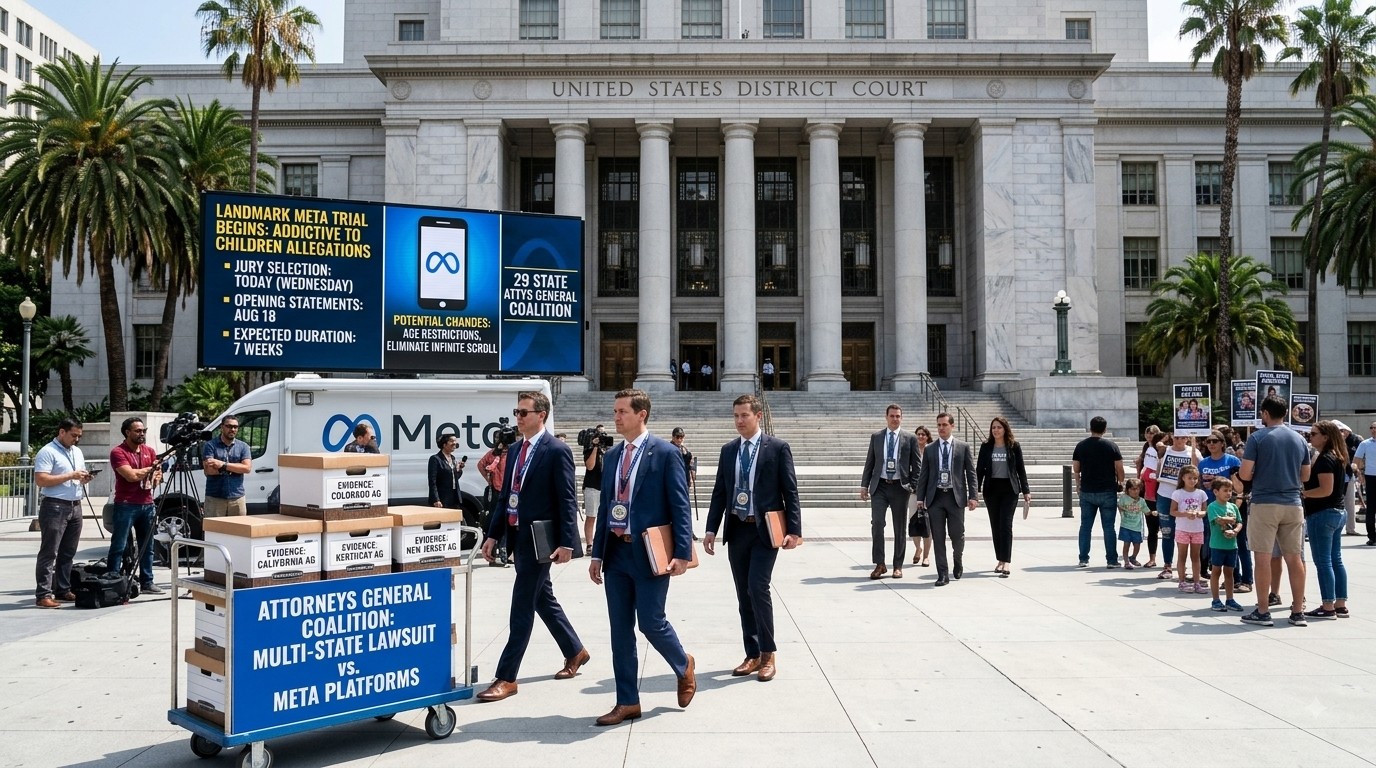
Meta Platforms enters a California federal courtroom Wednesday as jury selection begins in what could become the company's largest trial yet over the effects of social media on children, with opening statements scheduled to follow on August 18 in Oakland. The case, expected to last roughly seven weeks, pits Meta against a coalition of state attorneys general representing Colorado, Kentucky, California, and New Jersey, part of a broader 29-state effort alleging the company knowingly designed Facebook and Instagram to be addictive to young users.
The lawsuit, first filed in 2023 following a multistate investigation into Instagram and Facebook's impact on minors, alleges Meta deployed features such as infinite scroll and engagement-optimized recommendation algorithms specifically to maximize time spent on its platforms by children and teenagers, while publicly downplaying the risks. The states are also pursuing claims that Meta illegally collected and used children's data in violation of federal privacy law. Beyond monetary damages, the attorneys general are seeking a court order that would force Meta to implement stricter age-verification systems, eliminate infinite scroll functionality, and make other structural changes to how its platforms operate for younger users.
A Meta spokesperson pushed back on the allegations ahead of the trial, saying the company has 'listened to parents, worked with experts and law enforcement, and conducted in-depth research to understand the issues that matter most.' The company has consistently maintained that it has invested heavily in safety tools and parental controls and disputes characterizations that its design choices were intended to harm young users.
The Oakland trial is among thousands of cases pending against major social media companies, including Snap, Alphabet's YouTube, and ByteDance's TikTok, over allegations of harm to young users, with more than 3,300 additional individual lawsuits pending in Los Angeles County Superior Court alone. Meta has previously faced significant exposure in related litigation: a jury in a separate bellwether trial earlier this year awarded $6 million in compensatory and punitive damages split between Meta and YouTube, while a New Mexico jury ordered Meta to pay a $375 million civil penalty in a related case, with the state's attorney general indicating plans to seek roughly $3.7 billion in additional abatement costs.
The scale of potential financial exposure tied to the broader wave of youth social media litigation has become a growing point of concern for investors, with Meta's own securities filings acknowledging that the flood of cases could materially affect its business and financial results going forward. Court filings show state attorneys general have floated damages calculations running into the trillions of dollars in related proceedings, based on multiplying statutory penalties by the number of affected minors, though legal analysts widely view a negotiated structural settlement as the more probable eventual outcome rather than a payment of that magnitude.
For Meta, the outcome of the Oakland trial carries implications well beyond the immediate case, potentially setting a precedent for how courts across the country evaluate the thousands of remaining youth-safety lawsuits still working through the legal system, and for whether social media companies more broadly will face mandated design changes to core engagement features.