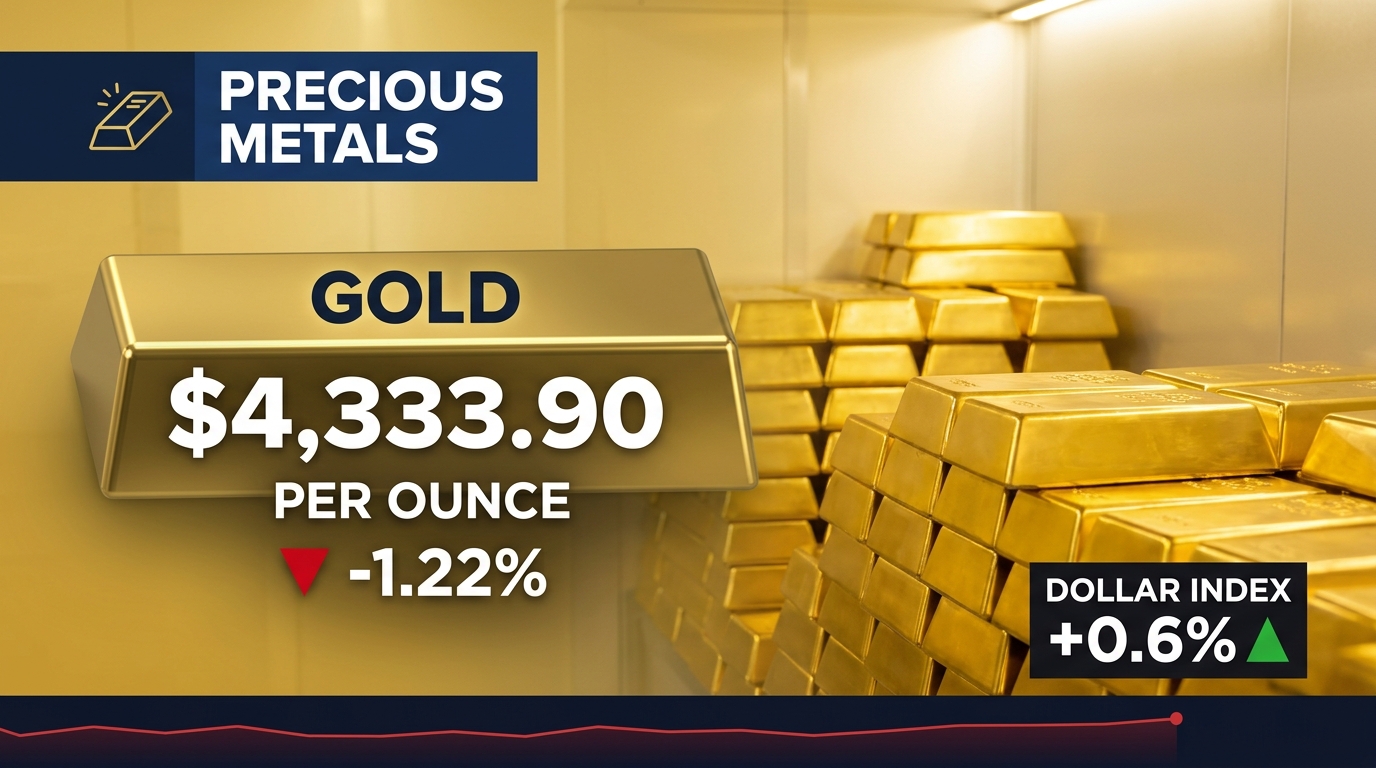
Gold prices retreated Thursday, with spot bullion falling 1.22% to $4,333.90 an ounce as a stronger U.S. dollar and the fallout from this week's Federal Reserve rate decision pressured the metal. The pullback comes even as gold remains one of the better-performing major asset classes of 2026, having benefited for much of the year from safe-haven flows tied to Middle East conflict escalation and persistent inflation concerns.
The immediate catalyst was Wednesday's Federal Reserve meeting, at which the central bank raised its benchmark rate by 25 basis points to a range of 3.75%-4% and Chair Kevin Warsh delivered an unexpectedly hawkish press conference. Warsh declined to describe current monetary policy as restrictive and distanced himself from the Fed's own projections showing a pause after one more hike, comments that pushed the dollar index up 0.6% to its strongest level since late July. Because gold is priced in dollars and pays no yield, a stronger greenback and the prospect of higher-for-longer interest rates both work against bullion, raising the opportunity cost of holding it relative to interest-bearing assets.
The move also reflects some retracement in Treasury yields at the front end of the curve. The two-year yield, which had spiked to its highest level since 2024 in the immediate aftermath of Wednesday's hike, eased slightly Thursday even as the 10-year yield held near 5%, a level last seen in 2007. That combination — a firmer dollar alongside still-elevated long-term yields — has left gold caught between competing cross-currents heading into the fourth quarter.
Despite Thursday's decline, most strategists remain constructive on gold's medium-term trajectory. The metal has drawn substantial institutional and central bank buying interest this year as a hedge against both geopolitical risk, with Middle East oil-supply disruptions pushing crude above $100 a barrel, and concerns that inflation could prove stickier than the Fed's forecasts assume. Central bank gold purchases have remained a structural source of demand largely independent of short-term dollar or rate moves, a dynamic that has helped cushion pullbacks throughout the year.
For portfolio construction, the setup argues for treating gold less as a pure momentum trade right now and more as a longer-duration hedge against policy error or a renewed escalation in the Middle East. Traders positioning for near-term moves should watch Friday's dollar index action and any follow-through commentary from Fed officials, both of which are likely to dictate whether bullion stabilizes above the $4,300 level or extends its retreat toward the next support zone in the $4,250 to $4,280 range.