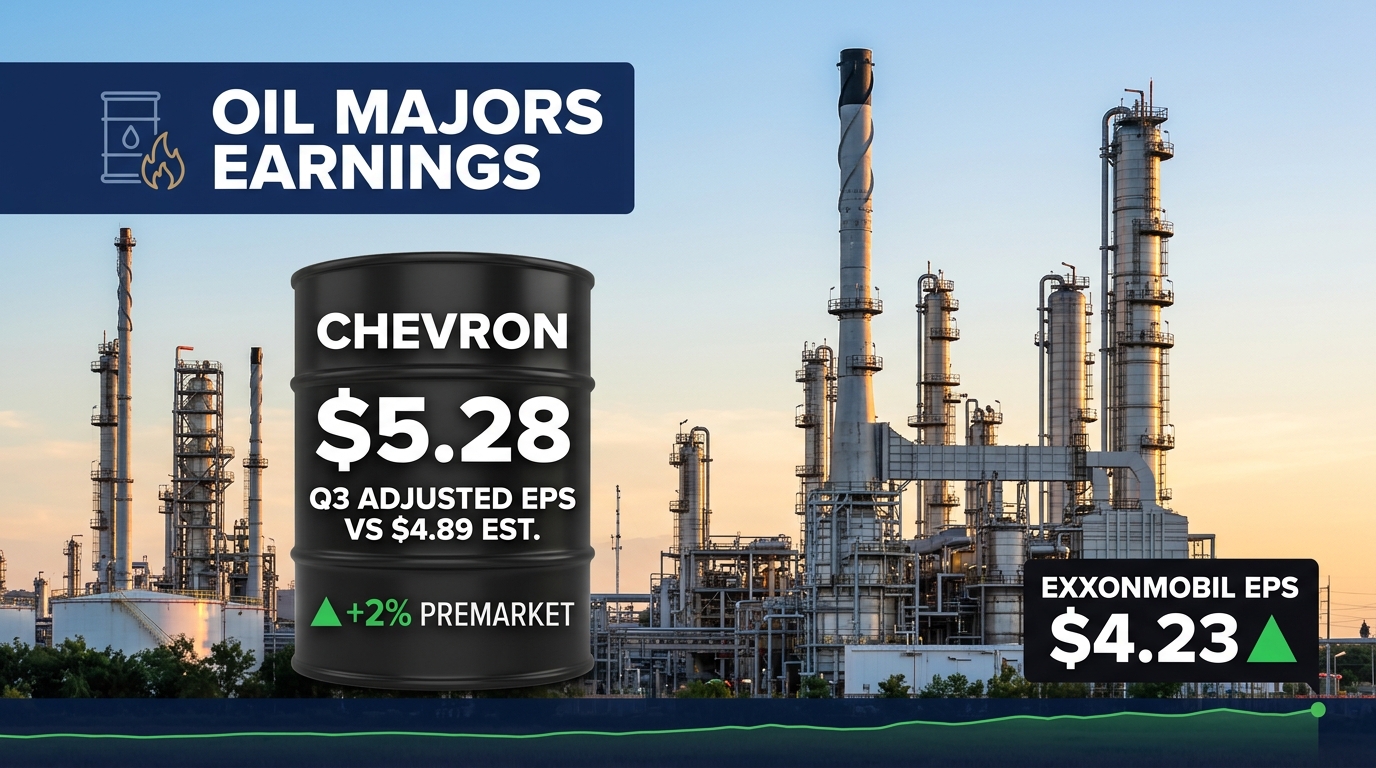
ExxonMobil and Chevron both beat third-quarter profit expectations on Friday, as war-driven refining margins turned their fuel-making businesses into profit engines that rival their upstream operations. Chevron shares rose about 2% in premarket trading, and the broader energy sector gained roughly 1.5% as technology stocks sold off.
Chevron reported adjusted earnings of $5.28 per share, ahead of the $4.89 expected by analysts polled by LSEG. Net income surged nearly 200% to $9.9 billion, or $5.06 per share, from $3.5 billion a year earlier, and revenue of $67.8 billion topped the $61.6 billion forecast. Refining profit jumped more than 300% to $4.9 billion, while upstream earnings rose about 70% to $5.7 billion, CNBC reported.
ExxonMobil posted adjusted earnings of $4.23 per share, above the $4.08 average estimate, with adjusted total earnings of $17.5 billion beating the $16.6 billion analysts expected, according to Reuters. Adjusted downstream earnings of $9 billion were up 120% from the second quarter, while adjusted upstream earnings of $7.3 billion fell 20% sequentially as Brent crude prices were lower than in the prior three months. Exxon earned more from refining than from upstream for the first time in at least six years and cut debt by $8 billion in the quarter.
The earnings boom traces to supply disruptions. The U.S.-Israeli war with Iran, the effective closure of the Strait of Hormuz and attacks on refineries in Saudi Arabia and Russia have knocked out fuel-making capacity and lifted gasoline and diesel prices, according to Reuters. Both companies ran U.S. refineries near full rates, and Chevron said diesel and jet fuel yields rose more than 10%.
Chevron's production fell slightly to 3.9 million barrels per day from about 4 million a year earlier, as international output declined partly because of the Middle East conflict. Chief financial officer Eimear Bonner said Chevron could raise capacity at its Pascagoula refinery by 7% by the end of the decade, while Exxon CFO Neil Hansen said the company is investing in its Baytown complex and using its trading team to direct supplies. Chevron also reduced net debt by nearly $14 billion versus year-end 2025.
For portfolio positioning, the results reinforce energy's role as a hedge against both geopolitical risk and an AI-driven technology pullback. Both stocks had already rallied hard, with Exxon up about 48% and Chevron up about 47% year to date as of mid-October, so much of the earnings power was visible to investors. The risk is a reversal in refining margins if Hormuz flows normalize or a diesel export restriction, which President Trump considered in September before ruling it out in early October, returns to the policy debate.
Traders will watch whether the post-earnings bid holds through the session, and how crude and diesel futures react to the next Middle East headlines. Balance-sheet progress, including Exxon's $8 billion debt reduction and Chevron's nearly $14 billion net-debt reduction since year-end, gives both names support if margins cool.