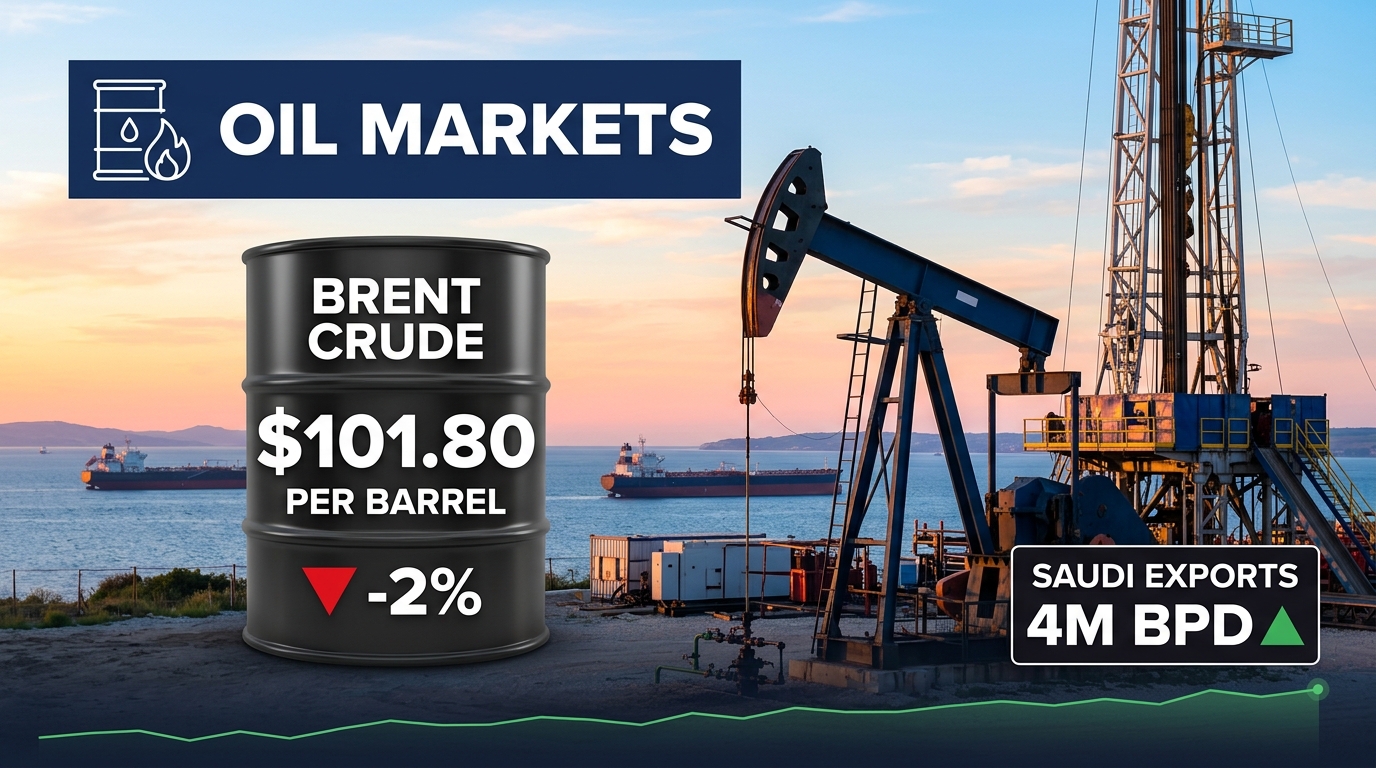
Brent crude oil fell approximately 2% to roughly $101.80 a barrel on Monday, extending its decline to a fourth consecutive session — the longest losing streak for the benchmark in three months — as geopolitical risk premiums built up over recent weeks began to unwind.
The catalyst was a weekend reversal by President Trump, who decided against authorizing U.S. military strikes on Houthi positions in Yemen after the Pentagon had already prepared for the operation. According to reports, Trump had initially ordered the Pentagon to ready airstrikes after Saudi Crown Prince Mohammed bin Salman urged him to intervene following Houthi missile and drone attacks on Saudi Arabia. By Sunday, however, Trump had changed course and called off the planned strikes.
Yemen's Houthi movement responded to the de-escalation by stating it would not target U.S. vessels transiting the Red Sea, a pledge that further calmed fears of an expanding regional conflict that traders had worried could disrupt critical Middle East energy shipping routes, including the Bab-el-Mandeb Strait.
Adding to the bearish pressure on prices, Reuters reported that Saudi Arabia has restored a larger share of its oil shipments than markets had previously assumed. Saudi crude exports recovered to more than 4 million barrels per day in September, according to Reuters, compared with roughly 2.4 million barrels per day in August, suggesting the kingdom's production and export capacity has proven more resilient to the ongoing regional tensions than initially feared.
The retreat in oil prices carries broad implications across financial markets. Lower energy costs are viewed by traders as easing near-term inflation pressure, which in turn supported a rally in government bonds. The 10-year Treasury yield slipped back below the closely watched 5% level, a threshold it had breached earlier in September amid concerns about persistent price pressures. Falling yields have historically supported valuations for both equities and non-yielding assets such as Bitcoin, which pushed above $85,000 in Monday trading.
U.S. crude also declined alongside the international benchmark, with West Texas Intermediate futures tracking Brent's slide lower. The combined effect of falling energy prices and easing geopolitical risk contributed to a broadly positive tone across global equity markets Monday, with S&P 500 futures advancing roughly 0.6% and Nasdaq-100 futures rising about 0.8% in early trading.
Energy-sector investors are now weighing whether the pullback in crude represents a durable shift or a temporary reprieve. Middle East tensions remain far from fully resolved, and any renewed escalation — whether involving the Houthis, Iran, or other regional actors — could quickly reverse the recent decline in prices. For now, however, the combination of a de-escalatory signal from Washington and firmer Saudi export data has given traders reason to reduce the geopolitical risk premium that had been embedded in oil prices through much of September.
Strategists caution that oil's trajectory over the coming days will likely hinge on developments surrounding the Trump-Xi summit later this week, as well as any further signals from Gulf producers regarding output policy heading into the fourth quarter.