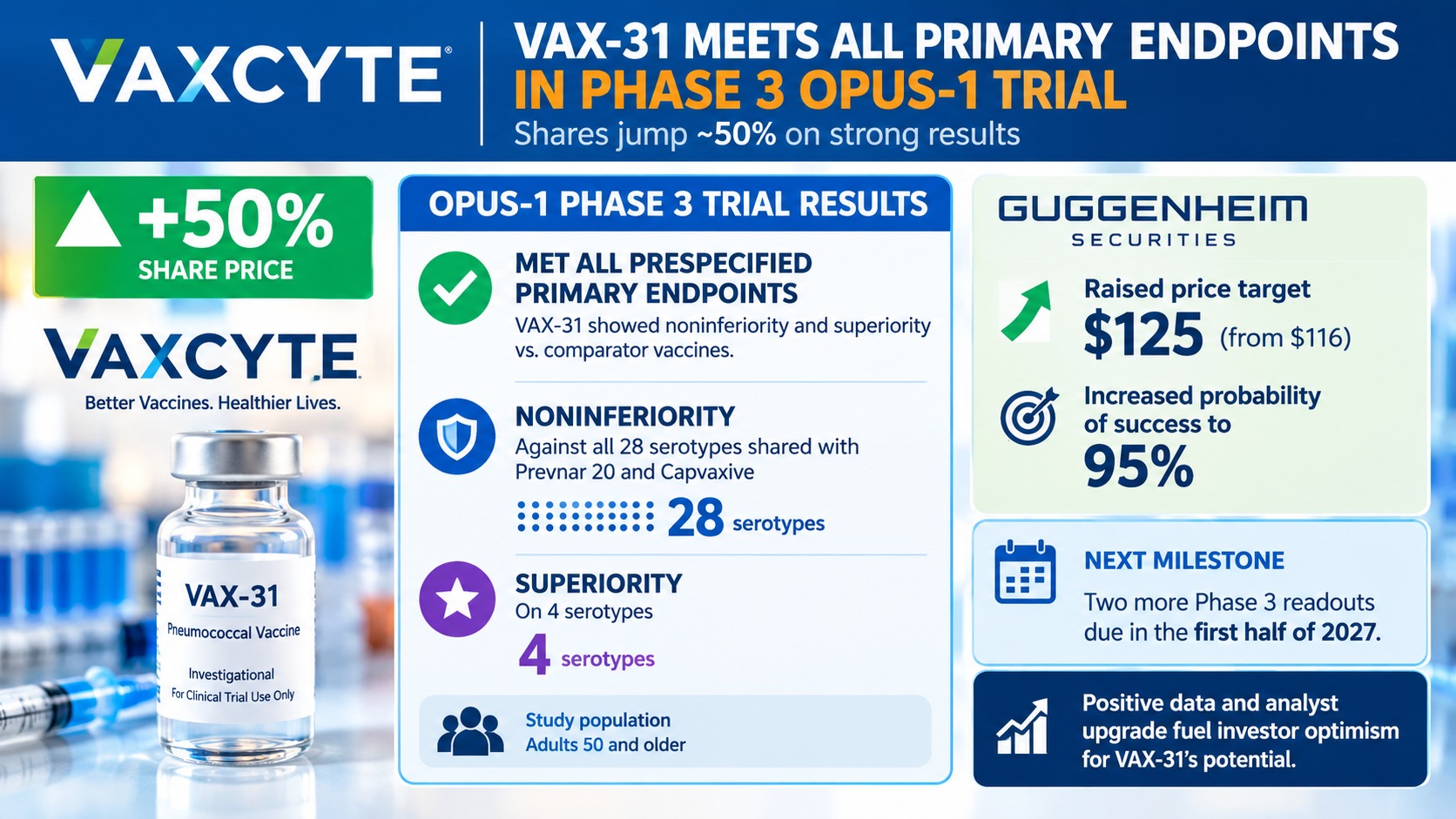
Vaxcyte (PCVX) shares jumped about 50% on Monday after the vaccine developer reported that VAX-31, its 31-valent pneumococcal conjugate vaccine candidate, met all prespecified primary endpoints in the pivotal adult Phase 3 OPUS-1 trial. The readout, which arrived in the fourth quarter as the company had guided, is a major catalyst that de-risks the lead program ahead of two further adult studies.
OPUS-1 enrolled more than 4,000 participants and compared VAX-31 head-to-head with Pfizer's Prevnar 20 and Merck's Capvaxive. In adults aged 50 and older, VAX-31 met the noninferiority threshold, a lower bound of the 95% confidence interval above 0.667, for all 28 serotypes it shares with the comparator vaccines. The three serotypes unique to VAX-31, along with cross-reactive serotype 20B, met the trial's superiority criteria.
Individual comparisons were also strong. Against Prevnar 20, VAX-31 met noninferiority for 20 of 20 shared serotypes. Against Capvaxive, it did so for 17 of 19. Serotypes 3 and 12F missed the stricter 0.667 threshold versus Capvaxive, although both cleared the historical 0.5 threshold, and VAX-31 met that looser bar for all 19 shared serotypes. Investors will likely focus on those two serotypes in the coming weeks.
Safety looked clean. The company said VAX-31 was well tolerated with a profile similar to the comparators across all ages studied, solicited reactions were generally mild to moderate and resolved within 48 hours, and no serious adverse events were considered vaccine-related.
Wall Street responded quickly. Guggenheim analyst Seamus Fernandez raised his price target to $125 from $116 while keeping a Buy rating and lifted his probability of success for VAX-31 in adults to 95% from 85%, describing the result as a best-case outcome that positions the vaccine for commercial leadership. Premarket trading had already shown a gain of about 51%.
Pneumococcal conjugate vaccines protect against invasive disease and pneumonia caused by the bacterium Streptococcus pneumoniae, and the FDA expanded Breakthrough Therapy designation for VAX-31 in May 2025 to include prevention of pneumonia. The company has said the OPUS-1 design could deliver a 14% to 34% increase in coverage against invasive pneumococcal disease relative to current standard-of-care vaccines in the United States.
The next catalysts are scheduled. Vaxcyte expects OPUS-2 and OPUS-3 results in the first half of 2027, along with infant Phase 2 dose-finding data by the end of that period, and plans a Biologics License Application submission for adults in the first half of 2028. The company reported about $2.5 billion in cash, cash equivalents and investments as of June 30, a sizable balance sheet cushion through those readouts.
For market participants, a 50% single-day move may leave much of the good news priced in, while Pfizer and Merck now face a credible challenger to their pneumococcal franchises. Biotech binary events can reverse quickly, and this article is informational only, not investment advice.