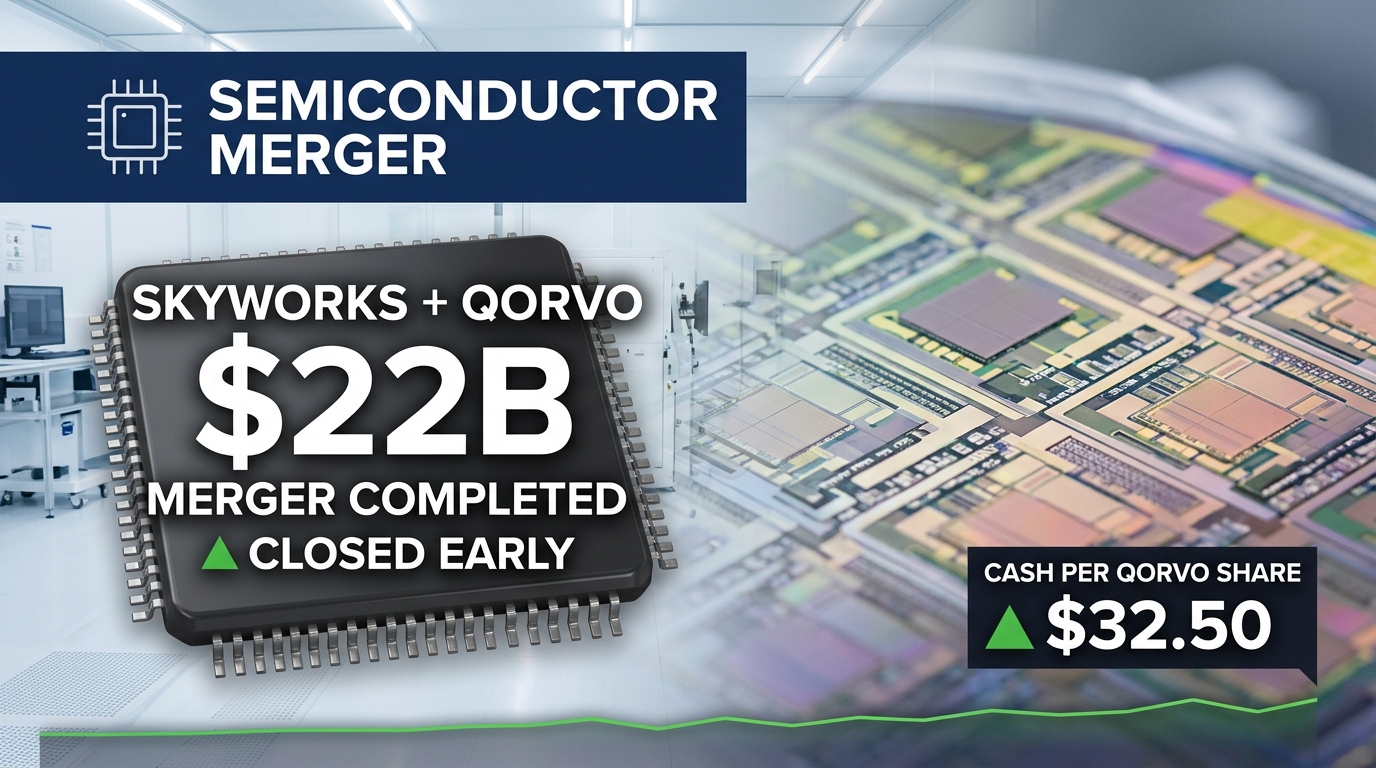
Skyworks Solutions (SWKS) completed its combination with Qorvo (QRVO) on Monday, closing a transaction valued at roughly $22 billion and creating a U.S.-based global leader in high-performance radio frequency, analog and mixed-signal semiconductors. The companies had said they expected to close on or about October 5 after Skyworks announced on September 30 that it had received every required regulatory clearance, ending a deal process that began with the October 2025 announcement and stretched across nearly a year.
Under the terms first announced on October 27, 2025, Qorvo shareholders receive $32.50 in cash and 0.960 Skyworks shares for each Qorvo share. The closing arrives earlier than the timetable Qorvo laid out in its annual report, which anticipated completion early in calendar year 2027.
The path was not frictionless. Both companies received a Request for Additional Information and Documentary Material, known as a Second Request, from the Federal Trade Commission on February 5, 2026, extending the review. Stockholders of both companies had approved the merger agreement at special meetings on February 11, 2026, leaving regulatory approval as the main remaining hurdle.
The combined company brings together two of the largest suppliers in RF semiconductors, with a portfolio spanning RF, analog, mixed-signal and power technologies and exposure to mobile RF front-ends, connectivity, defense and aerospace, and automotive markets. The tie-up is set to reshape competitive dynamics in connectivity and wireless components, where scale in design, manufacturing and customer relationships increasingly matters to handset makers and infrastructure buyers alike.
Capital structure moves accompanied the close. Skyworks launched exchange offers and consent solicitations for Qorvo's 4.375% senior notes due 2029 and 3.375% senior notes due 2031, to be swapped for new Skyworks notes, with consent payments expected concurrently with or promptly after closing. The offers were set to expire on October 2, and the exchange was conditioned on completion of the merger, which streamlines the combined company's debt stack.
What investors should watch now is integration. Combining two large RF suppliers requires aligning product roadmaps, manufacturing footprints and customer contracts, and the benefits depend on how quickly the new company can convert scale into margin and cash flow. Management commentary on synergy targets, leverage and capital allocation will likely drive sentiment over the coming quarters.
The close also arrives as markets weigh a 10-year Treasury yield near 5.28% and oil above $100 per barrel, conditions that can pressure semiconductor valuations and financing costs. Shareholders should watch the first combined disclosures closely for guidance on revenue mix and cost savings. This article is informational only and is not investment advice.