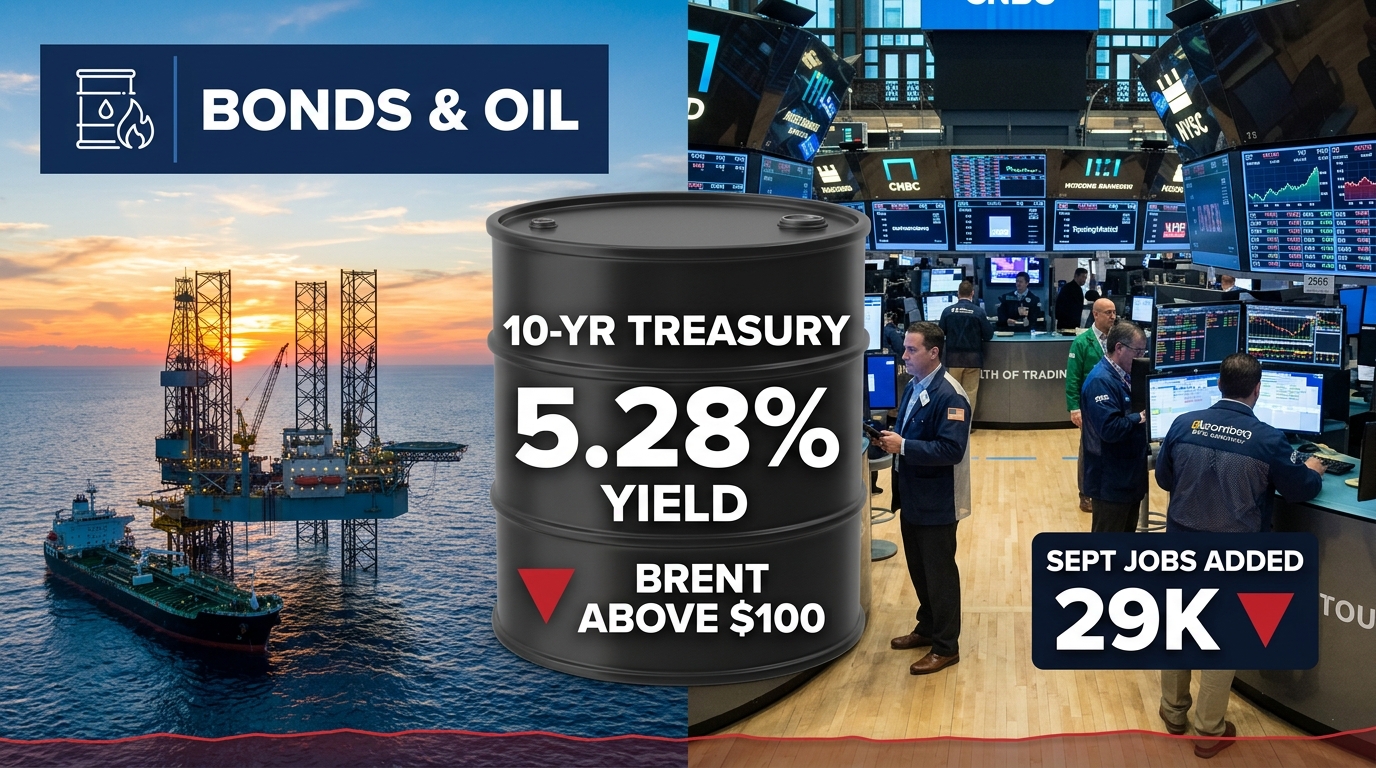
US stock futures edged lower in premarket trading on Monday as investors weighed a stubbornly high 10-year Treasury yield, Brent crude above $100 a barrel and an upcoming earnings season, following Friday's rally on a weak jobs report. Futures on the Dow and S&P 500 fell fractionally, while Nasdaq-100 contracts declined 0.1%.
Friday's labor data set the tone. September nonfarm payrolls rose by just 29,000, well below expectations, the previous two months were revised down by a combined 60,000 and unemployment edged up to 4.2%. The report reduced bets on another Federal Reserve rate hike in October, sending the Nasdaq 100 to fresh highs. The Dow rose 0.5%, or 250.40 points, to 51,176.96, the S&P 500 gained 0.7% to 7,722.72, the Nasdaq Composite advanced 1.2% and the VIX fell 6.6% to 15.31.
The complication is the bond market. The 10-year Treasury yield is near 5.28% despite the soft payrolls, which analysts describe as stubbornly weak demand for bonds. One strategist noted that yields are back inside a broad pre-financial-crisis range of 4% to 6% and argued that most of the structural adjustment in Treasuries may be complete, but higher borrowing costs still weigh on equity valuations.
Energy remains the second pressure point. Brent crude traded around $102 a barrel after the weekend, while the Abu Dhabi benchmark Murban was near $110 and the Brent-WTI spread was above $11, compared with a more typical $3 to $5. Iran's parliament speaker said the Strait of Hormuz will stay closed until Washington meets seven conditions, and the Houthis claimed strikes on Saudi oil sites, claims the Saudi-led coalition called misleading. Brent was about $73 before the war began in late February.
Policymakers are responding at the margin. The G7 agreed Friday to a 100-million-barrel stock release under US pressure, which covers roughly one day of world consumption, and Brent has not fallen back below $100. Gold dropped about 3% on the week to near $4,137 and the dollar index sits at an 18-month high, a mix that suggests investors are treating the Gulf conflict as an inflation-and-rates problem rather than a safe-haven event.
The calendar adds to the caution. Minutes from the Fed's September meeting arrive Wednesday and could offer clues on whether another hike remains on the table, and US services PMI data is also in focus. In Europe, Paris's CAC index fell 0.6% while the broader European STOXX gauge held in the green. For the week ended Friday, the S&P 500 slipped 0.3%, the Nasdaq gained 0.5% and the Dow dropped 1.3%.
For portfolio positioning, the setup rewards selectivity over broad exposure: falling labor momentum supports rate-cut hopes, yet yields and oil argue against chasing extended index gains. Traders may prefer defined-risk swing positions and event-driven names over large directional bets. This article is informational only and is not investment advice.