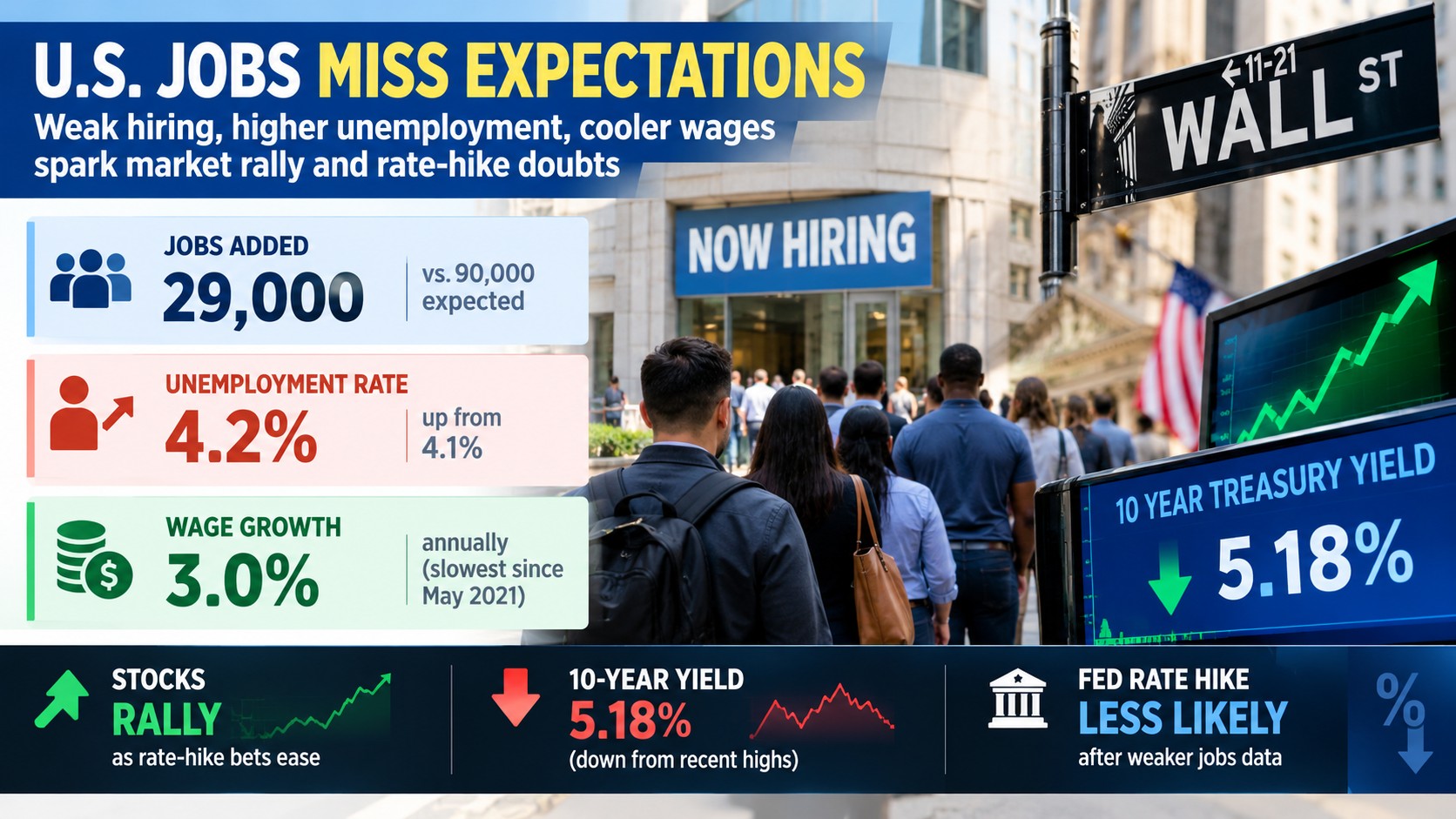
The US labor market lost momentum in September, with nonfarm payrolls rising by just 29,000 jobs, according to Labor Department data released Friday. Economists had forecast roughly 90,000 new positions, and the unemployment rate edged up to 4.2% from 4.1%. The report arrived at a delicate moment for investors, who had spent the week watching Treasury yields climb to multidecade highs while debating whether the Federal Reserve would raise interest rates at its policy meeting later this month.
Markets treated the miss as relief rather than a warning. S&P 500 futures jumped about 0.9% and Nasdaq 100 futures gained roughly 1.3% after the release, and the Dow Jones Industrial Average climbed about 400 points in early trading. The 10-year Treasury yield fell more than 5 basis points to around 5.18%, while the 2-year yield slid to about 4.75%, as traders trimmed bets on a rate hike.
Details beneath the headline were more nuanced. August payrolls were revised down to 133,000 from an initial 162,000, underscoring how quickly hiring momentum has faded. Through September the economy has averaged about 68,000 jobs per month, stronger than last year's pace of fewer than 10,000 but well below pre-pandemic norms. Annual wage growth slowed for a fourth consecutive month to 3%, the lowest reading since May 2021, easing concerns that labor costs could reignite inflation.
The rise in unemployment reflected a larger labor force rather than widespread layoffs. Participation increased as more people entered or re-entered the job market, and the household survey showed a sizable gain in employment. Analysts noted that this divergence between the household and payroll measures complicates the Fed's read on the economy and may mean the unemployment uptick overstates labor-market weakness.
Technology shares led the rebound. Intel and AMD each rose more than 3% as risk appetite returned, extending a week in which strong chip earnings kept growth stocks in focus despite pressure from the bond market. Lower yields tend to benefit longer-duration assets such as growth equities, which helps explain the outsized response in Nasdaq futures compared with the broader market.
Still, the 'bad news is good news' dynamic carries risk. Yields touched 24-year highs on Thursday, and recent manufacturing surveys pointed to building cost pressures, so inflation concerns have not disappeared. The US dollar index had also risen toward 101.8 as yields climbed, a headwind for multinational earnings that a pullback in rates could ease. A string of weak payroll reports would eventually shift investor focus from rate-hike fears to growth fears, which typically hurts cyclical sectors and small caps.
For positioning, the print favors rate-sensitive growth names and tilts the odds toward a Fed hold in October. Traders will now look to upcoming inflation readings and Fed commentary for confirmation. Until then, volatility around yield moves is likely to stay elevated, making position sizing and risk limits more important than conviction in any single directional call.