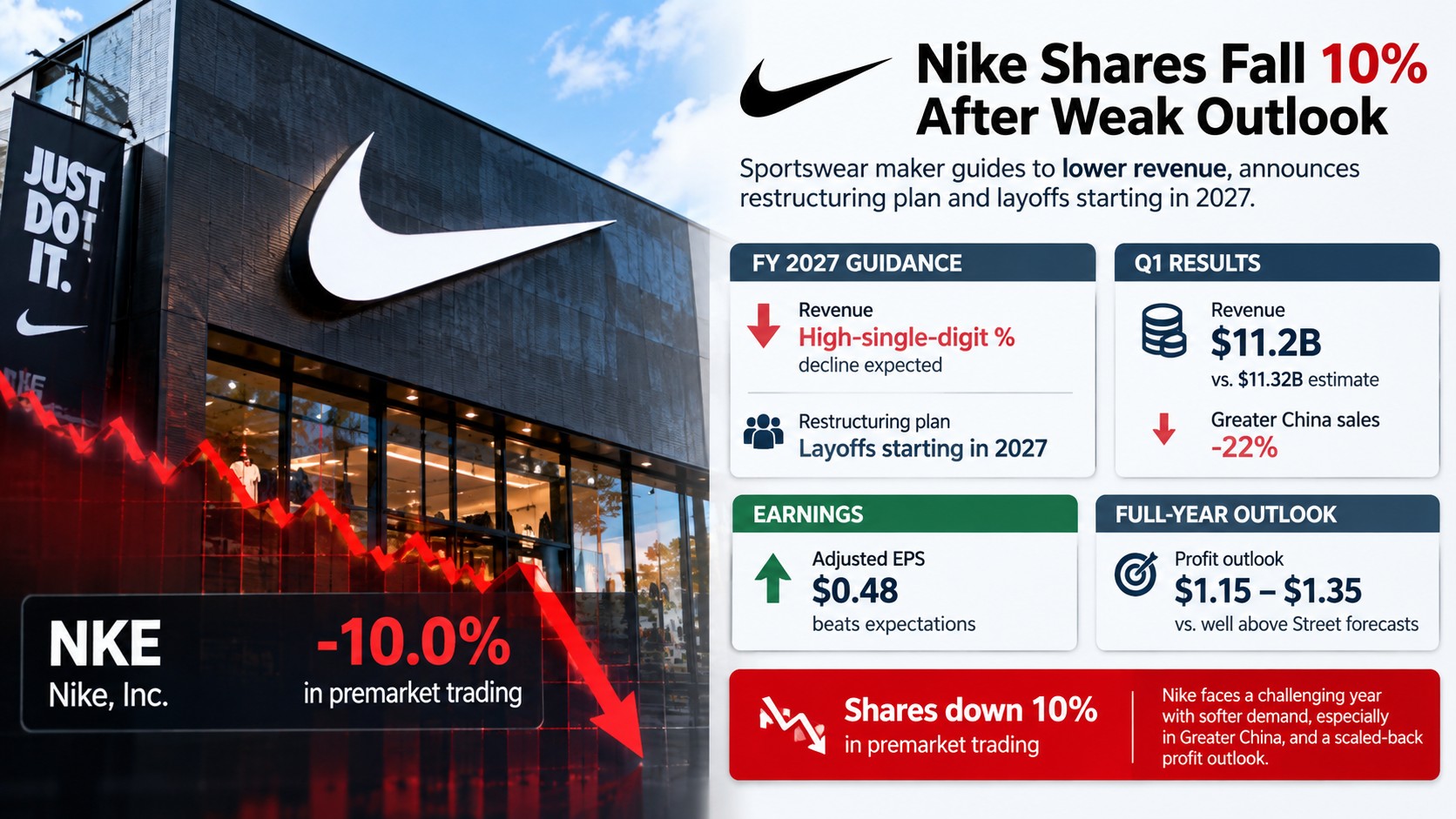
Nike shares tumbled roughly 10% in premarket trading Friday, extending a second straight day of losses after the sportswear maker reported a revenue miss, guided to a steep full-year sales decline and announced a restructuring plan that will lead to layoffs. The stock changed hands near $31.55 before the open, putting it at levels last seen in 2013 and leaving it down roughly 45% so far this year.
For the fiscal first quarter ended August 31, revenue was $11.21 billion, down 4% from a year earlier and below the $11.32 billion analysts expected. Earnings per share of 48 cents topped the 44-cent consensus, helped by a wider gross margin and cost discipline. The bigger concern for investors was the outlook: Nike expects fiscal 2027 revenue to fall by a high-single-digit percentage and adjusted earnings per share of $1.15 to $1.35, well under the roughly $1.66 to $1.69 Wall Street had penciled in.
Greater China remained the weak spot. Sales there fell 22% to about $1.18 billion, or 26% on a currency-neutral basis, while Nike Direct revenue dropped 8% and digital sales slid 13%. North America grew 2%, but Europe, the Middle East and Africa fell 5% and Converse sank 28%. Sportswear revenue declined by a low-double-digit percentage, with a planned pullback in Dunk supply trimming roughly $200 million from the quarter.
Management is also deliberately shrinking some product lines. Executives said reduced supply of select Sportswear and Jordan styles will continue to weigh on reported revenue through the rest of fiscal 2027 and into fiscal 2028 as Nike works to clean up marketplace exposure. That means the sales decline is partly self-inflicted, even if it leaves little near-term growth to offset weak demand in China.
Alongside the results, Nike unveiled a restructuring program it calls Pace, which aims to modernize its supply chain, organize the business into three geographies, build a new campus in India and change how and where employees work. The company expects roughly $2.5 billion in cumulative savings through fiscal 2031, against about $1 billion of pretax charges, mostly employee-related, including a 15-cent hit to fiscal 2027 earnings per share. Layoff decisions begin in calendar 2027, marking the third round of job cuts announced this year.
Peers largely held steady. Lululemon and On Holding each moved less than 1% in early trading, and On Holding recently posted 13.5% sales growth, suggesting the pressure is company-specific rather than a sector-wide consumer slowdown. Some European sportswear shares also slipped in sympathy.
For investors, the debate is whether the sell-off already reflects a long turnaround. The savings from Pace are weighted toward fiscal 2029 and 2030, leaving earnings under pressure in the near term, and the guidance implies another year of shrinking sales. Bulls will point to a depressed share price and improving gross margin, while bears note that the stock has now fallen sharply on guidance in consecutive sessions. Volatility is likely to stay elevated until management shows that demand is stabilizing.