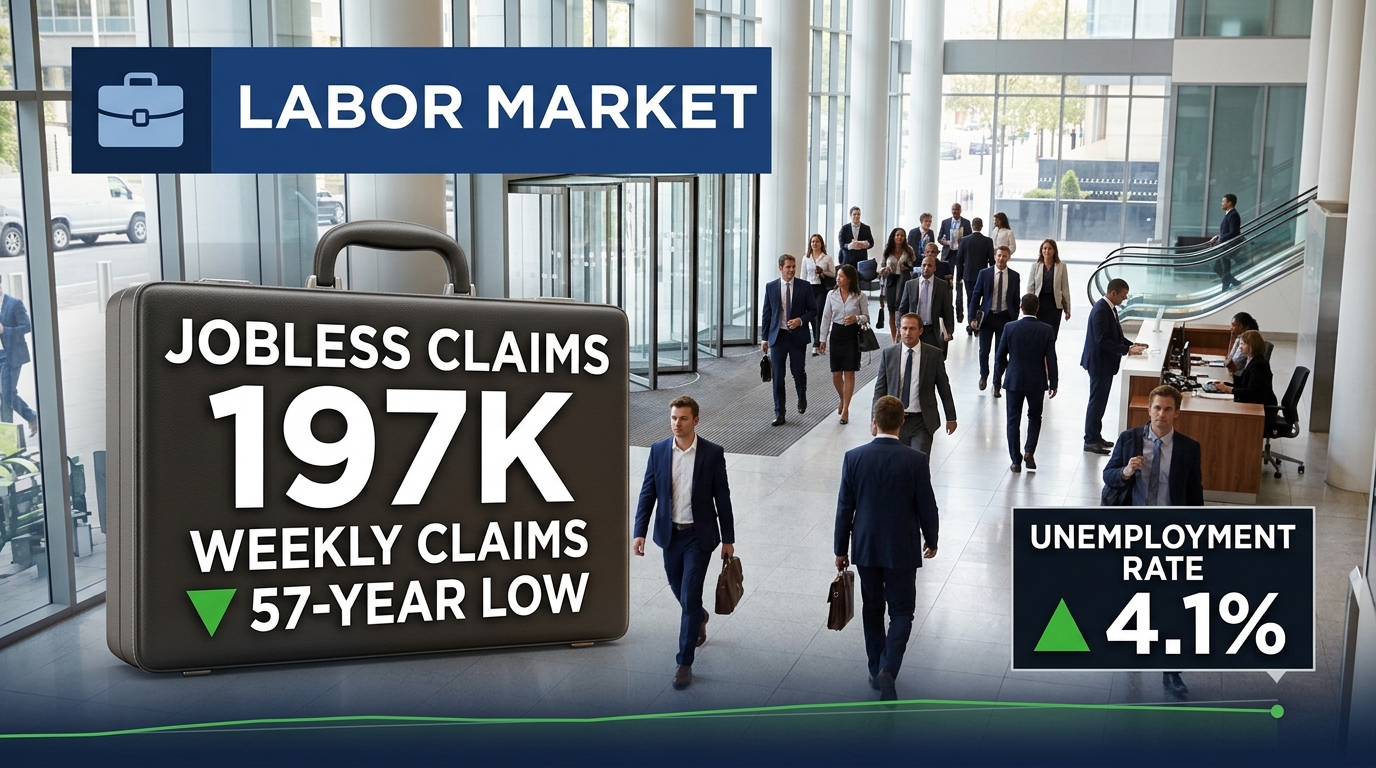
Initial claims for state unemployment benefits slipped 1,000 to a seasonally adjusted 197,000 for the week ended Sept. 19, the Labor Department said Thursday, coming in below the 201,000 forecast by economists and remaining near 57-year lows.
Continuing claims, which are viewed as a proxy for hiring, rose 2,000 to a seasonally adjusted 1.719 million in the week ended Sept. 12. That week covered the period when the government surveyed households for September's unemployment rate, and economists view the level as consistent with a stable jobless rate. The unemployment rate was unchanged at 4.1% in August, though the data showed more people who lost jobs were experiencing long bouts of joblessness.
Economists cautioned that the low readings are partly attributable to difficulties seasonally adjusting data around moving holidays such as Labor Day, and to residual seasonality that tends to push claims lower as the year winds down. Even so, the underlying trend remains consistent with a labor market that has regained its footing after stumbling through much of the summer, anchored by low layoffs. One economist said that if continuing claims stay at lower levels, the unemployment rate could move closer to 4%.
Hiring remains constrained. Companies are hesitant to add staff amid headwinds from rising energy prices tied to the U.S.-Israeli war with Iran and from import tariffs, according to economists. Worker shortages, driven by an immigration crackdown and retirements that are shrinking labor supply, are also limiting payroll growth, and a business survey published Wednesday found companies in September reporting increasing problems finding suitable staff.
The data matter more than usual because of the Federal Reserve's stance. The central bank raised its policy rate last week to 3.75%-4.00%, 16 of 18 policymakers signaled at least one more hike this year, and New York Fed President John Williams said Thursday that another increase by year-end is a reasonable expectation. Futures markets price roughly a 77.5% chance of an October hike. A tight labor market with low layoffs gives policymakers less reason to worry that tighter policy will trigger job losses, which is why strong claims data tend to push Treasury yields higher. The 10-year yield was near 5.15% Thursday, close to its highest level since 2007.
Short-dated Treasurys are the most direct expression of that repricing. The 2-year yield sits near 4.9%, reflecting the market's view that policy rates will keep rising, and any downside surprise in labor data would have an outsized effect on rate expectations. Conversely, sustained strength supports cyclical earnings but keeps pressure on rate-sensitive assets such as small caps, utilities and real estate.
Investors should treat the claims figure with caution given the seasonal distortions, but the message is consistent across recent data: the economy is not cracking under higher rates. The next tests include new home sales for August due at 10 a.m. ET, the monthly jobs report, and inflation readings that will determine whether the Fed follows through in October.