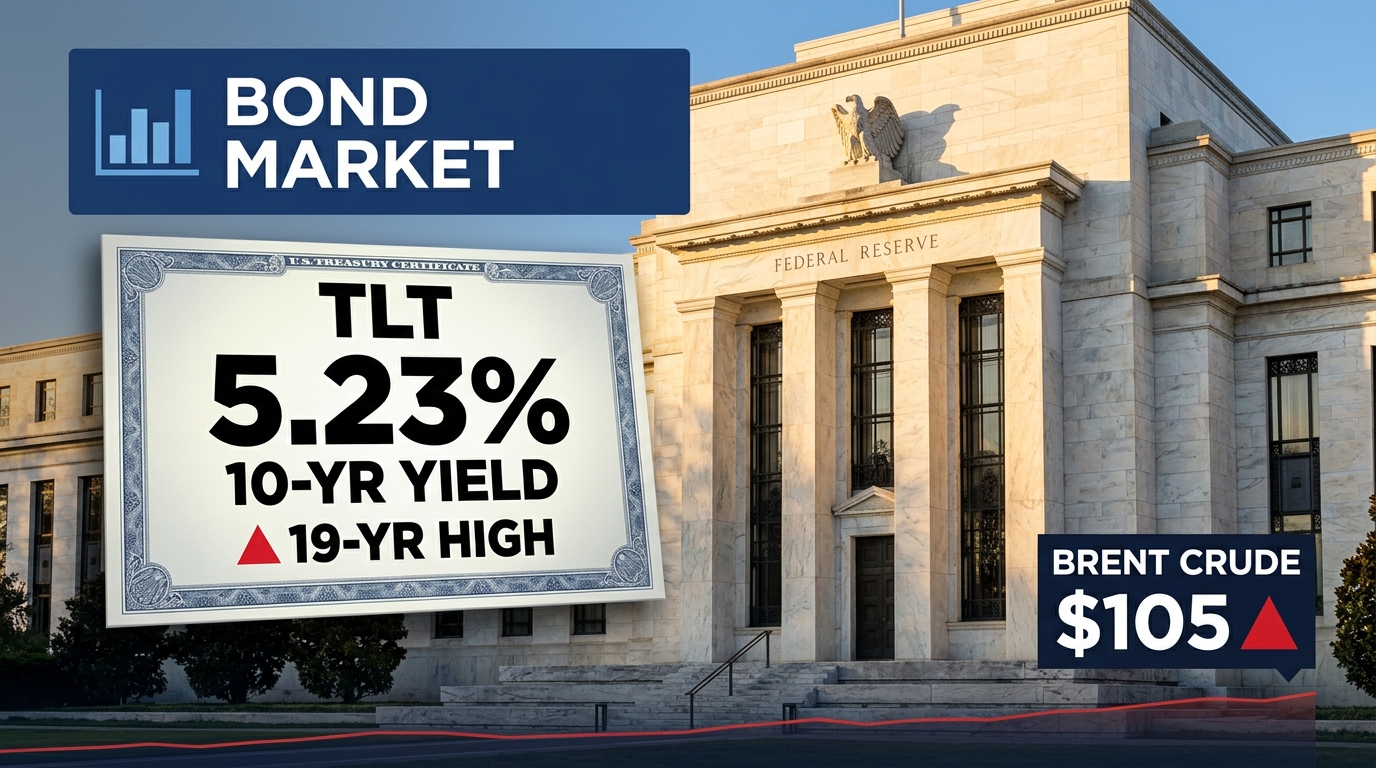
Bond yields, oil prices and the odds of further Federal Reserve tightening are converging into the dominant driver of US equities as the third quarter winds down. The benchmark 10-year Treasury note closed Monday at 5.23%, just shy of the 5.234% intraday peak touched Friday, the highest level since June 2007, while the 30-year bond finished at 5.55%. Only the shortest-dated Treasury bills escaped the sell-off across the curve.
Monday's session showed the strain. The Dow Jones Industrial Average fell 0.7% to 51,481.10, the S&P 500 lost 0.8% to 7,683.69 and the Nasdaq Composite slid 0.9% to 26,820.38, with decliners outnumbering advancers by about 3.55 to 1. The VIX volatility gauge rose 8.1% to 16.07, still well below panic territory. Futures wavered early Tuesday as oil retreated from overnight highs.
Oil is the main transmission channel. Brent crude for November delivery traded near $105.24 a barrel early Tuesday after jumping more than 2% earlier in the session and topping $108 on Monday, while West Texas Intermediate held near $92.5. The surge followed President Donald Trump's rejection of an Iranian proposal that would have reopened the Strait of Hormuz, although Qatari mediators are reportedly arranging separate talks with Washington and Tehran. Trump also denied offering sanctions relief and has said he expects strikes to resume after the November midterm elections. For context, Brent traded around $72 a barrel in late February, before the Iran war began.
Higher energy costs are feeding directly into the rate outlook. The Fed raised its target range by 25 basis points to 3.75%-4.00% on September 16, its first hike since 2023, in a unanimous 12-0 vote, and 16 of 19 policymakers projected at least one more increase this year. Money markets now price roughly 70% odds of an October hike, up from 57.6% a week earlier, after hawkish remarks from regional Fed presidents. Overseas, the Reserve Bank of Australia raised its cash rate by 25 basis points to 4.6%, a 15-year high, as higher fuel costs pushed up prices. Gold was not spared, closing Monday at $4,121, down 3.8% to a seven-week low, as rates, oil and the dollar all moved against it.
Today's calendar adds event risk. The Conference Board's September consumer confidence index, due at 10 a.m. ET, is expected near 90 versus 89.4 in August, and August JOLTS job openings are forecast around 7.225 million versus 7.271 million previously. Chicago Fed President Austan Goolsbee and New York Fed President John Williams are scheduled to speak this afternoon. A soft labor reading could ease rate fears while stoking growth worries, whereas a firm one would reinforce the case for further tightening.
For portfolio positioning, the setup favors caution on long-duration and rate-sensitive assets. Elevated yields compress equity valuations and raise borrowing costs, and quarter-end rebalancing by portfolio managers could amplify intraday swings in the final two sessions of the quarter. Analysts note that hope for a diplomatic deal has kept Brent from sustaining moves above $110, which means a headline reversal in either direction can quickly change the tape. Stock-specific catalysts, such as earnings beats and analyst upgrades, may offer better risk-adjusted opportunities than broad index exposure until yields stabilize.
Levels to watch include the 5.234% multi-year peak on the 10-year yield, $108 on Brent and the S&P 500's ability to hold near Monday's 7,683.69 close. A decisive break in yields would likely set the tone for the quarter's close and for the October Fed meeting.