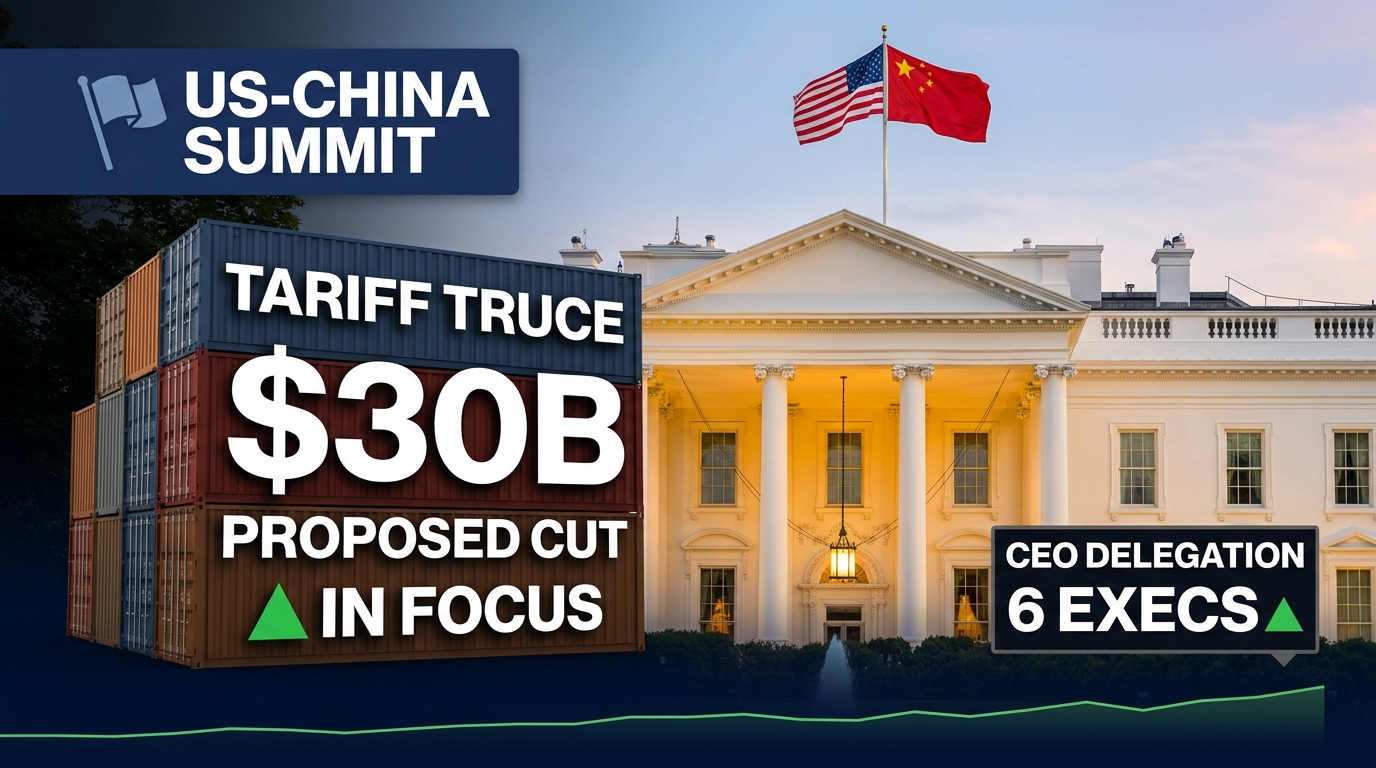
Wall Street's attention is turning to Washington ahead of Thursday's summit between President Donald Trump and Chinese leader Xi Jinping, the second face-to-face meeting between the two leaders this year and, according to strategists, one of the two events most likely to determine where major US indexes finish 2026. The talks will cover a dense agenda spanning trade tariffs, artificial intelligence, Taiwan, and the fallout from the ongoing US war in Iran.
The White House has confirmed a high-profile US business delegation will accompany the talks, including Amazon founder and executive chairman Jeff Bezos, Apple CEO Tim Cook, Google CEO Sundar Pichai, Dell Technologies founder Michael Dell, and Citigroup CEO Jane Fraser. Xi's government is reportedly bringing its own roster of top Chinese business leaders, underscoring how central corporate interests have become to a relationship increasingly defined by both economic competition and mutual dependence.
At the center of the discussions is the fragile US-China tariff truce, which is set to expire November 10. That agreement halted an escalation that had pushed US tariffs on Chinese imports above 100% and Beijing's retaliatory duties to 125% at the peak of last year's trade war, before negotiators reached a temporary deal that has since been extended multiple times. US and Chinese officials have already begun laying the groundwork in New York, with Treasury Secretary Scott Bessent meeting Chinese Vice Premier He Lifeng at JPMorgan Chase's headquarters over the weekend under a newly operating US-China Board of Trade designed to manage trade in nonsensitive goods.
Central to the talks is a proposed mutual tariff reduction covering up to $30 billion worth of products, alongside potential progress on agriculture and non-tariff barriers. Trump is also expected to press Xi on major Chinese purchases of US goods, including Boeing aircraft, as part of his broader push to narrow the bilateral trade deficit. A senior US official cautioned ahead of the meeting that no agreements had been finalized in advance, tempering expectations for a sweeping breakthrough.
On artificial intelligence, expectations for a formal agreement are similarly modest. Bessent said preliminary talks had focused on establishing a possible notification mechanism between the two countries around AI development, rather than any binding limits on the pace of frontier model development. Analysts note the framework for judging success will likely hinge not on new headline agreements but on whether China demonstrates measurable progress against commitments made at the leaders' prior summit in Beijing in May.
The stakes are heightened by domestic politics: the summit arrives with less than six weeks remaining in a US election cycle that has centered heavily on cost-of-living concerns, giving Trump added incentive to emerge with a tangible economic win. For markets, any signal on tariff relief, technology export controls, or agricultural purchases could move shares of exposed sectors sharply in either direction once the talks conclude Thursday.