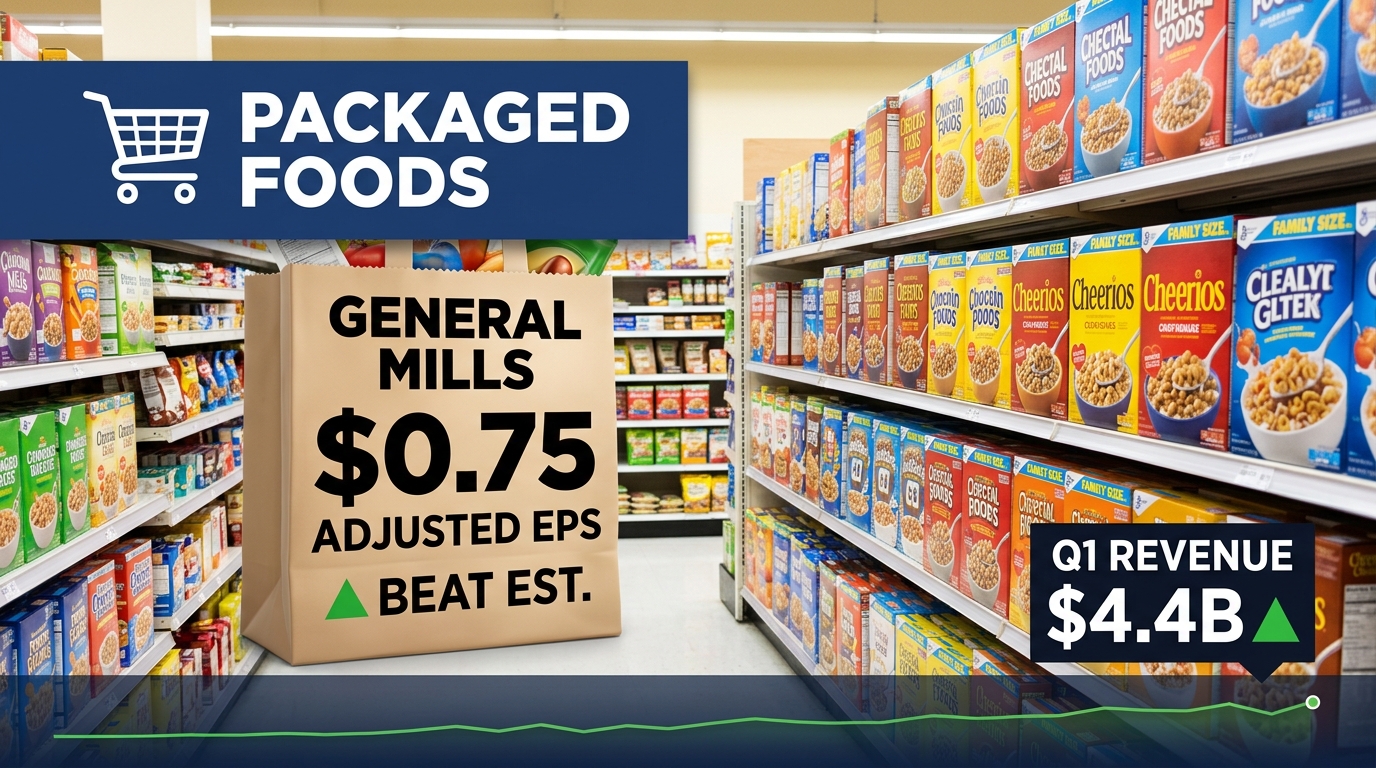
General Mills delivered a modest beat-and-hold quarter Wednesday, reporting fiscal first-quarter 2027 adjusted earnings per share of $0.75, ahead of the $0.72 consensus among 17 analysts, alongside revenue of $4.4 billion that topped the $4.34 billion Wall Street estimate. Despite clearing both bars, shares of the packaged-food giant traded down 0.65% in premarket activity to $35.22, reflecting investor caution about the company's ability to return to sustained organic growth.
The stock remains well below its 52-week high of $51.33, trading closer to its low of $31.75, underscoring a difficult stretch for General Mills and much of the broader packaged-food sector as consumers trade down amid persistent cost-of-living pressure. The consensus EPS estimate heading into the print had actually drifted down over the prior 90 days by roughly 10%, even as it ticked up modestly in the final month — a sign that analysts had been steadily recalibrating expectations lower as visibility into the quarter improved.
Chief Executive Officer Jeff Harmening framed the results around what the company calls its "Remarkability Playbook," a strategic framework centered on strengthening organic sales through product innovation and renovation, accelerating enterprise transformation, and maintaining disciplined capital allocation. Management highlighted early signs of improving momentum in North America Retail, the company's largest business, where US retail sales declined just 2.3% in the quarter compared with a steeper 3.6% drop in the second half of fiscal 2026.
Executives pointed to improving base volume trends and said Nielsen-measured price and mix were roughly flat during the quarter but are expected to accelerate through the remainder of the fiscal year. The company's portfolio spans household names including Cheerios, Nature Valley, Blue Buffalo, Häagen-Dazs, Old El Paso, Pillsbury, and Betty Crocker, giving its results broad relevance as a read on US grocery-aisle spending patterns.
Importantly, General Mills reaffirmed its full-year guidance following the print, signaling confidence that the modest first-quarter improvement can be sustained even as the company continues to navigate margin pressure and elevated input costs. The reaffirmation comes as General Mills works toward previously announced targets, including $3 billion in cost savings by fiscal 2030, part of a broader effort to fund reinvestment in its brands while protecting profitability.
The muted stock reaction despite the top- and bottom-line beat illustrates the skepticism still baked into shares of legacy packaged-food companies, many of which have struggled to reaccelerate volume growth even as pricing actions largely worked their way through the system. Investors will be watching subsequent quarters closely for confirmation that the sequential improvement in North America Retail sales marks a genuine inflection point rather than a temporary reprieve.