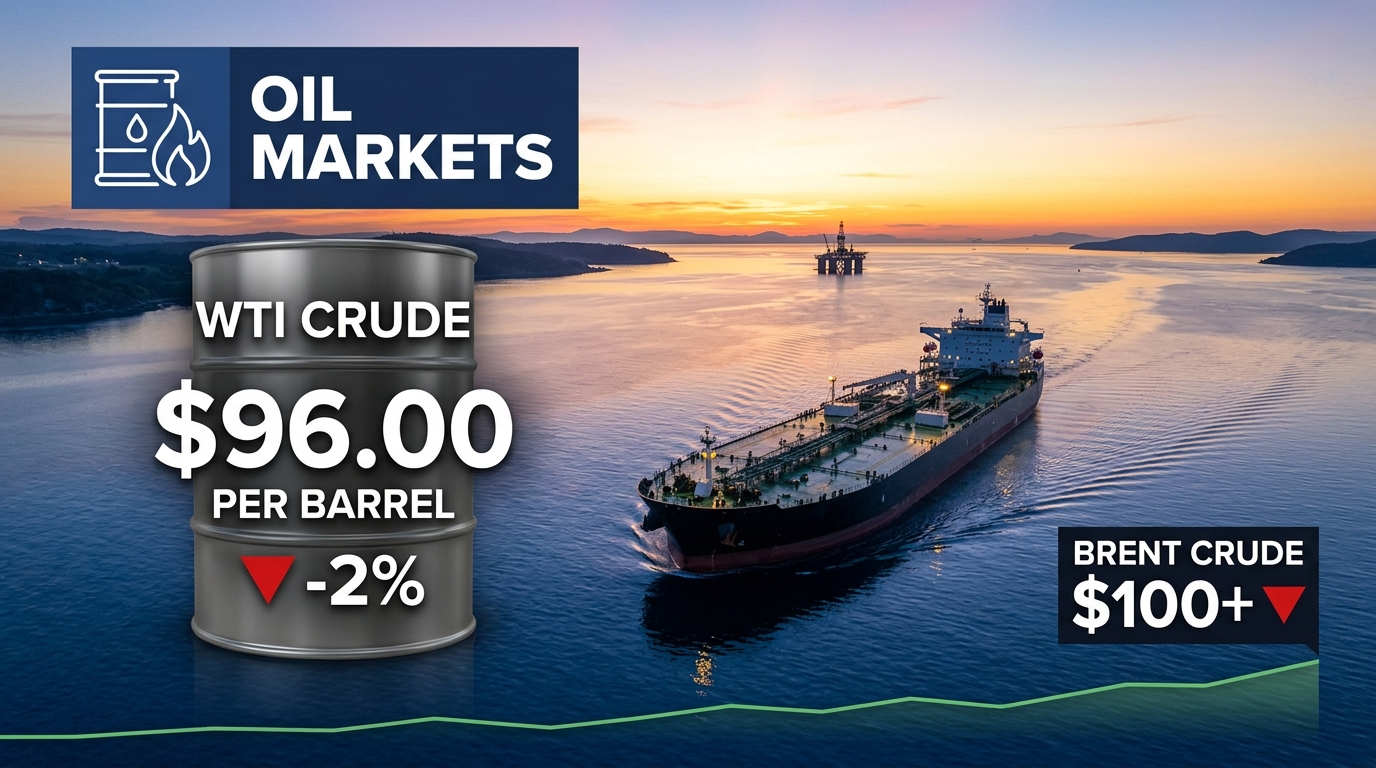
Crude oil prices extended their decline for a fourth consecutive session, with West Texas Intermediate holding near $96 a barrel and Brent crude settling just above $100, as diplomatic signals around the Strait of Hormuz continued to ease supply concerns that have haunted energy markets for much of 2026. The pullback follows a stretch in which crude had fallen more than 9% over the prior four trading days.
The latest catalyst came from a report by Japanese wire service Kyodo, which indicated Iran had offered to reopen the Strait of Hormuz within seven days if the United States takes concrete steps toward de-escalating the broader conflict in the region. While the report has not been independently confirmed by Western outlets, it was enough to pull European and Asian equity markets off their session lows and nudge U.S. stock futures back toward positive territory.
Satellite imagery has also provided tangible evidence that oil flows through the critical waterway may already be stabilizing. Observed loadings from Saudi Arabia's Gulf export terminals have jumped in recent days, suggesting the kingdom is shifting exports back toward the Strait of Hormuz following the shutdown of the East-West Crude Oil Pipeline earlier this month. U.S. Central Command chief Admiral Brad Cooper said separately that oil and liquefied natural gas shipments through Hormuz over the past two weeks reached their highest level in six months, with the main transit lanes now clear of mines.
The Strait of Hormuz has been at the center of global energy market volatility since fighting between the U.S. and Iran disrupted a large share of regional shipping earlier this year. At the height of the crisis, the International Energy Agency characterized the disruption as among the largest supply shocks in the history of the global oil market, with Brent briefly spiking above $118 a barrel before subsequent de-escalation efforts pulled prices back down.
Even with the recent pullback, the U.S. Energy Information Administration's most recent Short-Term Energy Outlook still projects Brent crude averaging around $90 a barrel in the second half of 2026, reflecting continued constraints on Middle East exports and elevated production shut-ins that the agency estimated at 6.7 million barrels per day in August.
For equity investors, falling oil prices carry a dual-edged impact. Lower crude tends to ease inflationary pressure and reduce input costs for a wide swath of the economy, a dynamic that could give the Federal Reserve more room to hold rates steady rather than pursue additional hikes. At the same time, sustained weakness in crude prices tends to pressure energy-sector equities and could weigh on producer profitability if the decline extends much further.
Traders are likely to stay focused on developments around the Trump-Xi summit later this week and any further confirmation of the Hormuz reopening timeline, both of which carry the potential to move oil prices sharply in either direction depending on how the diplomatic picture evolves over the coming days.