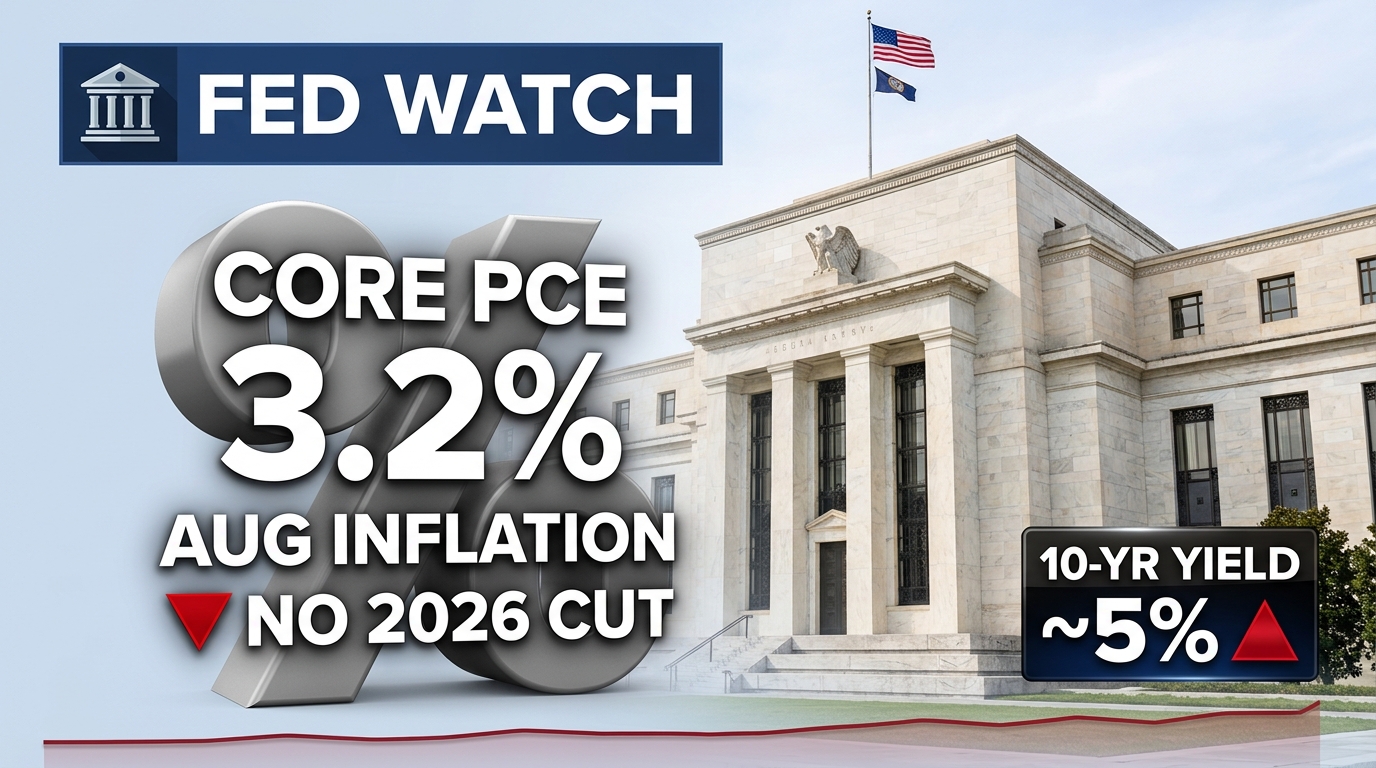
Federal Reserve Governor Christopher Waller effectively ruled out any interest rate cut for the remainder of 2026, telling audiences that core inflation running at 3.2% in August leaves little room for the central bank to ease policy in the near term. The remarks reinforce a hawkish tone that has dominated Fed communications since the central bank's first rate increase since 2023 earlier this month.
What Waller did not say carried nearly as much weight as what he did. He stopped short of committing to another rate hike at the Fed's November meeting, and he declined to specify what level of core PCE inflation would be required to trigger further policy action. Traders at several desks interpreted that silence as a deliberate hedge, one that leaves the door open for the Fed to hold steady if diplomatic progress on the Iran conflict were to quickly strip energy-related inflation pressure out of upcoming data releases.
The comments landed against a backdrop of intense focus on whether ongoing back-channel diplomacy between the U.S. and Iran, reportedly conducted partly through Qatari intermediaries, will produce a tangible breakthrough. Analysts noted that if those efforts fail to yield concrete progress, oil prices could rebound sharply toward $104 a barrel within days, complicating the inflation picture the Fed is trying to navigate.
Treasury yields have been highly sensitive to this back-and-forth. The benchmark 10-year yield has oscillated near the 5% threshold in recent sessions, moving lower on signs of Middle East de-escalation and higher when energy-related inflation risks resurface. Waller's comments, delivered without a clear commitment either way on the path of rates, did little to resolve that tension, and the S&P 500 gave back a portion of its earlier gains following his remarks.
The Fed's September policy meeting, held earlier this month, resulted in the central bank's first rate increase since 2023, a move driven by persistent inflation pressure tied in large part to elevated energy prices. The Federal Open Market Committee reiterated its commitment to price stability even as it acknowledged inflation remains above its 2% target, and the vote to raise rates was reportedly split among committee members.
Rate-sensitive sectors, including homebuilders, regional banks, and long-duration bond holdings, are likely to remain especially reactive to incremental Fed commentary in the weeks ahead. With Waller declining to rule out further tightening while simultaneously ruling out cuts, investors are left navigating a policy environment defined more by conditional statements than firm commitments.
Market participants will now turn their attention to President Trump's scheduled address this week, along with any further developments on the Iran diplomatic front, as the next potential catalysts capable of shifting the inflation and rate-path narrative that has kept Treasury markets on edge throughout September.