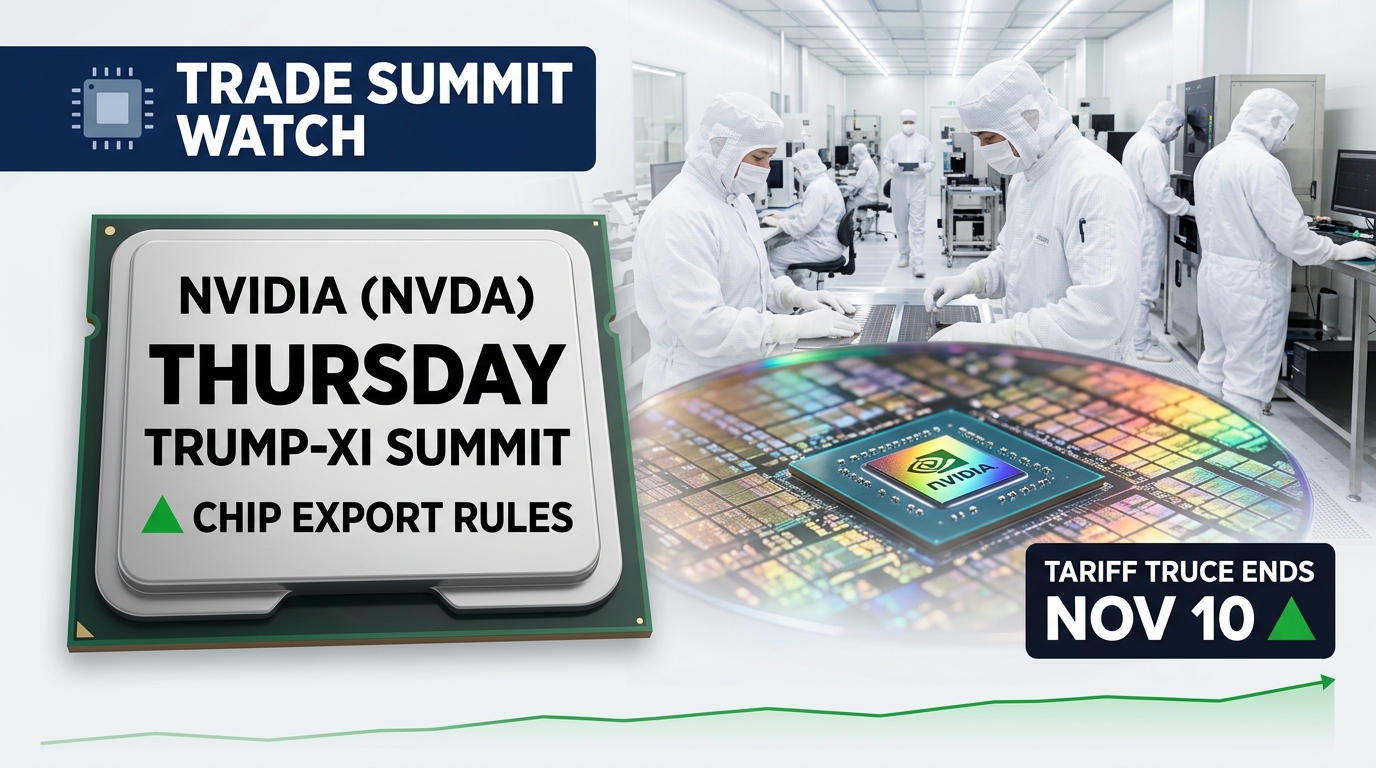
President Donald Trump and Chinese President Xi Jinping are scheduled to meet in Washington on Thursday for a high-level summit that investors across the semiconductor sector are watching closely, with Nvidia emerging as one of the most directly exposed companies to whatever emerges from the talks. The agenda is expected to span tariffs, critical minerals, artificial intelligence chip export controls, and broader economic tensions between the two countries.
Thursday's meeting arrives against the backdrop of a one-year tariff truce that the two nations agreed to in South Korea in late 2025, a framework that runs through November 10 of this year. Analysts note that because the truce remains active, this week's summit is more likely to function as a checkpoint on existing commitments rather than a venue for a comprehensive new trade agreement.
Nvidia's stake in the outcome centers on AI chip export policy, a category of rules that governs which U.S. semiconductor technology can legally be sold into China. The company has repeatedly flagged China as a significant but increasingly uncertain revenue opportunity, with prior rounds of export restrictions forcing Nvidia to develop scaled-down chip variants specifically for the Chinese market to remain compliant with U.S. regulations.
Rare earths are also expected to feature prominently in the discussions. China controls an estimated 85% of global rare earth processing capacity, giving Beijing significant leverage over industries ranging from electric vehicles to wind turbines to missile guidance systems, and by extension, over the broader technology supply chain that touches semiconductor manufacturing.
Market watchers say the range of potential outcomes from Thursday's summit is wide. A meaningful loosening of AI chip export restrictions could open a larger slice of the Chinese market to Nvidia's most advanced processors, potentially providing a significant tailwind to the company's growth trajectory. Conversely, a hardening of the current restrictions, or a breakdown in talks that raises the risk of new tariffs, could weigh on sentiment toward Nvidia and its semiconductor peers.
The dollar has also been reacting to summit expectations, with the Dollar Index trading near 100.22, close to its highest level since late July, following last week's Federal Reserve rate increase and a hawkish tone from policymakers. Currency strategists say the dollar's trajectory into and out of the summit could offer an early read on how markets are pricing the odds of a constructive outcome between Washington and Beijing.
Trump and Xi last met in Beijing in May 2026, a session that produced no comprehensive trade deal but did establish the negotiating framework that led to the current tariff truce. That history has left many analysts cautious about expecting a dramatic breakthrough this week, with several noting that incremental progress on narrow issues, rather than a sweeping agreement, is the more likely outcome.
For Nvidia investors, the key signal to watch will be any specific language addressing AI chip export policy, given the direct and immediate impact such rules have on the company's addressable market in China. Until more details emerge from Thursday's talks, Nvidia shares are likely to trade with elevated sensitivity to summit-related headlines throughout the week.