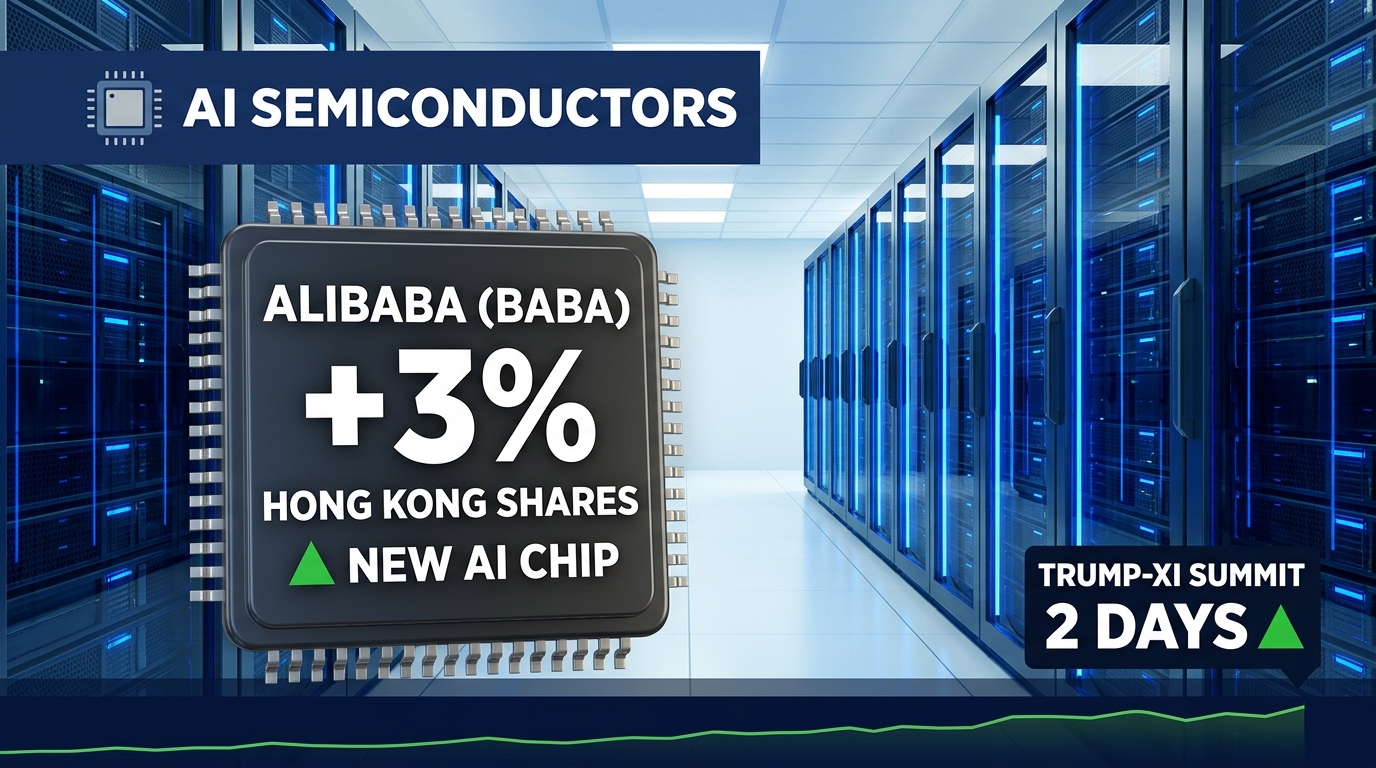
Alibaba shares climbed roughly 3% in Hong Kong trading after the Chinese e-commerce and cloud computing giant unveiled a new artificial intelligence chip alongside plans to significantly expand its data center footprint. The announcement reinforces Alibaba's positioning as one of China's leading contenders in the global race to build out domestic AI infrastructure amid ongoing U.S. export restrictions on advanced semiconductor technology.
The chip launch landed on a day when broader Asian markets were already trading with a firmer tone. Hong Kong's Hang Seng index moved marginally higher, while mainland China's CSI 300 closed up about 0.1%. Sentiment across the region was buoyed by a Japanese wire service report, attributed to Kyodo, indicating that Iran had offered to reopen the Strait of Hormuz within seven days if the United States takes steps toward de-escalating tensions in the region.
That geopolitical development helped pull U.S. equity futures off their overnight lows, with Dow Jones Industrial Average futures moving from a 0.25% loss toward a modest gain. European markets also turned positive following the report, with the Stoxx 600 index reversing an early decline to trade higher.
Alibaba's timing is notable given the looming summit between President Donald Trump and Chinese President Xi Jinping, scheduled for Thursday in Washington. The agenda for that meeting is expected to span tariffs, critical minerals, and artificial intelligence chip export controls, alongside broader economic concerns tied to the one-year tariff truce reached in South Korea in late 2025, which runs through November 10.
Analysts say Alibaba's push into homegrown AI chip development reflects a broader strategic shift among Chinese technology companies to reduce dependence on U.S. semiconductor suppliers, a vulnerability that has been repeatedly exposed by Washington's export restrictions on advanced processors bound for China. By expanding its own chip capabilities alongside its data center buildout, Alibaba is positioning itself to serve growing domestic demand for AI compute capacity even if access to leading-edge foreign hardware remains constrained.
The move also comes as global investors watch closely for any signals from the Trump-Xi summit regarding the future of AI chip export policy. A softening of restrictions could benefit U.S. chipmakers seeking access to the Chinese market, while continued or tightened controls would likely accelerate the kind of domestic substitution strategy Alibaba appears to be pursuing with its latest announcement.
For investors, the reaction in Alibaba shares underscores how sensitive Chinese technology stocks remain to both company-specific AI developments and the broader geopolitical backdrop. With the Hormuz de-escalation report easing some risk-off pressure across global markets and the Trump-Xi summit just days away, traders are likely to see continued volatility in China-exposed names as the week progresses. Alibaba's stock, along with peers in the Chinese technology sector, is expected to remain a focal point for investors positioning around the outcome of Thursday's high-level talks.