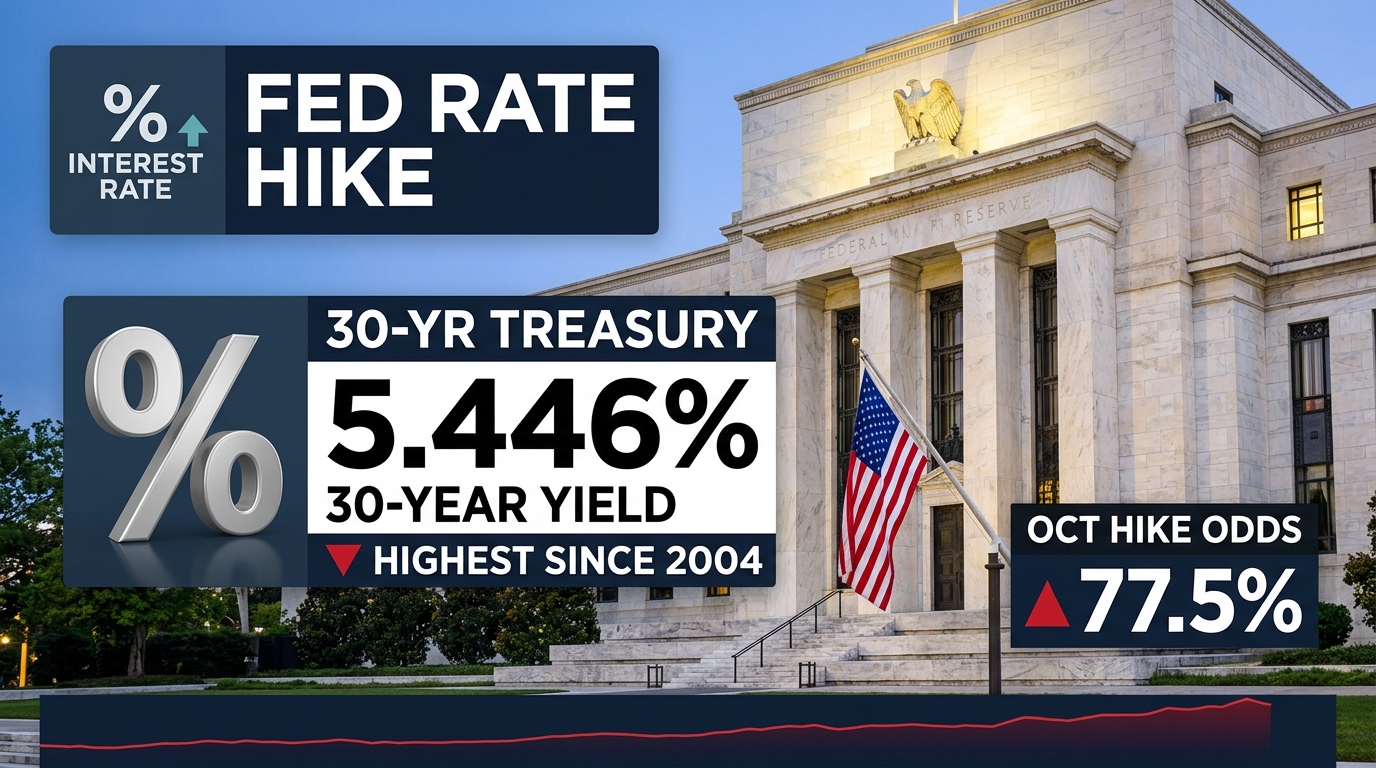
New York Federal Reserve President John Williams said Thursday that it is reasonable to expect another interest-rate hike before the end of 2026, a message that pushed futures-implied odds of an October increase to roughly 77.5% from about 53% a day earlier and helped drive long-dated Treasury yields to their highest levels in years.
Speaking at the London Macro Policy Forum, Williams said investors' expectations that another hike may be appropriate this year look like a sensible way to think about the outlook. He stopped short of committing to a specific meeting, stressing that policymakers will collect incoming data and weigh it much as they did between July and September. Williams also said the era of explicit forward guidance is over, echoing Fed Chair Kevin Warsh's approach of refraining from signaling the next move in advance.
The remarks come one week after the Fed raised its policy rate to a range of 3.75% to 4.00%, with 16 of 18 policymakers indicating that at least one more increase would probably be needed before the end of 2026. Recent data suggest the economy remains strong while inflation runs above 3%, and officials now expect price growth to return to the 2% target only in 2029. Williams called inflation the big challenge for policymakers, saying the goal is to bring it back to target in a timely manner. Boston Fed President Susan Collins warned on Wednesday of an increased likelihood that inflation stays notably above target.
Bond markets reacted quickly. The 10-year Treasury yield rose about 3 basis points to 5.15% in early trading after closing Wednesday at 5.104%, its highest close since July 2007. The 30-year yield touched 5.446%, a level not seen since June 2004, and the 2-year yield hovered near 4.9%. A weak five-year note auction on Wednesday added to the pressure, and investors now face a $44 billion sale of seven-year notes at 1 p.m. ET. Japan's 10-year government bond yield also climbed to a 30-year high, a sign that the selloff in duration is global rather than confined to U.S. debt.
Equities are absorbing the shift. On Wednesday the S&P 500 fell 0.75% to 7,706.03, the Nasdaq Composite lost 1.13% to 26,936.04, the Dow Jones Industrial Average slid 0.68% to 51,511.59 and the small-cap Russell 2000 dropped 1.77% to 2,838.67. Early Thursday trading extended the weakness, with the Nasdaq Composite down about 0.8%, the Dow off roughly 182 points and the S&P 500 lower by about 0.5%. The dollar has strengthened alongside yields, with the DXY index at its best levels since the end of July.
For portfolio construction, the mechanics are familiar. Higher Treasury yields raise the discount rate applied to long-duration growth assets, increase borrowing costs for smaller and more leveraged companies, and offer income-seeking investors a competitive alternative to equities. Rate-sensitive areas such as utilities, real estate and small caps typically feel the most pressure when yields climb this quickly, while shorter-duration, cash-generative businesses tend to hold up better. Wednesday's declines were led by utilities and consumer discretionary shares, each down more than 1%.
Traders will also watch the labor market, where weekly jobless claims fell to 197,000, and the diplomatic calendar, including a White House meeting between President Donald Trump and Chinese President Xi Jinping. With oil near $100 a barrel and diesel prices at records, energy-driven inflation remains the wild card for a Fed that has said it will decide meeting by meeting. Until inflation shows sustained cooling, the burden of proof sits with the data, and every release is a potential catalyst for the next repricing in rates.