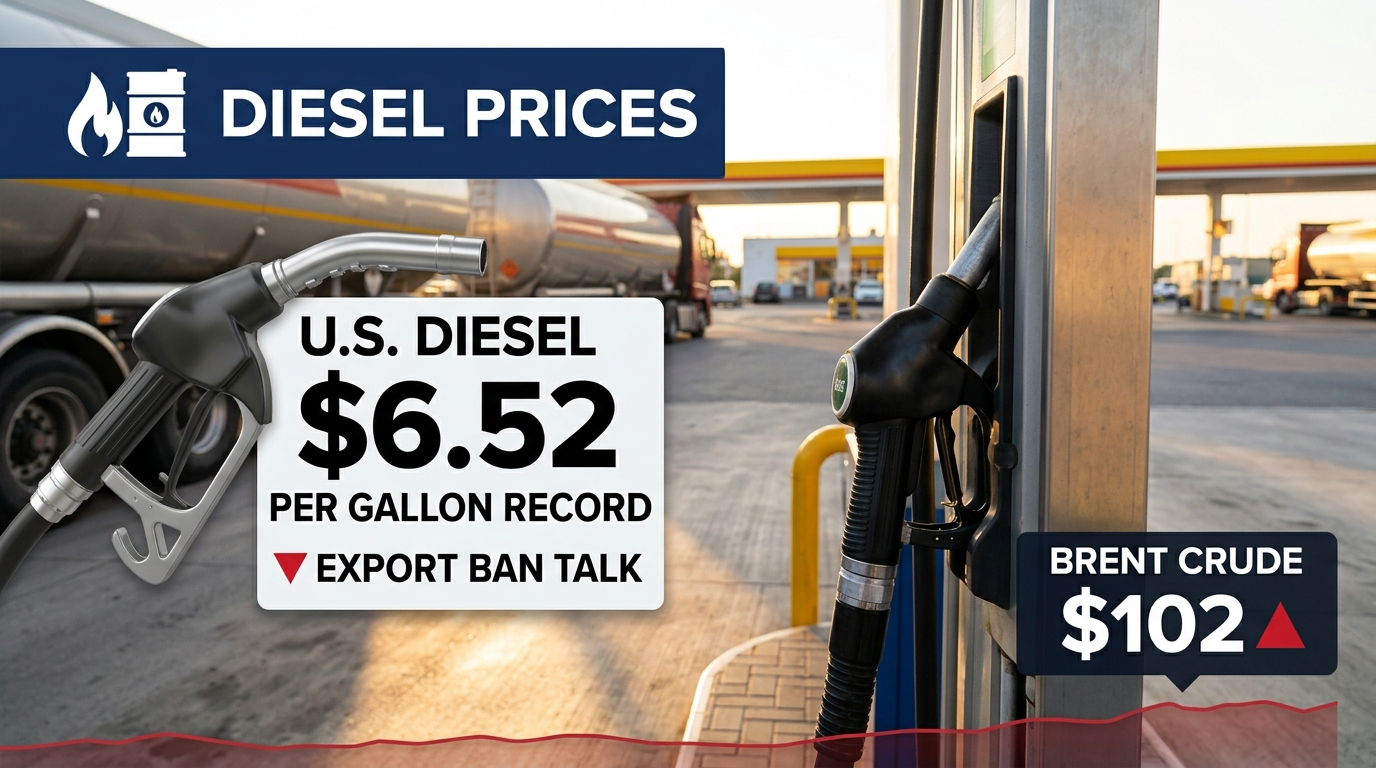
U.S. diesel prices have climbed to a record national average of about $6.52 a gallon, and speculation that the White House could restrict diesel exports kept energy markets on edge, with Brent crude holding near $102 a barrel on Thursday after a sharp rebound the previous session.
Brent futures fell 94 cents, or 0.9%, to $102.13 a barrel in early trading, while West Texas Intermediate eased 0.7% to $91.56. The pullback followed a jump of nearly 4% on Wednesday that snapped a five-day losing streak, as traders weighed fresh attacks in the Strait of Hormuz, dislocations in global fuel markets and conflicting signals over a diesel export curb. Thursday's dip came as Iran said it remained open to diplomacy to end its war with the United States, even as the two sides remain far apart on how to do so.
The export debate has whipsawed diesel futures. President Donald Trump said on Tuesday that he would support a ban on diesel exports, and Politico reported Wednesday that the administration was preparing a 90-day restriction, sending ultra-low-sulfur diesel futures down as much as 7.5% at one point. A White House official said the report was not accurate, but Bloomberg later reported that Energy Secretary Chris Wright had told oil industry leaders to prepare for possible curbs, even as Wright said publicly that a ban would not work.
Industry groups and analysts argue that an export ban would do little for pump prices. Refined products are priced off global benchmarks, so limiting shipments could shrink producer revenue, discourage investment and tighten supply in importing regions, potentially benefiting refiners in Asia. Analysts also note that a major new U.S. refinery has not been built since 1977, so restricting exports would not create new domestic capacity. The debate is politically charged ahead of the midterm elections, when fuel costs are a top voter concern, and U.S. oil industry groups have urged the president not to proceed.
For equity investors, the channel that matters is inflation and rates. Rising energy costs feed directly into headline inflation, and traders have linked crude's recent strength to the selloff in Treasurys that pushed the 10-year yield above 5% and the 30-year to its highest since 2004. New York Fed President John Williams said Thursday that another rate hike this year would be reasonable, and futures now price about a 77.5% chance of an October increase. Higher fuel costs also squeeze transport, airlines and consumer discretionary budgets, even as energy producers benefit from elevated prices.
Positioning implications are mixed. Energy remains a hedge against escalation in the Persian Gulf, but a diplomatic breakthrough could send crude sharply lower in a single session, as the recent five-day decline showed. Investors holding energy exposure should expect headline-driven swings tied to Iran talks, Hormuz shipping incidents and any formal decision on diesel exports, all of which can reprice the sector within hours. Meanwhile, consumer-facing sectors face a margin and demand risk if diesel and gasoline stay near current levels through the fall.