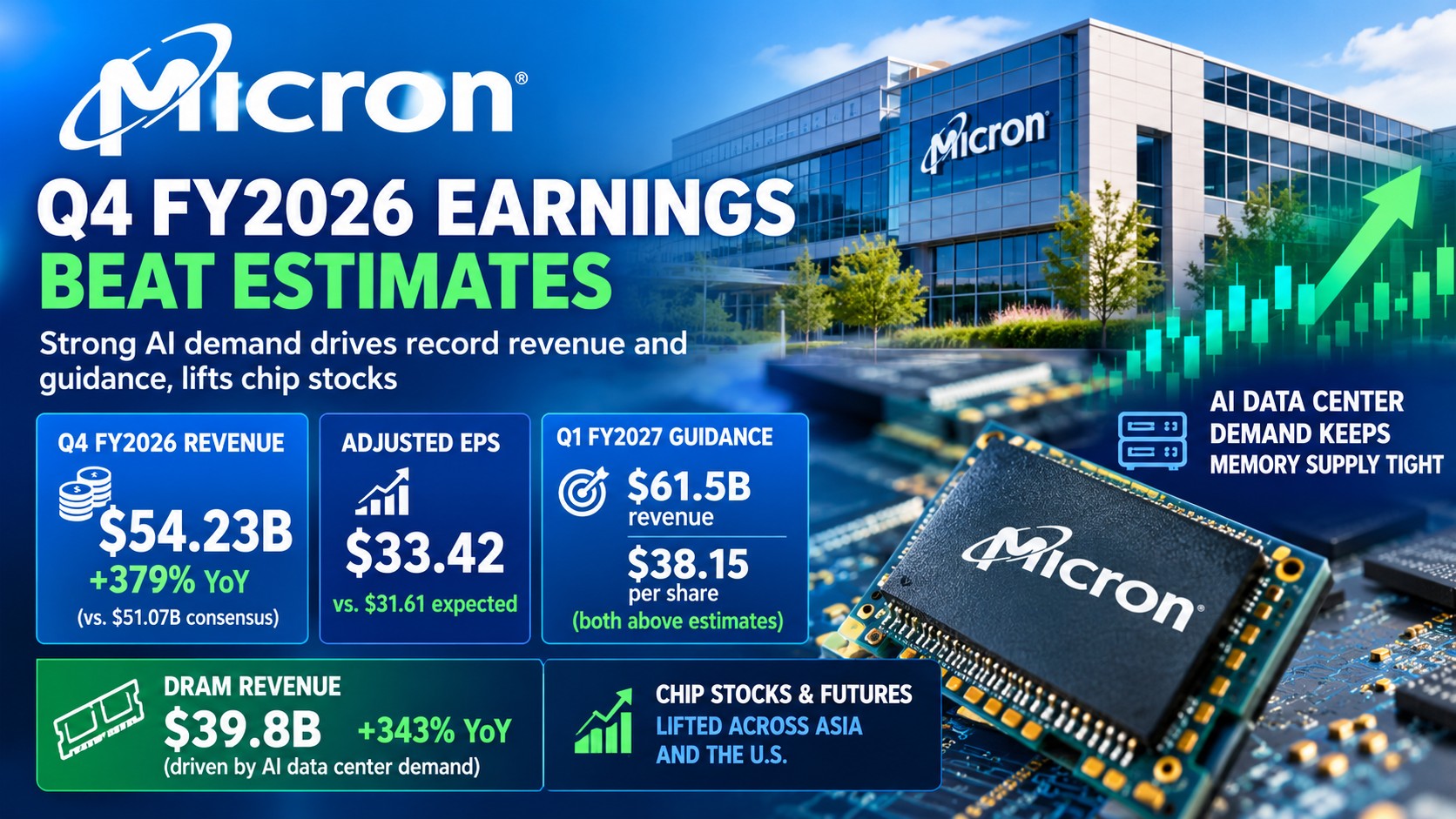
Micron Technology (MU) closed out fiscal 2026 with record results after the bell on Wednesday, September 30, reporting fourth-quarter revenue of $54.23 billion. That figure is up 379% from $11.32 billion a year earlier and 31% above the prior quarter's $41.46 billion, and it topped the $51.07 billion consensus compiled by LSEG. Adjusted earnings per share came in at $33.42 against expectations of $31.61, while GAAP net income reached $37.70 billion, or $32.87 per diluted share.
The segment detail shows where the growth is concentrated. DRAM revenue rose 343% year over year to $39.8 billion, or 73% of total sales. Core data center revenue reached $18.00 billion, up more than tenfold from a year earlier, while cloud memory added $16.28 billion, ahead of the $15.14 billion analysts had modeled. Mobile and client sales totaled $13.11 billion, and automotive and embedded revenue of $6.82 billion beat the $4.73 billion estimate by a wide margin.
Profitability is exceptional for a historically cyclical memory maker. Adjusted gross margin reached 87.0%, versus the 86.1% analysts had modeled, and adjusted operating income totaled $44.64 billion. For the full fiscal year, Micron generated $133.19 billion in revenue, compared with $37.38 billion in fiscal 2025, along with $89.68 billion in operating cash flow against $27.37 billion in net capital spending.
Guidance was the bigger surprise. Micron expects fiscal first-quarter revenue of about $61.5 billion, plus or minus $1.5 billion, and adjusted earnings of $38.15 per share. Analysts had been looking for roughly $57 billion and $35.40. Chief Financial Officer Mark Murphy said gross margins for the rest of fiscal 2027 should exceed first-quarter levels, though he cautioned that the pace of price increases will moderate after DRAM prices rose by double digits and NAND prices climbed about 30% sequentially.
The market response was measured at home but powerful abroad. Micron shares were flat at Wednesday's close and edged higher in extended trading, yet the read-through lifted semiconductor names overnight. Japan's Nikkei 225 gained roughly 3% and South Korea's Kospi rose about 1.6%, with South Korea's September exports surging 83.5% from a year earlier. In the United States, S&P 500 futures added about 0.3% and Nasdaq-100 futures rose roughly 0.6% early Thursday.
The macro backdrop is less friendly. The 10-year Treasury yield rose to about 5.33% on Thursday, its highest level since April 2002, while the Dow ended September roughly 3.5% lower as oil prices and bond yields stoked fears of further Federal Reserve rate hikes. Speculative funds have also added 66,665 contracts to a net short position in S&P 500 futures, bringing it to 355,121, which could amplify any squeeze if technology leadership persists.
For portfolio positioning, the report reinforces that AI infrastructure spending is still converting into earnings for memory suppliers, with management having said earlier this year that supply is likely to stay tight beyond 2027. The risk is valuation and rates. With guidance now far above consensus, expectations are elevated, and a hot jobs report on Friday could push yields higher and pressure long-duration growth shares. Investors may prefer staged entries in AI-linked semiconductor exposure over chasing the open, while monitoring payrolls data and Treasury yields for confirmation.